Quick verdict: A Poodle is usually the more adaptable choice for families that value trainability, different size options, and a polished, predictable routine. A Portuguese Water Dog may be better if your family wants a robust, athletic companion for outdoor activities, water play, and daily involvement.
Both breeds are intelligent, active, low-shedding dogs with curly or wavy coats. That similarity can make the decision look simple, but their everyday demands are not identical. This comparison will help you judge the two breeds by the factors that matter after the first few weeks of excitement: exercise, training, grooming, space, children, noise, and your family’s schedule.

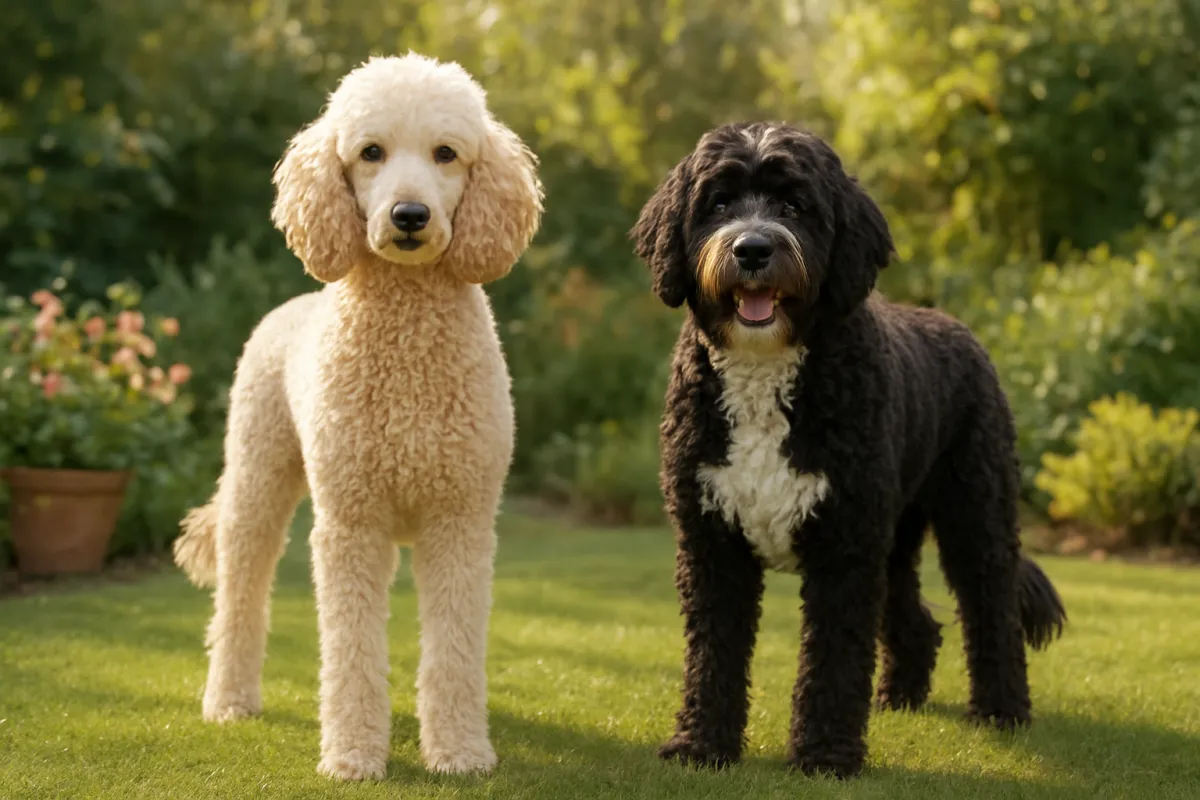
1. Compare the breeds by your real daily routine
The best family dog is not the breed with the most appealing photograph or the longest list of talents. It is the dog whose needs fit your normal week, including workdays, school runs, rainy weather, travel, grooming appointments, and periods when nobody feels especially energetic.
Start by answering these questions honestly:
- How much time can an adult devote to exercise and training every day?
- Will the dog regularly join walks, hikes, swimming, or outdoor games?
- Can your household budget for professional grooming or learn coat care at home?
- Do you need a smaller dog, or are you comfortable with a medium-to-large athletic breed?
- How much barking, jumping, chewing, and adolescent energy can your family manage?
Both breeds can be affectionate family companions, but both also need more than a short bathroom walk. The American Kennel Club describes Poodles as active, intelligent, and highly trainable, while Portuguese Water Dogs are athletic working dogs that need daily exercise and positive training. The AKC Poodle profile and Portuguese Water Dog profile are useful starting points for understanding their official breed characteristics.
2. Side-by-side comparison: Poodle vs Portuguese Water Dog
The table below gives a practical overview. Individual dogs can differ substantially, so treat these points as tendencies rather than guarantees.
| Factor | Poodle | Portuguese Water Dog | What it means for your family |
|---|---|---|---|
| Size options | Toy, Miniature, and Standard varieties | One medium-sized breed type | Poodles offer more flexibility for homes with different space or handling needs. |
| Energy level | High; needs physical and mental activity | High; especially suited to active households | Plan daily exercise plus activities that use the dog’s brain. |
| Trainability | Very responsive and eager to learn | Bright, willing, and capable, but can be spirited | Both reward consistency; neither should be left without structure. |
| Coat | Curly, continuously growing hair with minimal shedding | Wavy, curly, or tightly curled low-shedding coat | Low shedding does not mean low grooming. |
| Grooming | Regular brushing, trimming, bathing, and nail care | Regular brushing, trimming, bathing, and coat drying | Swimming and outdoor play can increase coat-maintenance work. |
| Water interest | Often enjoys swimming and retrieving | Strong historical connection to swimming and water work | The Portuguese Water Dog may be the natural match for water-focused families. |
| Family interaction | People-oriented and adaptable when well socialized | Affectionate, energetic, and strongly involved with its people | Both can struggle if regularly isolated or under-stimulated. |
| Best home rhythm | Active but adaptable, with training and grooming built in | Consistently active, structured, and hands-on | Your weekly schedule may matter more than your yard size. |
3. Temperament and family life
Poodles: observant, responsive, and versatile
Poodles are often a strong choice for families that want a dog capable of learning household rules quickly. Their intelligence can make training rewarding, but it also means they notice inconsistency. If one person allows jumping or barking while another person corrects it, a Poodle may become confused or opportunistic.
They can be playful and sociable, and Standard Poodles often enjoy being included in walks, games, and family outings. Smaller Poodles may be easier to accommodate physically, but a small body does not remove the need for exercise, enrichment, or respectful handling around children.
Portuguese Water Dogs: energetic, affectionate, and purposeful
Portuguese Water Dogs were developed as working companions around water, and that background still matters. They tend to do best when they have a job, a training goal, an activity to anticipate, or a family that actively includes them.
Their enthusiasm can be a major advantage for families who enjoy hiking, retrieving games, agility, swimming, or structured outdoor adventures. It can be difficult, however, for a household that wants a dog content to relax after a brief walk. A bored Portuguese Water Dog may create its own entertainment through barking, chewing, digging, or repeated attention-seeking.
With either breed, early socialization is important. Introduce puppies gradually to different people, calm dogs, handling, grooming tools, household sounds, and appropriate environments. Children should always be supervised with dogs, and they should learn not to disturb a dog while it eats, sleeps, or retreats to its own space.
4. Exercise and mental stimulation
Exercise is one of the clearest decision points in a Poodle vs Portuguese Water Dog comparison. Both breeds need more than physical exhaustion. They also need opportunities to think, cooperate, sniff, retrieve, and learn.
A Poodle may fit well with a family that can provide a combination of:
- Brisk walks, jogging, swimming, or active play.
- Short obedience sessions spread throughout the day.
- Retrieving games, scent work, food puzzles, or trick training.
- Dog sports such as agility, rally, obedience, or tracking.
A Portuguese Water Dog may be especially satisfying for a family that wants an active project. In addition to walks, consider retrieving, dock or water activities where safe and appropriate, hiking, agility, rally, and cooperative training. The breed’s athletic background can make it an excellent partner for people who genuinely enjoy doing things with their dog.
A large yard is helpful but not sufficient. Dogs can run around a yard without receiving meaningful exercise or mental engagement. Conversely, a smaller home can work if the family consistently provides outdoor activity, training, and calm-time practice.
5. Grooming, shedding, and household maintenance
Neither breed should be chosen as a shortcut around grooming. Their low-shedding coats may leave less loose hair on furniture, but curly and wavy coats can trap debris and form mats close to the skin.
Poodles generally need regular brushing and professional or careful home trimming. The required schedule depends on coat length, activity, and how easily the coat mats. Keeping the coat shorter can make daily care more manageable, but it still requires maintenance. The AKC’s Poodle grooming guidance explains why brushing down to the skin matters and why routine trimming is part of responsible ownership.
Portuguese Water Dogs also need brushing, bathing, drying, and trimming. Their coat may be kept in a retriever-style trim or a lion-style trim, but the practical issue is the same: an active dog that swims, hikes, or plays outdoors can bring moisture and plant material into the coat. Check the ears, paws, armpits, and areas behind the legs after outdoor adventures.
Before choosing either breed, identify a groomer who is comfortable with the coat type, or price the equipment and time needed to maintain it yourself. Regular nail care, ear checks, dental care, and skin checks are part of the routine for both breeds. For dogs with sensitive skin, our guide to gentle dog shampoos for sensitive skin may help you compare bathing products without over-washing.
6. Training and behavior management
Both breeds are capable learners, but “smart” does not mean automatically easy. Intelligent dogs can learn unwanted behaviors just as quickly as desirable ones, particularly when jumping, barking, stealing objects, or pulling produces attention or access.
What usually helps a Poodle
- Short, varied training sessions that prevent boredom.
- Reward-based teaching with clear household rules.
- Early practice with grooming, clipping, bathing, and handling.
- Calm routines that teach the dog how to settle, not only how to perform.
What usually helps a Portuguese Water Dog
- Daily opportunities to work with a person rather than exercise alone.
- Consistent boundaries during the adolescent period.
- Training that channels retrieving, carrying, swimming, and movement.
- Gradual practice with being alone, relaxing, and ignoring distractions.
Positive reinforcement is a practical choice for both breeds. If behavior problems become persistent, intense, or unsafe, seek help from a qualified reward-based trainer or veterinary behavior professional. Avoid treating exercise as the only answer to anxiety, reactivity, or destructive behavior.
7. Which breed is better for specific family situations?
Choose a Poodle if your family needs flexibility
A Poodle may be the better fit if you want to select among Toy, Miniature, and Standard varieties, or if you prefer a dog that can move between active outings and structured home life. A well-socialized Poodle can suit families interested in training, dog sports, companionship, and a low-shedding coat.
Choose a Portuguese Water Dog if your family lives actively outdoors
A Portuguese Water Dog may be the better choice if weekends commonly involve hiking, swimming, retrieving, boating environments, or other energetic activities. You should be comfortable with a dog that wants to participate rather than simply observe.
For families with young children
Neither breed is automatically safer or easier because of its reputation. Consider the individual dog’s temperament, the children’s behavior, supervision, and whether adults can manage exercise and grooming. A Standard Poodle or Portuguese Water Dog may be physically exuberant, while a Toy or Miniature Poodle may be more vulnerable to rough handling.
For apartment or townhouse living
Apartment life can work with either breed if you provide reliable outdoor exercise, enrichment, and quiet-time training. Pay particular attention to barking, elevator or hallway manners, and the dog’s ability to settle after activity. The Portuguese Water Dog may be harder for a sedentary household, while a Poodle’s size options can make the logistics easier.
8. Common decision mistakes
- Choosing based only on shedding: Low-shedding coats still require brushing and trimming.
- Assuming intelligence removes training work: Both breeds need repetition, boundaries, and socialization.
- Buying for a child’s interest: Adults must remain responsible for exercise, grooming, veterinary care, and behavior.
- Overestimating the yard: Outdoor space does not replace walks, training, or interactive play.
- Ignoring alone-time needs: People-oriented dogs should be taught independence gradually.
- Comparing only puppies: Puppy energy is temporary; adult exercise, grooming, and temperament should guide the decision.
- Forgetting grooming logistics: Ask about appointment availability, coat length, drying, and home brushing before bringing the dog home.
9. What if your household is still uncertain?
What if you want a low-shedding dog but have allergies?
No dog is completely allergy-free, and reactions can vary by person and individual dog. Spend time with adult dogs of the breed before committing, and discuss your situation with a medical professional if allergies are significant.
What if you work full-time?
Plan for midday support, enrichment, and gradual alone-time training. A dog walker or daycare may help some households, but it does not replace teaching the dog to rest calmly or assessing whether the total routine is realistic.
What if you prefer a calmer companion?
Ask breeders or rescues about adult temperament rather than relying on breed labels. An adult dog with a known history may give you more reliable information about energy, sociability, grooming tolerance, and settling behavior.
What if you are choosing between varieties of Poodle?
Compare the individual variety’s size, fragility, exercise needs, and compatibility with your children and other pets. A smaller Poodle may be easier to house, but it still deserves enrichment and careful handling.
10. A practical decision checklist
Before making a final choice, mark the statements that describe your household:
- We can provide daily physical activity even during busy weeks.
- We are willing to schedule regular grooming and maintain the coat between appointments.
- We want to train a dog beyond basic commands.
- We can supervise children and teach them respectful dog handling.
- We have a plan for workdays, travel, illness, and bad weather.
- We will meet the adult dogs, ask about health testing, and evaluate temperament carefully.
- We understand that low shedding is not the same as low maintenance.
If most of your answers are yes, either breed may be worth investigating. If you enjoy water-based activities and want a particularly athletic partner, investigate Portuguese Water Dogs first. If you want more size flexibility and a dog known for broad training versatility, investigate Poodles first.
11. Final verdict: Poodle or Portuguese Water Dog?
The better family dog depends on the balance between adaptability and athletic intensity. A Poodle is often the safer general recommendation for families seeking a highly trainable, versatile companion with multiple size options. A Portuguese Water Dog is often the stronger match for an active household that wants to build daily life around exercise, outdoor work, and shared activities.
Choose the Poodle when flexibility, training variety, and household adaptability are your priorities. Choose the Portuguese Water Dog when your family can consistently meet a vigorous working dog’s need for movement, structure, and involvement. In either case, select the individual dog carefully, plan for grooming from the beginning, and judge the match by your actual routine rather than by appearance alone.
For more practical pet-care comparisons, visit the LaokPet homepage or read our comparison of French Bulldogs and Boston Terriers.