The most reliable way to stop a cat from scratching furniture is to redirect the behavior, not eliminate it. Place an appealing, stable scratching surface beside the furniture, make the furniture temporarily less rewarding, and reinforce your cat every time they use the approved alternative.
Scratching is normal feline behavior used for stretching, claw maintenance, play, and visual and scent marking. Your goal is therefore to protect the sofa, chair, or door while giving your cat a suitable place to perform the same natural action. This guide shows you how to identify the cause, set up the right alternatives, and troubleshoot the plan if progress is slow.
1. Identify what your cat is trying to do
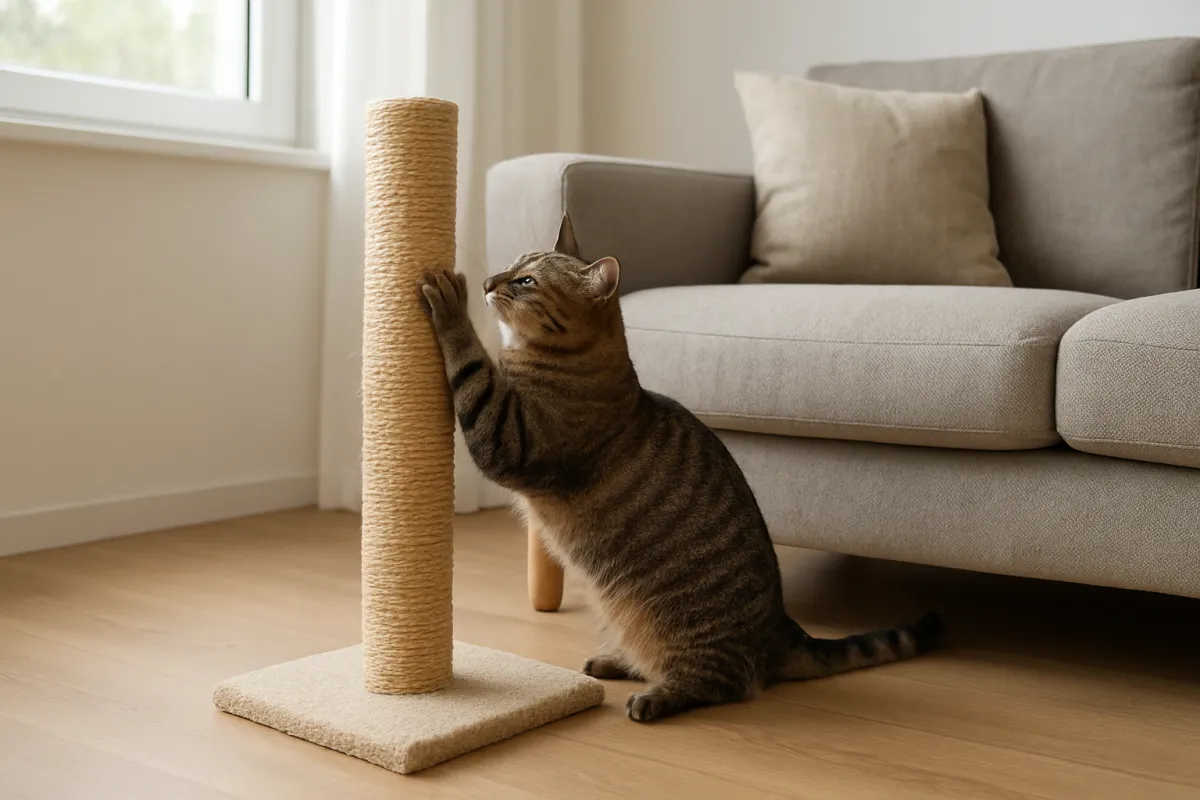
Before buying a scratching post, watch the behavior for a day or two. The location, timing, body position, and surface often tell you which replacement will work best.
- Vertical scratching: Your cat stands tall and pulls downward on a sofa arm, wall, curtain, or door frame.
- Horizontal scratching: Your cat crouches or lies low while scratching a rug, carpet, mattress, or the floor.
- Stretching: Scratching happens after waking, especially near a sleeping area.
- Marking: Scratching occurs in visible, high-traffic locations or after household changes.
- Play or excitement: Scratching appears during energetic play, greetings, or bursts of activity.
Do not assume that one scratching post will suit every cat. A cat that prefers the side of a couch may ignore a flat cardboard pad, while a cat that scratches a rug may not use a tall sisal tower.
Checkpoint: Write down the main furniture target, whether the scratching is vertical or horizontal, the surface involved, and the times it usually happens. These observations will guide the rest of the setup.
2. Choose a scratching alternative that matches the furniture
The replacement should be easy to reach, difficult to knock over, and large enough for your cat to use comfortably. A vertical scratcher should allow the cat to stretch upward with the front legs extended. A horizontal scratcher should stay flat and resist sliding across the floor.
Offer more than one material when you are unsure of your cat’s preference. Common options include sisal, corrugated cardboard, untreated wood, carpet, and upholstery-like fabric. Texture preferences vary, so the best choice is the one your cat repeatedly selects.
Use this comparison when planning your setup:
| Scratching pattern | What to look for | Useful placement | Warning sign |
|---|---|---|---|
| Pulls down on sofa arms | Tall, rigid vertical post with a rough surface | Immediately beside the sofa arm | Post wobbles or is shorter than the cat’s full stretch |
| Scratches rugs or carpet | Flat or angled cardboard, sisal, or carpet pad | On the exact floor area being targeted | Pad slides, curls, or has an unfamiliar texture |
| Scratches after waking | Scratcher placed near the bed or favorite resting spot | Along the cat’s normal morning route | Scratcher is hidden in a room the cat rarely visits |
| Scratches door frames | Vertical panel secured to the frame or nearby wall | Beside the doorway at paw height | Only a loose mat is offered on the floor |
| Several cats scratch different areas | Multiple types and locations rather than one shared post | Near each cat’s preferred zone | One post is crowded, guarded, or inaccessible |
For general guidance, the ASPCA’s advice on destructive scratching also emphasizes variety, stability, and placing approved scratchers near the furniture being targeted. A veterinary behavior guide from VCA Animal Hospitals explains why scratching should be redirected rather than suppressed.
3. Put the scratcher in the right location
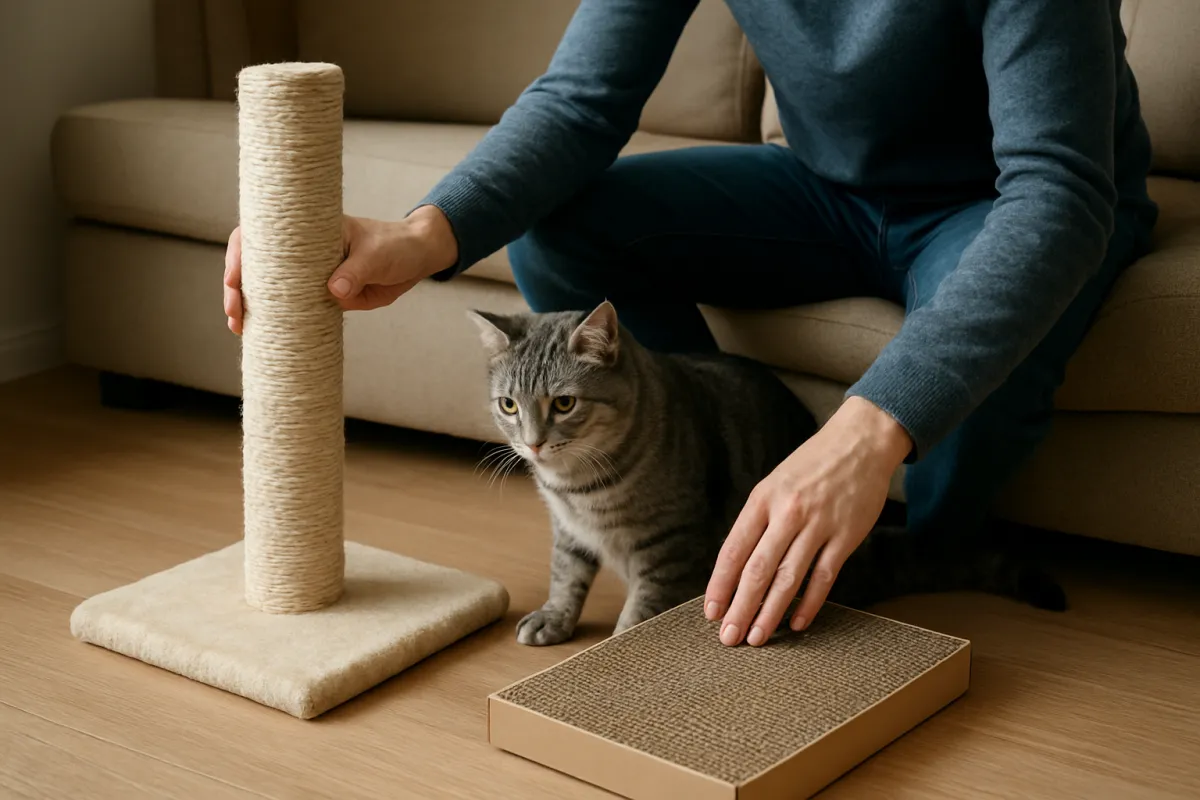
Placement is often more important than appearance. Start by putting the new scratcher directly beside the furniture, even if that is not where you ultimately want it to remain. Once your cat uses it consistently, move it only a few inches at a time.
Good locations usually include:
- Beside the sofa arm or chair corner being scratched.
- Near the cat’s sleeping area for post-nap stretching.
- Near a doorway, hallway, or window where the cat spends time.
- Close to a favorite play area or climbing structure.
- In a social area where the household regularly spends time.
A scratcher hidden behind furniture may be ignored because scratching can serve a communication purpose. If your cat scratches in a prominent location, the alternative should initially be just as visible.
Checkpoint: Test stability by gently pressing the post from different directions. If it shifts, tips, or makes a startling noise, secure it or choose a heavier model.
4. Make the furniture temporarily less appealing
While teaching the new habit, reduce access to the old target. Use a furniture cover, smooth protective material, or a cat-safe commercial deterrent designed for that purpose. Double-sided tape and upside-down carpet runner material are commonly suggested temporary barriers, but test any product on a hidden section first to avoid damaging upholstery or finishes.
Do not create a hazard with loose plastic, dangling cords, sharp edges, unstable covers, or materials your cat may chew and swallow. The barrier should be uncomfortable or inconvenient to scratch, not frightening or dangerous.
Whenever possible, place the approved scratcher directly in front of or beside the protected furniture. Removing the target without providing a convenient alternative can simply send the cat to another chair, rug, or wall.
5. Teach the new habit without forcing it
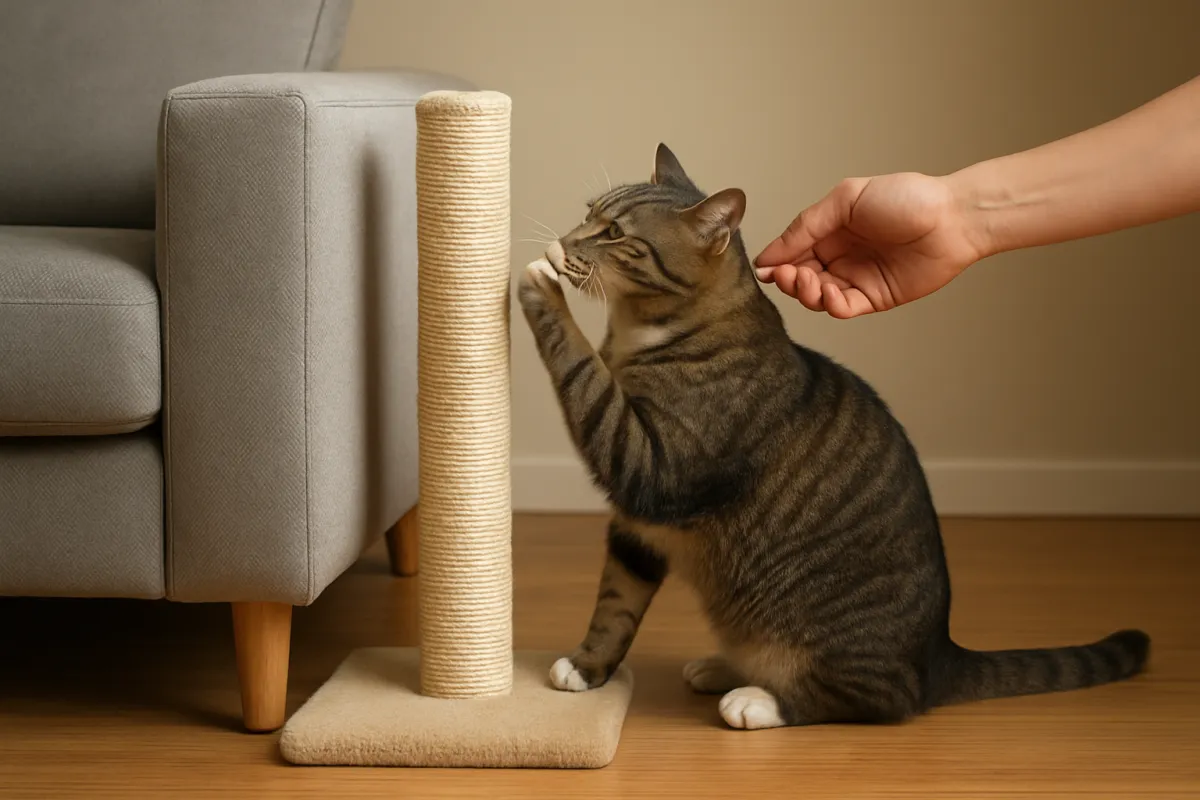
Invite investigation rather than physically manipulating your cat. Drag a wand toy across the scratcher, place a favorite toy nearby, or offer a small treat after the cat approaches it. Some cats respond to catnip, but not all cats do, and kittens may show little interest.
If your cat scratches the furniture while you are present, stay calm. Interrupt with a neutral sound or redirect attention to a toy, then reward the cat when they use the scratcher. Avoid grabbing the cat, shouting, spraying water, or holding their paws against the surface. The ASPCA specifically warns against forcing a cat’s claws onto a scratching post.
Reward timing matters. Give praise, a treat, or a brief play session within a few seconds of the desired scratching. This helps your cat connect the reward with the action you want repeated.
Checkpoint: For the first week, keep treats or a favorite toy near the main scratching station. Record whether your cat uses the scratcher independently, only after prompting, or not at all.
6. Protect the furniture while the habit develops
Training is easier when the cat cannot rehearse the unwanted behavior repeatedly. Cover sofa arms, move lightweight chairs temporarily, close access to a problem room when practical, or use a washable throw over vulnerable upholstery.
Trim the sharp tips of your cat’s claws regularly if your cat tolerates it. Nail trimming reduces the damage caused by accidental contact, but it does not remove the need to scratch. Ask a veterinary professional or qualified groomer to demonstrate the technique if you are uncertain about where the sensitive inner portion of the claw begins.
Never declaw a cat as a routine solution. Declawing is an invasive procedure and is not equivalent to a nail trim. Focus instead on environmental changes, scratching alternatives, and veterinary guidance when behavior changes suddenly.
7. Reinforce the routine every day
Use short, predictable sessions instead of repeatedly moving your cat to the scratcher. After meals, naps, and interactive play are useful times to guide attention toward an approved scratching area because many cats naturally stretch or scratch during transitions.
Keep the scratcher usable. Replace cardboard when it becomes too worn, remove loose threads, and check that posts remain stable. If the surface becomes saturated with scents, dirty, or damaged, your cat may return to the furniture.
In a multi-cat home, watch for blocking or competition. Provide separate scratchers in different rooms if one cat prevents another from reaching the preferred location. The Humane Society of the United States’ cat-care tips similarly recommend positioning scratching outlets near commonly targeted furniture.
8. Troubleshoot slow or inconsistent progress
What if my cat ignores the new scratching post?
Move it directly beside the damaged area and try a different orientation or material. If the cat scratches horizontally, use a horizontal pad; if the cat stretches vertically, use a tall, secured post. You can also try placing a toy or treat near the base, but do not rely on catnip alone.
What if my cat uses the post but still scratches the sofa?
Keep both options available and make the sofa less accessible for longer. Add a second approved scratcher at the exact spot where the sofa scratching continues. Some cats need separate surfaces for marking, stretching, and play.
What if the scratching started suddenly?
Look for changes such as moving furniture, a new pet, visitors, construction noise, altered work schedules, or conflict with another cat. Sudden increases in scratching can be associated with stress or territorial marking. If the change persists or appears with hiding, appetite changes, aggression, urine marking, pain, or other unusual behavior, contact your veterinarian.
What if my cat scratches people as well as furniture?
Do not use hands or feet as toys. End rough play calmly, redirect to a wand toy, and provide daily interactive play that lets the cat chase and capture an appropriate object. Seek professional behavioral help if scratches are frequent, severe, or linked to fear or aggression.
Common mistakes that delay results
- Buying an attractive but unstable scratcher: Cats often avoid equipment that moves or collapses.
- Placing the post in a hidden corner: A convenient human location may be a poor cat location.
- Offering only one texture: You may accidentally choose a surface your cat dislikes.
- Moving the scratcher too soon: Establish consistent use before changing its position.
- Rewarding too late: Delayed rewards are harder for the cat to connect with scratching.
- Punishing after the event: Cats may become wary of you without learning what to scratch instead.
- Removing every scratching outlet: The natural behavior will usually reappear somewhere else.
Practical checklist for the next seven days
- Observe and record the furniture, direction, texture, and timing of scratching.
- Choose at least one scratcher that matches the current behavior.
- Secure it so it cannot slide, tip, or collapse.
- Place it directly beside the targeted furniture.
- Cover or protect the furniture with a safe temporary barrier.
- Reward every voluntary use immediately.
- Inspect the setup daily and repair or replace damaged materials.
- Do not yell, spray, chase, or force the cat’s paws onto the scratcher.
- Contact a veterinarian if the behavior changes abruptly or appears connected to stress, pain, or illness.
Advanced tips for difficult cases
If your cat repeatedly targets one corner, consider a purpose-built wall-mounted scratch panel that covers the area while preserving the cat’s preferred angle. For a rug scratcher, anchor the pad to the floor or place it beneath a heavy piece of furniture so it cannot move.
For cats that scratch near windows or entryways, inspect the view outside. Seeing unfamiliar cats or wildlife may increase territorial marking. Closing blinds at certain times, adding privacy film, or moving the approved scratcher to that area may reduce the trigger, although the best response depends on the individual cat.
In homes with several cats, create more vertical territory, resting places, and separated resources. Scratching may increase when a cat feels the need to establish space or avoid another animal. If household tension continues, a veterinarian or certified feline behavior professional can help you build a broader management plan.
Next actions: start with the furniture your cat targets most
Today, place a stable scratcher beside the most frequently damaged piece of furniture and cover the target area. Observe which direction and material your cat chooses, then adjust the setup rather than assuming the first product will work.
Once the cat uses the approved surface reliably, keep it in place and gradually improve the room’s appearance around it. The answer to how to stop a cat from scratching furniture is not to stop scratching altogether; it is to make the right surface easier, safer, and more rewarding to use than the furniture.
Frequently asked questions
How long does it take to stop a cat from scratching furniture?
Some cats begin using a well-placed alternative quickly, while others need repeated adjustments over several weeks. Progress depends on whether the new surface matches the cat’s preference and whether the furniture remains easy to access.
Should I put catnip on the scratching post?
You can test it if your cat responds to catnip, but it is optional. Placement, stability, height, texture, and immediate rewards are usually more important than scent.
Can I use a scratching post for every cat?
You can start with one, but separate scratchers are often more practical in multi-cat homes. Provide different locations if cats guard resources or prefer different surfaces.
Is scratching a sign that my cat is unhappy?
Not necessarily. Scratching is normal, but a sudden increase combined with hiding, aggression, appetite changes, urine marking, or other unusual behavior deserves closer attention and possible veterinary advice.