To introduce a dog to a baby gate, let the dog investigate it gradually, reward calm behavior, and begin with short sessions before expecting the dog to remain separated behind it. Never use the gate as punishment or leave a baby and dog together without active adult supervision.
A baby gate can give your dog and child useful space while helping your household adjust to new routines. The goal is not simply to make your dog tolerate a barrier. You want the gate to become a predictable part of daily life, with comfortable resting areas and positive experiences on both sides.
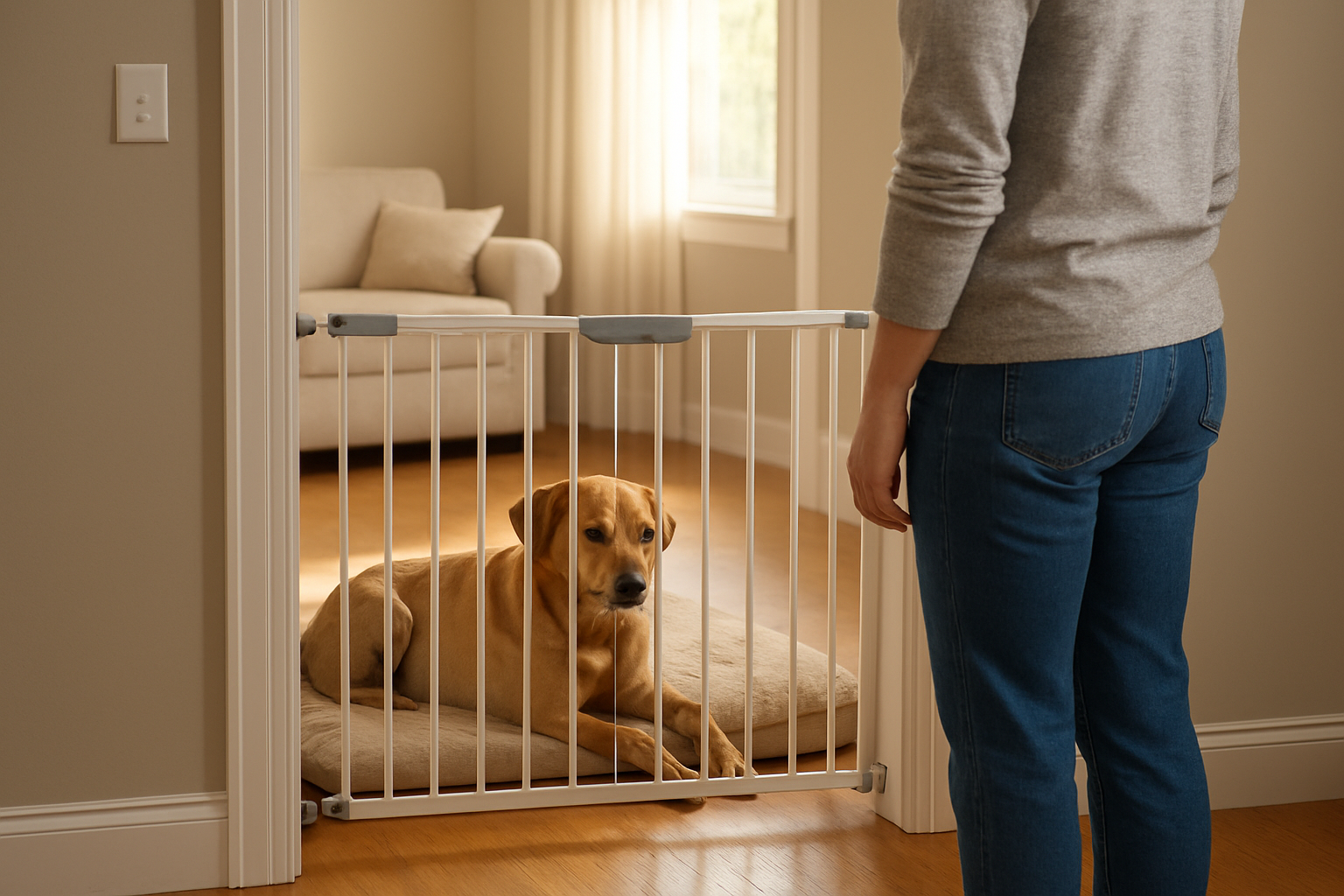
1. Prepare the space before training begins
Choose a doorway or opening where the gate will genuinely improve safety and household flow. Common locations include the nursery entrance, a hallway, the kitchen, or a room where your dog already rests comfortably.
Use a gate that is tall and firmly secured for your dog’s size, jumping ability, and determination. Pressure-mounted gates may be unsuitable at the top of stairs or in locations where a strong dog could dislodge them. Follow the manufacturer’s installation instructions and check that there are no gaps where a paw, collar, or head could become trapped.
Set up the dog’s side before you begin. Include water, a comfortable bed, and a safe chew or food puzzle if your dog enjoys these items. Keep children’s toys, food, medicines, and small objects out of reach on both sides of the barrier.
Gather these supplies
- Small, high-value treats that your dog can eat quickly
- A comfortable bed or mat
- A favorite chew or food puzzle, used only when appropriate
- A secure baby gate suited to the doorway and the dog
- A leash or harness for controlled practice if your dog needs extra guidance
2. Teach calm behavior beside the baby gate
Before closing the gate, let your dog see and smell it while it is secured in place. Stand several feet away and wait for your dog to notice the barrier without rushing toward it. Mark the calm moment with a quiet “yes” or another familiar signal, then give a treat.
Repeat this several times, stopping while your dog is still relaxed. If your dog freezes, backs away, barks, paws, or repeatedly jumps at the gate, increase the distance and make the exercise easier. The ASPCA’s guidance on dogs and babies also recommends preparing dogs for new sights, sounds, smells, and household equipment through gradual positive experiences.
Once your dog can look at the gate and return attention to you, add a simple behavior such as sitting, lying on a mat, or looking toward you. Reward the behavior immediately. You are building a useful pattern: notice the barrier, remain composed, and choose an alternative action.
3. Practice with the gate open, then partly closed
Begin by moving through the doorway while the gate remains open. Reward your dog for staying on the chosen side or following you calmly, depending on the behavior you want in that location.
Next, close the gate for only a few seconds while you remain directly beside it. Feed a treat through the bars if your dog stays loose and quiet. Open the gate before your dog becomes distressed, then pause and repeat.
Do not make every opening a dramatic release. Sometimes open the gate when your dog is calm, wait a moment, and then continue with an ordinary household activity. This reduces the chance that the barrier becomes a signal that exciting access is about to happen.
Checkpoint: Move on when your dog can remain relaxed with the gate closed for several brief repetitions. Relaxed behavior may include soft body language, normal breathing, sniffing, lying down, or calmly taking treats.
4. Increase distance and duration gradually
When short closures are easy, take one step away, return, and reward. Then try two steps, a few seconds in another room, or a brief routine such as picking up laundry. Change only one difficulty at a time whenever possible.
If your dog starts barking or pawing, avoid scolding. Return to the last distance or duration that worked and repeat it. A slower progression is usually more useful than allowing repeated unsuccessful attempts.
Keep sessions short, especially during the first few days. Several calm practices of one to five minutes can be more productive than one long session. Continue giving your dog normal exercise, attention, and rest outside the gate so separation does not feel like social exclusion.
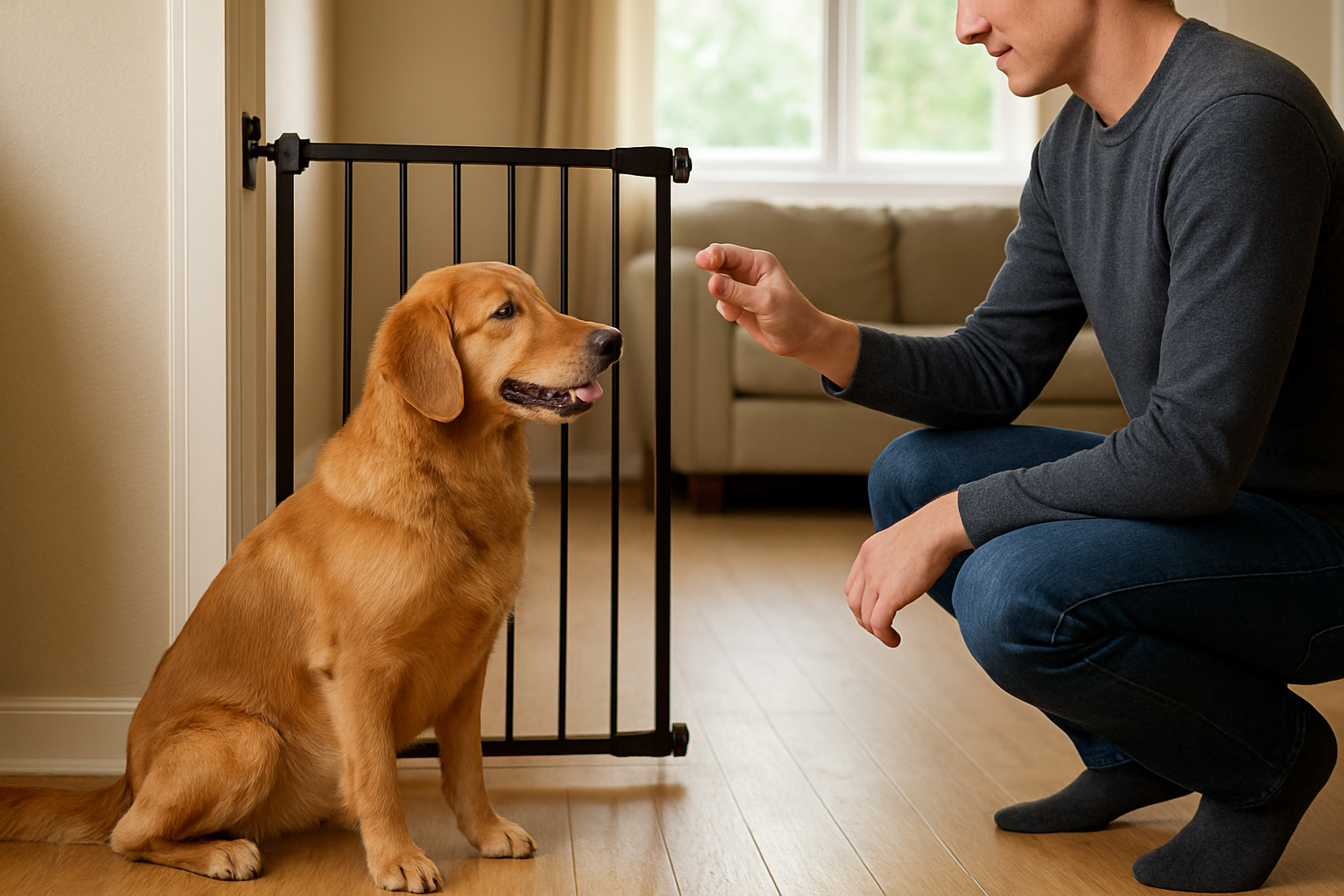
5. Pair the gate with baby-related routines
Once your dog understands the barrier, practice while ordinary family activities happen on the other side. You might sit nearby with the baby, fold clothes, prepare a bottle, or read quietly. Keep the dog far enough away to stay comfortable and reward calm observation.
Never use the gate as a substitute for supervision. A dog may be able to reach through the bars, knock over lightweight equipment, or become more excited when a baby cries or moves. The Dogs Trust guidance on dogs and children recommends using physical separation such as baby gates when an adult is distracted, while still treating supervision and intervention as essential.
Watch your dog’s body language. Lip licking, yawning, turning away, tucked posture, pacing, hard staring, growling, or repeated attempts to escape can indicate discomfort or rising arousal. The ASPCA’s dog-bite prevention guidance explains why recognizing signs of anxiety, fear, or threat is an important part of preventing unsafe interactions.
Use this comparison table during practice:
| What to look for | What it usually means | What to do next | Warning sign |
|---|---|---|---|
| Loose posture and accepts treats | The dog is coping well | Repeat the same step, then progress slowly | Stops eating or becomes unusually still |
| Looks at the gate, then looks away | The barrier is noticeable but manageable | Reward the choice to disengage | Stares continuously at the child or doorway |
| Brief whining or pawing | The session may be too difficult or exciting | Shorten the duration and increase distance | Escalating barking, lunging, or biting at the gate |
| Settles on a bed | The dog has an alternative behavior | Quietly reinforce the settle | Cannot settle even after the situation becomes easier |
6. Troubleshoot common problems
What if my dog barks at the gate?
First, identify whether your dog is frustrated, frightened, overexcited, or trying to reach a person. Move farther away, reduce the activity on the other side, and reward quiet pauses rather than shouting over the barking. If the barking continues, end the session calmly and try again at an easier level.
What if my dog jumps over or pushes the gate?
Do not rely on training alone if the barrier is physically inadequate. Choose a more secure or taller gate, block nearby furniture that could act as a launching point, and ask a veterinarian or qualified behavior professional for help if the behavior is persistent or aggressive.
What if my dog will not take treats?
Refusing food can mean the situation is too stressful, the reward is not useful in that environment, or your dog is distracted. Increase distance, shorten the session, and try again when the dog is calmer. Do not force the dog toward the gate.
Common mistakes to avoid
- Installing the gate and immediately leaving the dog behind it for a long period
- Using the gate only when the dog is being punished or removed from family activity
- Allowing the dog and baby to touch through the bars
- Ignoring early stress signals because the dog has not growled
- Moving too quickly from a quiet practice session to a crying, crawling, or feeding baby
- Assuming a small or familiar dog cannot knock over equipment or injure a child
- Leaving food, chews, or toys near the barrier when another child or pet could create competition
Safety notes for homes with babies
Keep the dog and baby physically separated whenever you cannot actively watch them. A gate is a management tool, not a guarantee of safety. Keep doors latched, check the gate regularly, and make sure adults know which areas are dog-free or child-free.
If your dog has a bite history, guards food or toys, shows intense fear around children, or displays stiff body language and lunging, stop close-contact practice. Contact your veterinarian and request a referral to a qualified veterinary behaviorist or reward-based behavior professional. If a bite occurs, obtain prompt medical advice and professional behavior support.
Action checklist for the next seven days
- Day 1: Install and inspect the gate; create a comfortable dog area.
- Day 2: Reward calm looks and movement near the open gate.
- Day 3: Close the gate for a few seconds while standing nearby.
- Day 4: Add one or two steps of distance, then return and reward.
- Day 5: Practice during a quiet household routine.
- Day 6: Introduce a slightly longer separation only if the dog remains relaxed.
- Day 7: Review the gate, the dog’s body language, and any triggers that still require an easier setup.
Advanced tips for busy or multi-pet homes
Teach a mat or “settle” behavior away from the gate before combining it with baby-related activity. In homes with multiple pets, practice one animal at a time so you can tell which individual is becoming stressed. Rotate access to family areas rather than allowing one pet to remain isolated for long periods.
If your dog is highly social, provide predictable contact before and after planned separations. If your dog prefers quiet, give it a low-traffic retreat. The Dogs Trust advice on introducing a dog to a new baby emphasizes preparing dogs for changes in routine and helping them remain part of family life.
Your next steps
Start with the physical setup today, but treat training as a gradual process rather than a single introduction. Observe whether your dog can relax, eat, disengage, and settle; those are more useful measures than simply staying behind the gate.
When you know how to introduce a dog to a baby gate, the main decision is straightforward: make the barrier secure, make calm behavior rewarding, and reduce the difficulty whenever your dog shows stress. Used consistently alongside active supervision, the gate can provide safe separation without making your dog feel pushed out of family life.