The best bird cages for cockatiels in small homes are wide, rectangular, easy to clean, and large enough for your bird to stretch and move between perches without hitting the bars. In a compact home, prioritize usable floor space and safe construction over extra height, decorative features, or a small footprint that leaves no room for enrichment.
This guide is based on veterinary housing guidance from VCA Animal Hospitals and the Merck Veterinary Manual, together with practical space-planning considerations for apartment and small-home owners. You will learn which dimensions matter, how to check bar spacing, where to place the cage, and when a compact cage is simply too small.
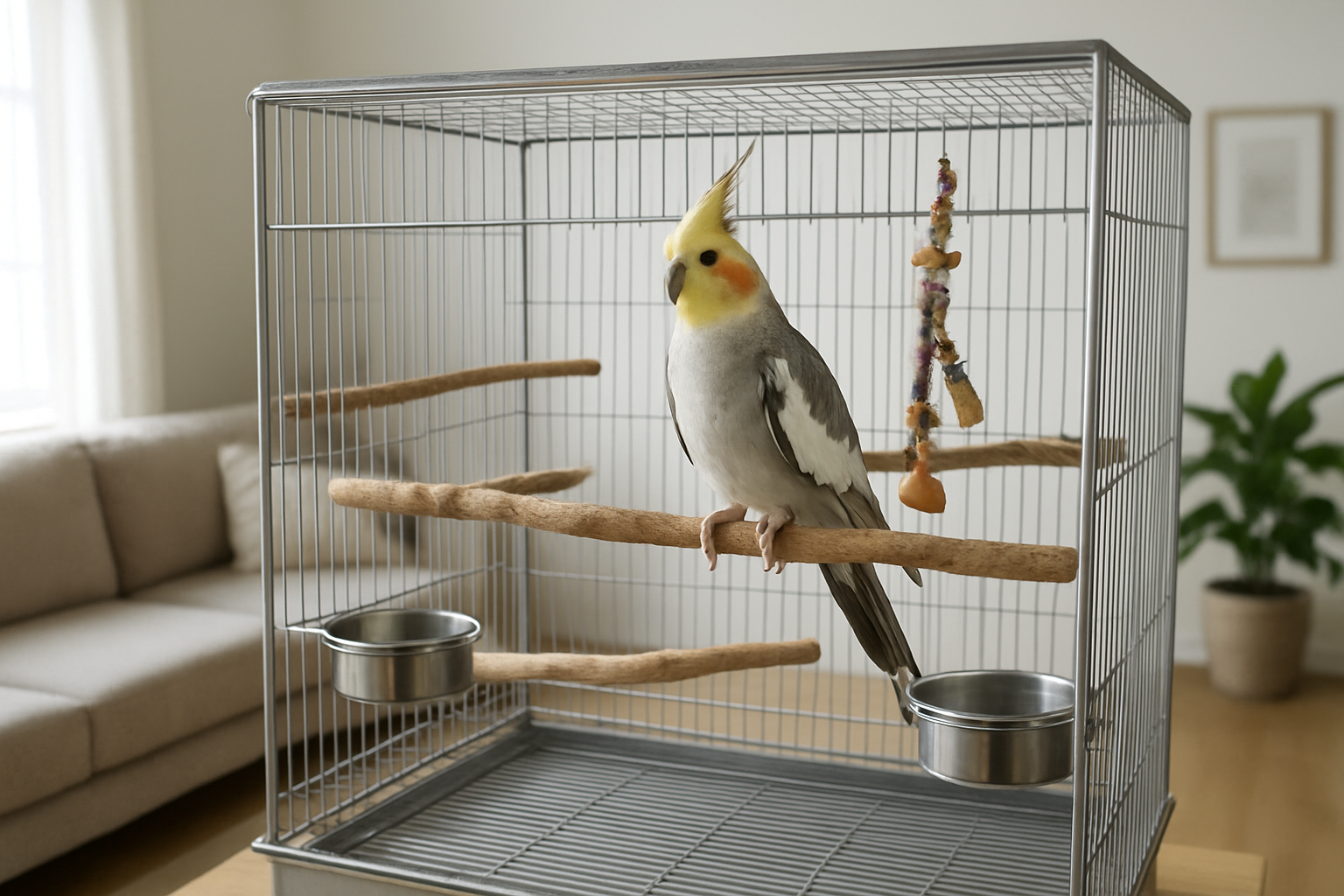
1. Measure your room before you compare bird cages
Start with the space where the cage will actually live. Measure the available width, depth, and height, then allow extra clearance for opening doors, removing trays, changing food, and carrying the cage if necessary.
A cage that technically fits against a wall may be impractical if you cannot reach the rear panel or slide out the cleaning tray. In a small home, this everyday access matters because a difficult cage is more likely to be cleaned less often or arranged poorly.
Allow space around the cage
- Leave enough room to open the main door without hitting furniture.
- Keep the cage away from kitchen fumes, smoke, direct drafts, and strong heat sources.
- Make sure the stand or base is stable and cannot be easily knocked over.
- Check that ceiling fans, open windows, and other household hazards are not within the bird’s flight path.
The cage should be part of a safe living area, not just an object squeezed into an unused corner. VCA’s household safety guidance for birds is useful when reviewing hazards around the proposed location.
2. Choose width and usable space over decorative height
Cockatiels use their cage for climbing, perching, playing, feeding, and stretching. A tall, narrow cage may look space-efficient, but it often offers less useful movement than a wider rectangular model.
Merck Veterinary Manual lists 20 × 20 × 30 inches as a minimum reference for cockatiels, lovebirds, and similar small parrots, with 1/2-inch bar spacing. VCA also emphasizes that birds should be able to turn around, stretch, and flap without striking cage furnishings. Treat these figures as a starting point rather than a target to exceed only by a few inches.
In a small home, a wider cage with a sensible height is usually a better compromise than a very narrow tower. If your bird spends substantial time inside, or if you keep more than one cockatiel, choose a larger enclosure and discuss the arrangement with an avian veterinarian.
A simple comparison can help you reject unsuitable designs quickly:
| What to look for | Why it matters | Warning sign |
|---|---|---|
| Wide rectangular layout | Creates room for back-and-forth movement and wing stretching | Very tall cage with little side-to-side space |
| About 1/2-inch bar spacing | Helps reduce the risk of a cockatiel getting its head or body caught | Large gaps, flexible bars, or unclear specifications |
| Non-toxic, durable metal construction | Supports cleaning and resists chewing better than porous materials | Peeling coating, rust, sharp welds, or exposed metal |
| Large removable tray | Makes routine cleaning easier | Shallow tray that spills litter and food onto the floor |
| Secure doors and feeder openings | Reduces escape risk and accidental openings | Loose latches or doors that move when the bird climbs |
3. Check construction, coating, and escape prevention
Most practical cockatiel cages are made from metal with a durable coating or stainless steel. The precise material and coating should be clearly identified by the manufacturer. Avoid buying a cage when the product description does not explain the finish, bar dimensions, or intended bird size.
Inspect product photographs and specifications for rough welds, sharp corners, exposed screws, flaking paint, and doors that can be pushed open from inside. Cockatiels are active climbers, so a latch that seems adequate for a quiet bird may not remain secure once the bird learns how it works.
Round cages are generally a poor choice because they provide less useful corner space and can make perch placement and cleaning awkward. VCA’s small-bird housing guidance explains why rectangular, all-metal designs are usually more practical.
4. Plan the interior before you buy
Manufacturers may list external dimensions, but the usable interior becomes smaller once you add perches, bowls, toys, and a swing. Before choosing a cage, sketch where these items will go and confirm that your cockatiel will still have a clear central area for movement.
Perches should vary in size and position
Use several safe perches with different diameters and textures rather than placing every perch at the same height. VCA recommends that a bird’s toes wrap around much of the perch without the foot being forced into an awkward grip. Natural wood perches can provide useful variety, but replace any that become splintered or heavily damaged.
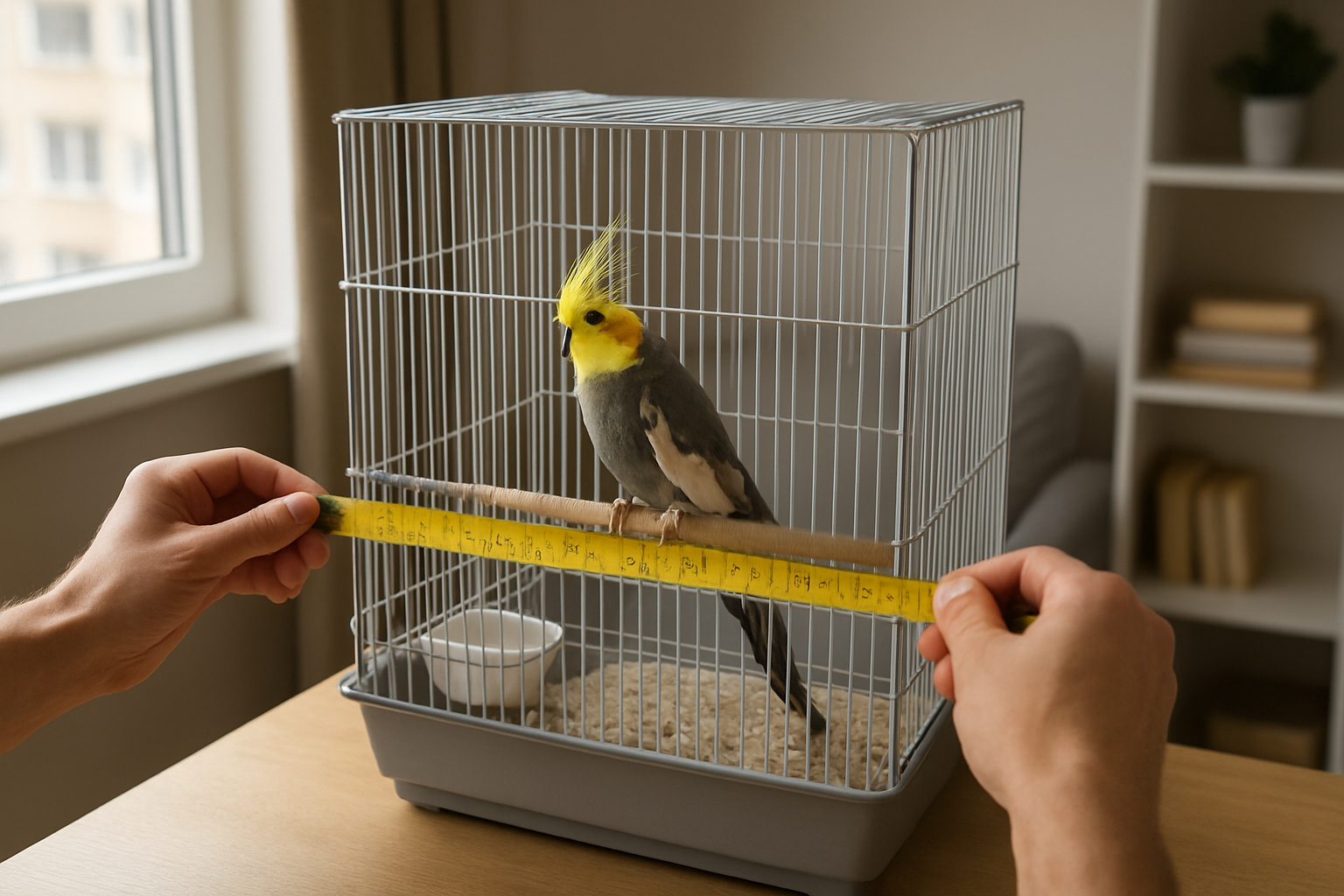
Do not rely on sandpaper perch covers to manage nails. They may irritate the underside of the feet, and they do not replace appropriate veterinary care when nails become overgrown. More information is available in VCA’s guide to safe bird perches.
Keep food, water, and toys manageable
- Place food and water where droppings are unlikely to fall directly into them.
- Leave a clear route between resting areas instead of filling every section with toys.
- Choose toys made for birds and remove damaged parts, loose fibers, or hazardous hardware.
- Use a cage layout that allows you to remove bowls without disturbing the bird unnecessarily.
5. Make cleaning realistic in a small home
Cleaning access is one of the most important differences between an attractive cage and a practical one. Look for a removable tray, a grate that can be lifted safely, feeder doors that do not require opening the entire cage, and surfaces that can be wiped without hidden gaps.
Food particles, droppings, feather dust, and dander collect throughout the enclosure. VCA’s cage-hygiene guidance supports regular cleaning of the tray, bowls, perches, and surrounding area. In a small apartment, a poor tray design can also spread mess onto nearby floors and furniture.
Consider the weight of the cage as well. A removable stand or locking casters can make deep cleaning easier, but wheels should lock firmly and should not allow the enclosure to wobble.
6. Compare cage styles for small homes
Wide cage on a rolling stand
This is often the most flexible option if you have enough floor width. It can be moved for cleaning or adjusted slightly to improve lighting, but measure doorways and check the stability of the stand before buying.
Tabletop cage
A tabletop model can work when floor space is limited, provided it is large enough and sits on a strong, stable surface. The table must support the cage without vibration, and the bird should not be placed so low that household traffic causes constant disturbance.
Corner cage
Corner designs may appear efficient, but many sacrifice width or create awkward cleaning angles. Consider one only if its interior dimensions, door access, and ventilation are genuinely suitable.
7. Avoid common buying mistakes
- Choosing by external size alone: Interior space disappears quickly after adding accessories.
- Buying a cage that is too narrow: Height does not compensate for limited side-to-side movement.
- Assuming “small bird” means any small cage: Cockatiels need more room than many finches and can damage weak construction.
- Ignoring bar spacing: Always confirm the measurement in inches or millimeters before ordering.
- Overloading the interior: Too many toys and perches can leave no clear flight or stretching area.
- Putting the cage in the kitchen: Cooking fumes and overheated nonstick coatings can be dangerous to birds.
- Forgetting replacement parts: Check whether trays, grates, bowls, and wheels can be replaced.
8. What if your home cannot fit the recommended size?
If no suitable cage fits your current room, do not solve the problem by accepting a very small enclosure. Reconsider the location, remove nearby furniture, or choose a cage with a simpler stand and better width-to-height proportions.
You can also provide a secure play area outside the cage, but out-of-cage time is an addition, not a substitute for adequate housing. Always supervise flight time and remove hazards such as open windows, ceiling fans, other pets, exposed wires, and unsafe cookware.
If your cockatiel shows unusual inactivity, difficulty moving, persistent foot problems, or changes in droppings, contact an avian veterinarian rather than assuming the cage is the only cause. Birds can hide illness, and prompt assessment is important when behavior changes suddenly.
9. A practical pre-purchase checklist
- Measure the room, doorway, elevator, and intended cage location.
- Confirm the interior dimensions, not only the advertised exterior size.
- Look for a rectangular layout with useful width.
- Verify bar spacing of about 1/2 inch for a cockatiel-sized bird.
- Check the coating, welds, doors, latches, and tray design.
- Plan space for varied perches, food, water, toys, and a clear movement zone.
- Confirm that the cage can be cleaned without dismantling it.
- Check replacement-part availability and return conditions.
- Review the room for fumes, drafts, direct sun, fans, and other hazards.
10. Next actions before you place an order
First, write down the maximum width, depth, and height your home can accommodate while preserving cleaning access. Next, eliminate any model that does not clearly state its bar spacing, internal dimensions, construction, and cleaning features.
Finally, compare the remaining cages by the space your cockatiel will have after furnishing, not by the number of included accessories. A simpler, wider cage is often the more sensible choice for a small home than a taller model packed with features.
Bottom line: choose the largest safe rectangular cage your home can support
The best bird cages for cockatiels in small homes are not necessarily the smallest cages that fit. They are the largest safe, cleanable, stable enclosures that leave your bird room to stretch, perch, play, and move while still working with your daily routine. If you must compromise, reduce decorative extras before reducing usable width, safe bar spacing, or cleaning access.