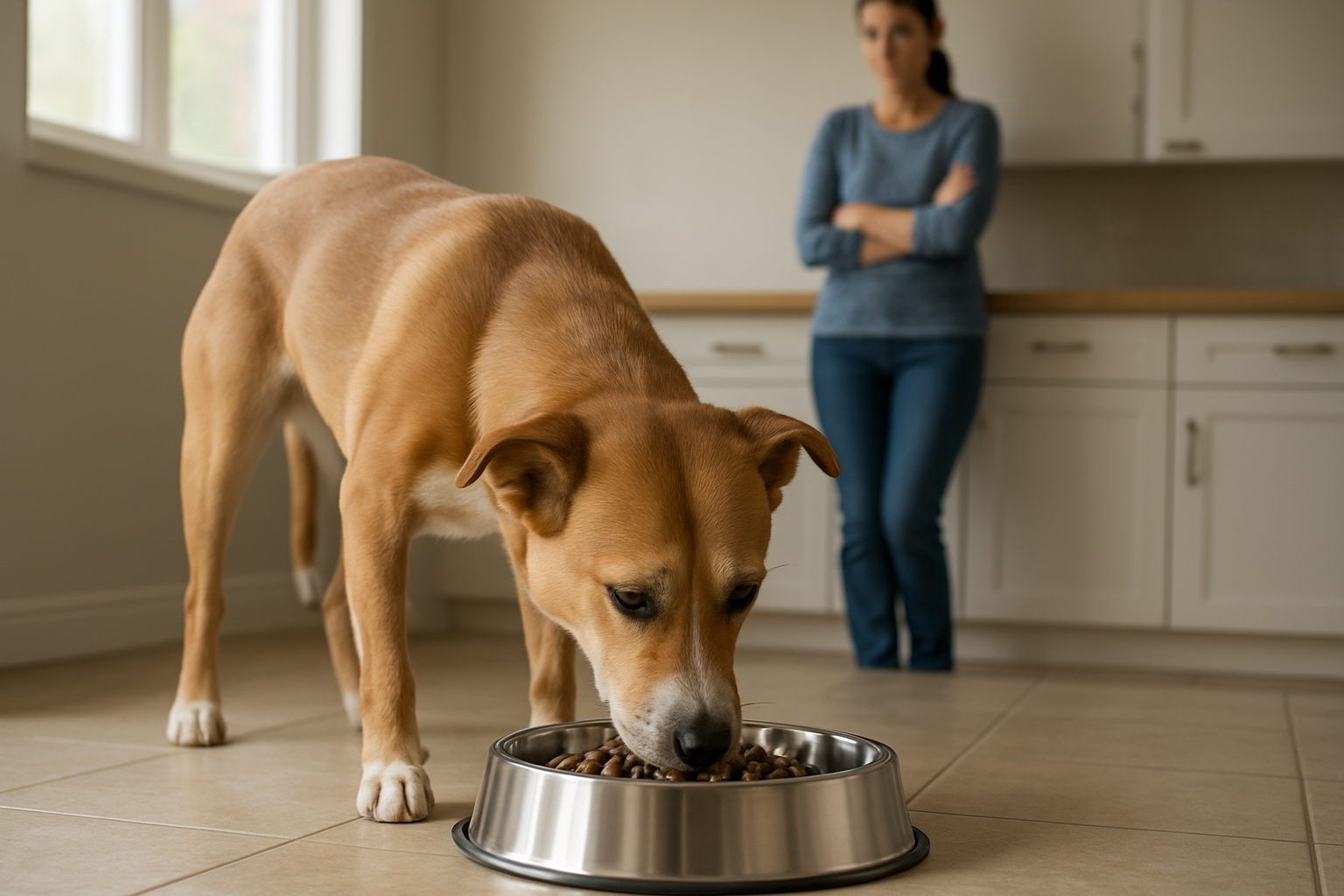
The best slow feeder bowl for a dog that eats too fast is one that makes food harder to reach without causing frustration, choking risk, or difficult cleaning. Look for a stable, food-safe bowl with obstacles suited to your dog’s size and eating style rather than choosing the most complicated design.
Fast eating can lead to regurgitation, stomach upset, and swallowed air. A slow feeder may help, but it is only one part of a safer feeding routine. This guide explains what to compare, which designs fit different dogs, and what to do if your dog still gulps meals or shows warning signs.
1. Decide whether a slow feeder bowl is the right solution
Slow feeder bowls use raised sections, grooves, or maze-like channels to prevent a dog from taking large mouthfuls at once. Veterinary guidance commonly recommends them as one option for dogs that consume meals too quickly, alongside smaller meals, food puzzles, hand-feeding, or spreading kibble across a flat surface. See the guidance from VCA Animal Hospitals and the American Kennel Club for the broader evidence basis.
A bowl is most useful when your dog eats dry or semi-moist food and can comfortably reach the food between the raised areas. It may be less suitable for a dog with facial structure, dental pain, mobility problems, or a tendency to become anxious around food. In those cases, ask your veterinarian whether a different feeder or feeding method would be safer.
Check the problem before shopping
- Does your dog finish meals in seconds, cough, regurgitate, or swallow large pieces?
- Does another pet create competition during mealtimes?
- Is your dog eating a measured portion, or is free-feeding making intake difficult to monitor?
- Can your dog currently eat calmly from a normal bowl?
If food competition is the main issue, feeding pets in separate areas may help more than buying a more difficult bowl. If vomiting, repeated regurgitation, weight change, or coughing continues, arrange a veterinary assessment instead of treating the bowl as a complete fix.
2. Compare the main slow feeder bowl designs
There is no single best pattern for every dog. The right design should slow the meal while allowing your dog to make steady progress without excessive frustration.
Use this comparison when evaluating a slow feeder for dogs that eat too fast:
| Design or feature | What to look for | Warning sign | Best fit |
|---|---|---|---|
| Rounded maze channels | Smooth, open paths with no sharp corners | Your dog cannot reach food or repeatedly gives up | Most adult dogs needing moderate slowing |
| Raised center post | A broad, stable post with space around it | Your dog knocks the bowl over or bites the post | Dogs that gulp from the center of a flat bowl |
| Shallow ridges | Low obstacles that are easy to inspect and clean | The pattern barely changes eating speed | Small dogs, short-nosed dogs, or beginners |
| Deep maze or narrow channels | Channels wide enough for your dog’s muzzle | Food becomes trapped or your dog shows stress | Experienced dogs that need a stronger challenge |
| Slow feeder insert | A secure fit inside a familiar bowl | The insert slides, lifts, or leaves gaps | Owners who want to keep an existing bowl |
Rounded surfaces are generally easier to inspect and clean than intricate patterns. Avoid designs with inaccessible pockets, sharp edges, loose parts, or openings that could trap a jaw or toenail. The goal is controlled eating, not maximum difficulty.
3. Choose a practical material and construction
Material considerations
Common slow feeder bowls are made from stainless steel, silicone, ceramic, or plastic. Material alone does not determine safety; construction, condition, and cleaning habits matter too.
- Stainless steel: Often a practical choice when you want a durable, non-porous surface and straightforward cleaning.
- Silicone: Useful when flexibility, light weight, or storage matters, but check that the bowl does not collapse during use.
- Ceramic: Can be heavy and stable, although chips and cracks should be treated as reasons to replace it.
- Plastic: Usually lightweight and available in many patterns, but inspect it regularly for deep scratches, chewing damage, or lingering odors.
Look for clear food-contact information from the manufacturer and follow the stated cleaning instructions. A dishwasher-safe claim can be convenient, but you should still check whether the maze is fully exposed to water and detergent.
Stability matters more than decoration
A bowl that slides across the floor may make your dog eat more frantically and spill food. Choose a broad base, a substantial weight, or a properly attached non-slip ring. For strong or determined dogs, test the bowl with an empty meal area first to see whether it can be pushed, flipped, or carried.
4. Match the difficulty to your dog
Start with a moderate pattern. Put down part of the normal meal and observe whether your dog can reach the food smoothly, pause naturally, and finish without pawing or biting the bowl.
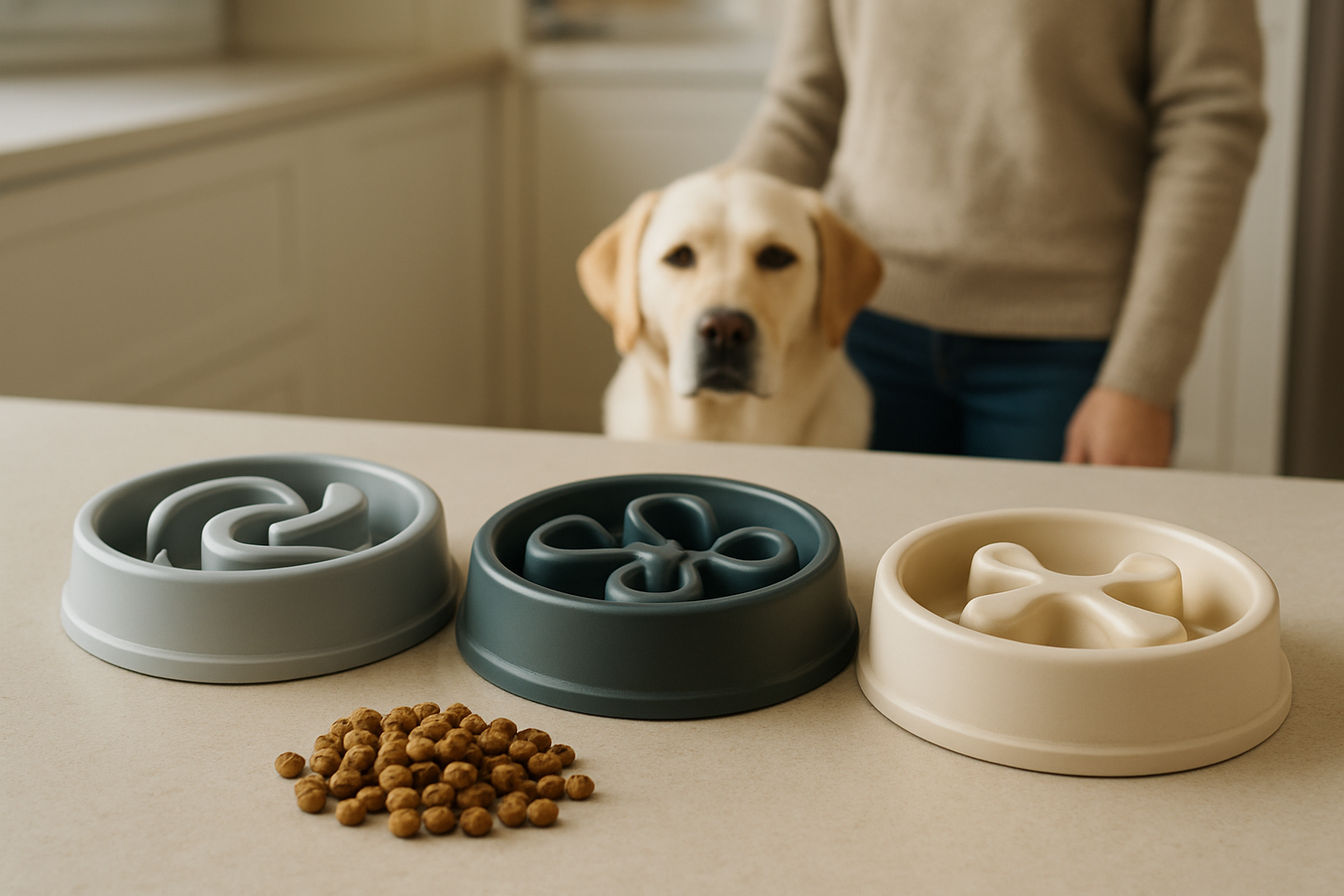
For a short-nosed dog, puppy, senior, or dog with limited neck movement, prioritize shallow channels and a wide opening. A very deep maze can force awkward angles and may leave food inaccessible. For a large dog, check the bowl’s diameter and channel width rather than relying only on the advertised size label.
Wet food requires extra attention. Thick food can smear into grooves and become difficult to remove, while very narrow patterns may encourage excessive licking. A shallow slow feeder, lick mat, or several small dishes may be more practical, depending on your veterinarian’s advice and your cleaning routine.
5. Set up safer mealtimes
A slow feeder works best when combined with sensible portions and a calm environment. Measure the food before serving, and consider dividing the daily amount into multiple meals if that fits your dog’s routine. VCA discusses smaller, structured meals and interactive feeding as ways to manage fast eating and overeating.
- Introduce the bowl with a portion of the usual food rather than changing the diet at the same time.
- Supervise the first several meals.
- Place the bowl on a level, non-slip surface.
- Keep other pets away if competition causes frantic eating.
- Wash the bowl frequently, especially after wet food.
- Avoid adding extra treats simply because the meal takes longer.
Do not put rocks, improvised objects, or loose toys into a food bowl to slow eating. They can become choking hazards, damage teeth, or create hygiene problems. If a bowl fails, use a purpose-designed feeder or another controlled feeding method instead.
6. Know the limitations and warning signs
A slow feeder can reduce eating speed, but it does not guarantee protection from bloat or gastric dilatation-volvulus. The Blue Cross guidance on bloat identifies signs such as a swollen or hard abdomen, repeated unproductive retching, drooling, pain, panting, and restlessness. These signs require immediate veterinary attention.
Contact your veterinarian promptly if your dog repeatedly vomits, regurgitates, coughs while eating, loses weight, seems painful, or cannot eat comfortably from the feeder. A dog that suddenly begins eating unusually fast may also need evaluation for changes in appetite, stress, or an underlying medical problem.
7. Consider alternatives to a slow feeder bowl
A bowl is not the only way to slow a meal. The AKC’s dog-bowl guide also discusses puzzle feeders and slow-feed designs, while VCA suggests options such as a muffin pan, food spread over a flat surface, hand-feeding, and interactive feeders.
- Food puzzle: Suitable for dogs that enjoy problem-solving and can use the toy without chewing pieces off.
- Snuffle mat: Useful for supervised nose work with dry food, provided the mat remains clean and intact.
- Several small dishes: A simple option when you want to divide one meal without adding a complex maze.
- Hand-feeding during training: Helpful for calm dogs and owners who can provide consistent supervision.
Choose the alternative that your dog can use safely and that you can clean consistently. More enrichment is not automatically better if it causes frustration or encourages chewing.
Action checklist before you buy
- Measure your dog’s muzzle width and compare it with the channel openings.
- Choose a pattern that is challenging but visibly accessible.
- Check the base for slip resistance and tipping resistance.
- Inspect the surface for sharp edges, loose pieces, and deep crevices.
- Confirm whether the bowl suits dry food, wet food, or both.
- Review the cleaning instructions and replacement policy before purchasing.
- Plan to supervise the first meals.
Common mistakes when buying a slow feeder bowl
- Choosing the hardest maze because it appears more effective.
- Buying by breed name alone instead of checking actual muzzle and bowl dimensions.
- Ignoring slipping, tipping, or chewing behavior.
- Assuming a slow feeder replaces portion control or veterinary advice.
- Leaving wet food in deep grooves for long periods.
- Continuing to use a bowl after it becomes cracked, chipped, or heavily scratched.
What if the bowl does not work?
If your dog still finishes immediately, try a wider pattern with more separated food zones, divide the meal into smaller portions, or feed in a separate room. If your dog becomes frustrated, paws aggressively, refuses food, or appears uncomfortable, move to a simpler feeder and ask your veterinarian for guidance.
Next actions
- Record how quickly your dog currently finishes a normal meal.
- Measure the dog and identify whether dry or wet food will be used.
- Select a stable, washable design with moderate obstacles.
- Test a partial meal under supervision.
- Keep the bowl only if eating becomes slower and calmer without distress.
The best slow feeder bowls for dogs that eat too fast are not necessarily the most elaborate. Choose the simplest design that reliably slows your dog, remains easy to clean, and fits their body and eating style. If fast eating comes with vomiting, pain, coughing, or signs of bloat, skip experimentation and contact a veterinarian.