The best automatic litter boxes for multi-cat households are the ones that combine adequate interior space, dependable safety sensors, a sealed waste area, and simple cleaning. For many homes, a premium rotating model such as the Litter-Robot 4 is the strongest all-round option, while open-top and rake-style designs may suit cats that dislike enclosed spaces or owners with tighter budgets.
However, one automatic box does not always replace every traditional litter box. Cats may avoid a noisy, crowded, or poorly placed unit, and veterinary guidance still recommends multiple boxes in separate, accessible locations. This guide explains what to check, how the leading designs differ, and when an automatic box is—or is not—the right solution for your home.
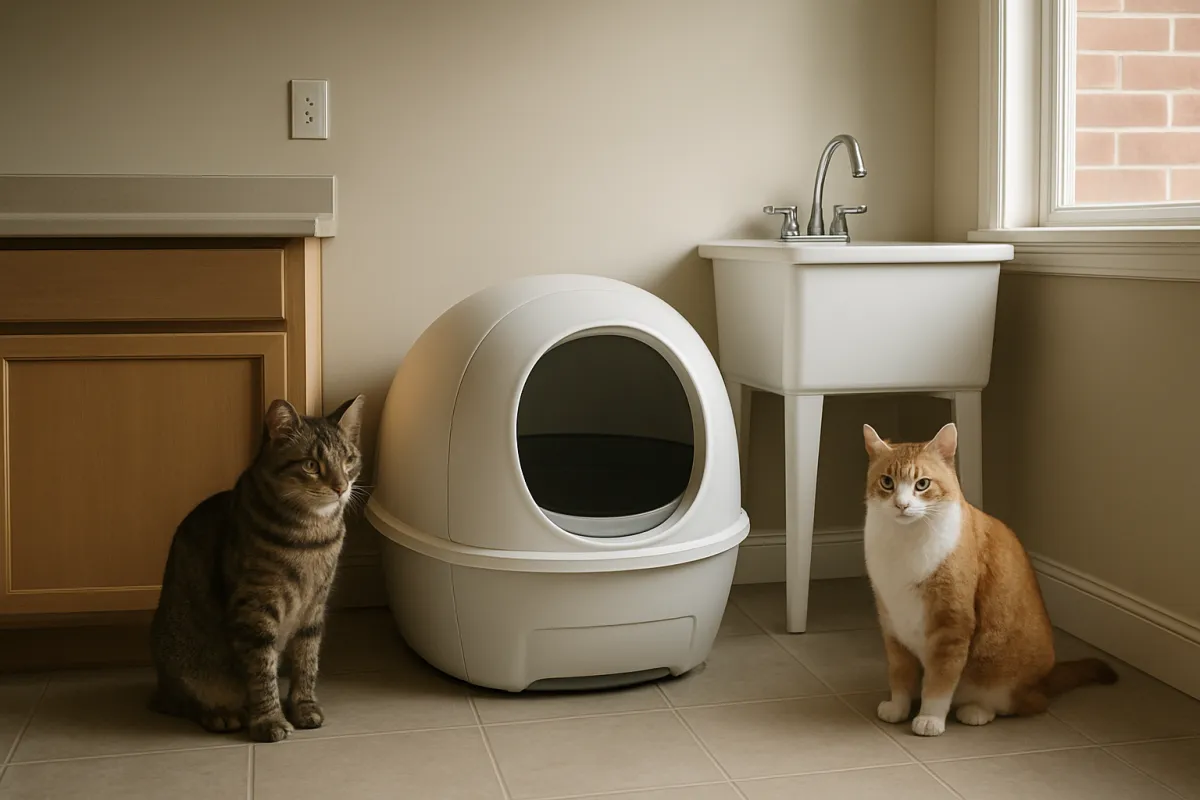
1. Start with your cats, space, and litter routine
Before comparing brands, write down the practical conditions the box must handle. A two-cat apartment has different requirements from a five-cat home with large breeds, senior cats, or cats that guard resources.
- Number of cats: More cats mean more frequent cycles, larger waste capacity, and greater importance placed on backup options.
- Largest cat: Measure from nose to the tip of the tail. Veterinary guidance suggests that a litter box should be about one and a half times the cat’s body length, although automatic designs often have unusual interior dimensions.
- Age and mobility: Kittens, senior cats, and cats with arthritis may struggle with high entry steps or deep enclosed openings.
- Litter preference: Most rotating and sifting systems work best with clumping litter, but some rake-style systems use crystal litter or specific tray formats.
- Available floor area: Check the full footprint, including the entrance, waste-drawer access, power cable, and space needed to remove the top or drum for cleaning.
The American Animal Hospital Association and American Association of Feline Practitioners recommend one litter box per cat plus one additional box as a general rule. In a multi-cat household, the boxes should be distributed in quiet areas rather than placed together as one large cluster. An automatic litter box can reduce scooping, but it should not be treated as a guarantee that every cat will share one resource comfortably.
For more practical cat-care guidance, see LaokPet’s guide on making a cat carrier more comfortable.
2. Compare the main automatic litter box designs
Automatic litter boxes generally use one of three cleaning methods. Understanding the mechanism is more useful than choosing by app features or appearance.
Rotating or sifting systems turn, roll, or sift the litter so clumps fall into a covered drawer. These models can provide strong odor containment and work well with frequent use, but they are usually larger and more expensive. They also require regular disassembly and washing because small amounts of waste can stick to the interior.
Open-top sifting systems use a moving tray or conveyor arrangement while leaving the litter area exposed. The open shape may be less intimidating for large, nervous, or claustrophobic cats. The trade-off is that odors may be more noticeable, and litter can be scattered more easily around the unit.
Rake-style systems move a rake across the litter surface and collect waste in a compartment or tray. They can be straightforward and relatively compact. They may be less forgiving of soft or poorly formed clumps, and some products require proprietary trays, liners, or litter types.
Use the following comparison as a starting point rather than a ranking. The best design depends on your cats’ preferences and your willingness to maintain the machine.
Automatic litter box comparison for multi-cat homes
| Design | What to look for | Strengths | Warning sign | Best fit |
|---|---|---|---|---|
| Rotating or sifting | Large opening, sealed drawer, reliable motion and presence sensors | Good waste separation and odor control; often accepts ordinary clumping litter | Small interior, difficult drum removal, or unclear cleaning instructions | Busy multi-cat homes willing to pay more for convenience |
| Open-top sifting | Low entry, stable base, high side walls, clear litter-level guidance | More open feel for large or cautious cats | Waste leaks, exposed odor, or litter scattered outside the unit | Large cats and households prioritizing accessibility |
| Rake-style | Strong rake, replaceable parts, compatible litter, accessible tray | Simple operating concept and sometimes lower initial cost | Proprietary consumables, stuck clumps, or a narrow litter bed | Smaller households with predictable litter habits |
3. Evaluate the features that matter most
Interior size and entry design
Do not judge capacity by the outside dimensions alone. A machine can look large while offering a cramped usable area. Look for the interior opening, floor space, maximum recommended cat weight, and the manufacturer’s instructions for kittens or small cats.
An open entrance may be preferable for cats that dislike covered boxes. Conversely, an enclosed drum can help contain odor and litter, provided the opening is large enough and the cat can enter and leave without feeling trapped.
Safety sensors and cycle timing
A suitable machine should detect a cat entering or approaching and pause its cleaning cycle. It should also have a delay after use so that urine and feces can form stable clumps before removal. Do not rely on a product description that merely says “smart” or “automatic”; check the manual for the actual sensor behavior.
Automatic cleaning does not eliminate supervision. Watch the first several cycles, inspect whether clumps are removed cleanly, and make sure the machine stops if litter becomes overfilled or the waste drawer is not seated correctly.
Waste capacity and odor control
In a multi-cat home, a small drawer can become full quickly. A sealed drawer, carbon filter, or tight-fitting lid may reduce odor, but none replaces regular emptying. The more cats use the box, the more often you should inspect the drawer rather than waiting for an app notification.
Be cautious with claims such as “odor-free” or “no maintenance.” You will still need to remove waste, top up litter, wipe sensors, clean the interior, and occasionally wash removable parts.
Litter compatibility
Compatibility with your preferred litter can affect both cost and reliability. Clumping clay is common in rotating systems, while some rake-style units are designed around crystal litter or disposable trays. Switching litter solely to suit a machine may cause avoidance if your cats strongly prefer the current texture or scent.
Unscented litter is often a safer starting point for cats with established preferences. If a cat suddenly stops using the box, do not assume the machine is malfunctioning; litter texture, location, noise, access, and inter-cat tension may all be involved.
Cleaning and repair access
Look for removable waste drawers, accessible seals, washable components, and replacement parts that are clearly listed by the manufacturer. A machine that performs well but is difficult to open can become unpleasant to maintain.
Smartphone monitoring may be useful for tracking cycles, drawer status, or approximate usage. Treat activity data as a convenience feature, not a medical diagnostic tool. A change in urination or defecation patterns deserves attention, particularly if it is accompanied by straining, vocalizing, blood, lethargy, or repeated trips to the box.
4. Leading options for different multi-cat households
Litter-Robot 4: the premium all-rounder
The Litter-Robot 4 is designed for multi-cat use and uses a rotating cleaning system with a covered waste drawer. The manufacturer states that it is suitable for up to four cats, supports clumping litter, and includes sensors intended to stop operation when a cat is detected. Its app can provide usage information and maintenance alerts.
Its main advantages are waste containment, a familiar clumping-litter workflow, and a design aimed at repeated daily use. The limitations are the high purchase cost, substantial footprint, and the fact that app connectivity and automated cleaning do not remove the need for hands-on washing and inspection.
Best for: households with two to four cats that want strong odor containment and are comfortable paying a premium for a mature product ecosystem.
Neakasa M1: an open-top alternative
The Neakasa M1 takes a different approach with an open-top litter area and automated waste separation. Its open design may appeal to large cats or cats that avoid enclosed boxes. The manufacturer also positions it for multi-cat homes and provides app-based monitoring on supported models.
The open structure can make entry easier and allow cats to see their surroundings. It may also expose more odor and litter, and buyers should pay close attention to sealing, cleaning access, and the precise model included in a promotion. Product specifications and included accessories can vary by version.
Best for: large, cautious, or accessibility-sensitive cats whose owners prefer an open toilet area over maximum enclosure.
PetSafe ScoopFree Clumping: a simpler rake-style choice
PetSafe’s ScoopFree Clumping Self-Cleaning Litter Box uses a rake mechanism and accepts clumping litter. PetSafe describes the product as suitable for multi-cat households, with a covered waste area and removable components for cleaning.
This design may suit buyers who want a more familiar, straightforward mechanism. Before buying, confirm whether the specific model includes the waste container and accessories you expect, how often the manufacturer recommends emptying it, and whether the litter bed is large enough for your biggest cat.
Best for: owners who prefer a rake-style system and want to use ordinary clumping litter without moving to a fully enclosed rotating unit.
When a non-automatic box is the better option
A large, open, high-sided conventional box may be better for a cat with arthritis, a kitten below the automatic unit’s minimum weight, or a household where the machine would be placed in a narrow, noisy, or hard-to-reach location. It is also a sensible backup during power outages, repairs, illness, or introductions.
5. Set up the box without creating litter problems
Place the machine in a quiet area with a clear escape route. Avoid positioning it beside food and water, next to a loud appliance, or in a cupboard where one cat could block another’s exit.
During the transition, leave the old box available. Put the new unit nearby but not so close that it creates a single congested toilet zone. Follow the manufacturer’s acclimation instructions, keep the machine powered off if recommended, and use familiar litter rather than changing several variables at once.
- Fill only to the marked litter level; excess litter can interfere with the mechanism.
- Run several supervised cycles before leaving the machine unattended.
- Check that each cat can enter, turn, eliminate, and leave comfortably.
- Empty the waste drawer before it reaches its limit, especially during the first week.
- Keep a manual box available until every cat has used the automatic box repeatedly.
If cats are tense with one another, add resources rather than expecting one machine to solve the conflict. The AAFP notes that reduced access to resources can contribute to inter-cat tension, and a confident cat may prevent another from using a box safely.
6. Avoid these common buying mistakes
Buying based only on the number of cats
A product labeled “multi-cat” may still be too small for a large breed or too slow for a busy household. Compare interior dimensions, waste capacity, cycle delay, and recommended usage together.
Removing every ordinary litter box immediately
This can turn a product transition into a house-soiling problem. Keep a backup box until your cats have clearly accepted the new machine.
Assuming an app proves health
Usage counts and weight estimates can highlight a possible change, but they may be affected by two cats using the box, sensor errors, or incomplete identification. They should prompt observation or veterinary advice, not replace it.
Ignoring maintenance effort
Every automatic system still needs waste removal, litter replenishment, sensor cleaning, and periodic deep cleaning. Read the manual’s maintenance section before buying, not after the first jam.
Choosing the cheapest available model
Low initial cost can be offset by proprietary trays, replacement liners, difficult-to-source parts, or poor access for cleaning. Compare the complete ownership routine rather than the checkout price alone.
7. Troubleshoot the most common problems
What if a cat refuses to use it?
Turn off automatic cycling temporarily if the noise is frightening, place familiar litter inside, and keep a normal box nearby. Check for high steps, a cramped entrance, strong odors, or a location that makes the cat feel cornered. Never force a cat into the machine.
What if waste sticks to the interior?
Check litter depth, clumping time, humidity, and the cleaning delay. Very soft clumps may require a different litter or a longer delay. Clean the affected surfaces according to the manual and inspect seals for damage.
What if the house still smells?
Empty the drawer more often, clean hidden surfaces, replace filters when required, and inspect the floor beneath the unit. Strong odor can also indicate that the machine is too small for the number of cats or that one cat has diarrhea or another health issue.
What if a cat starts urinating outside the box?
Check access, cleanliness, litter preference, and conflict with other cats, but do not treat the behavior as merely disobedient. Straining, frequent attempts, crying, blood, or little urine can signal an urgent urinary problem. Contact a veterinarian promptly if these signs appear.
8. A practical buying checklist
- Measure your largest cat and compare the usable interior, not only the external footprint.
- Confirm the minimum cat weight and whether kittens can use automatic mode safely.
- Choose a model with documented presence or weight sensors and a cycle pause function.
- Check litter compatibility before purchasing.
- Confirm how waste is contained, emptied, and cleaned.
- Look for replacement parts, warranty terms, and support documentation.
- Plan a location with power, ventilation, quiet surroundings, and an escape route.
- Budget for litter, liners or filters if required, and occasional replacement parts.
- Keep at least one conventional box during acclimation and maintenance.
9. Next actions before you buy
First, count your cats, measure the largest one, and identify the litter they already accept. Next, shortlist one rotating model, one open-top model, and one simpler rake-style option. Compare their actual interior dimensions, cleaning instructions, consumables, and support policies.
Finally, decide what problem you are trying to solve. If your priority is odor containment and reduced daily scooping, a sealed rotating system may justify its higher cost. If your cat dislikes enclosed spaces, an open-top design may be the more realistic choice. If your budget is limited or your cat has special access needs, a large conventional box may deliver better reliability.
The best automatic litter boxes for multi-cat households are not automatically the most expensive ones. Choose the design that your cats can enter comfortably, that you can clean consistently, and that fits alongside enough separate litter resources for peaceful daily use.
Frequently asked questions
Can one automatic litter box serve several cats?
Sometimes, but it depends on the number, size, and relationship of the cats. A high-capacity unit may reduce scooping for a small group, but it should not be the only toilet resource if one cat blocks another or if any cat avoids the machine.
Are automatic litter boxes safe?
They can be safe when used according to the manual and equipped with functioning sensors, but supervision remains important. Check that the machine pauses when a cat approaches and keep power cords, loose parts, and cleaning chemicals out of reach.
Do automatic litter boxes eliminate odor?
No. They can remove waste sooner and contain it better than an open tray, but odor depends on drawer capacity, litter, cleaning frequency, ventilation, and the number of cats using the unit.
Should you buy a model with health tracking?
Health tracking can be useful as an observation aid, especially in a multi-cat home, but it is not a diagnosis. Treat unusual changes as a reason to inspect the box and contact your veterinarian when symptoms or persistent changes occur.
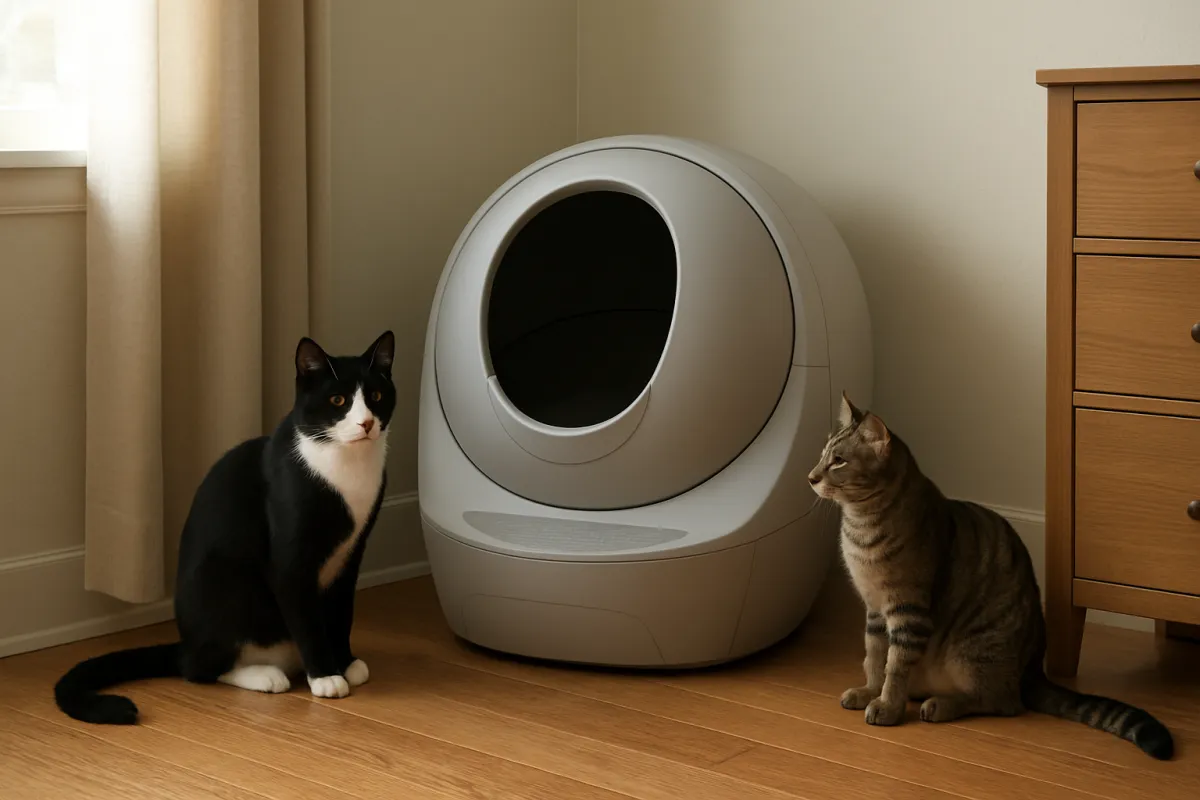
A carefully arranged multi-cat home with a large automatic litter box in a quiet, accessible utility area.
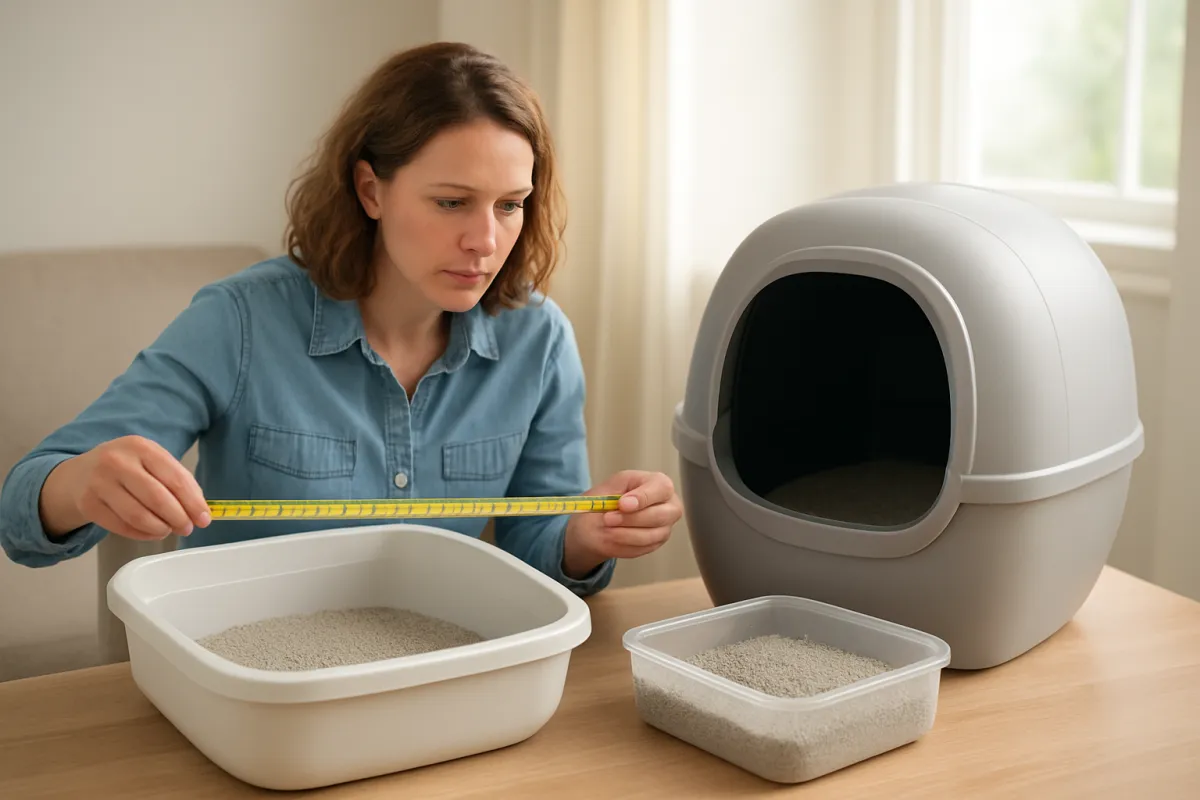
A cat owner comparing an open-top automatic litter box with a covered rotating model beside a measuring tape and a bag of unscented clumping litter.
Evidence basis: This guide combines manufacturer specifications and support information for representative products with feline-environment guidance from the American Animal Hospital Association and the American Association of Feline Practitioners. Product features, compatibility, included accessories, and pricing can change, so verify the exact model and current terms before ordering.
Related reading: what to look for in automatic cat feeders for wet food and more practical advice on LaokPet.
Pingback: Best Stainless Steel Cat Water Fountains: How to Choose a Cleaner, Quieter Option – LaokPet