The best automatic cat feeders for wet food are designed to keep meals chilled, covered, and portioned until the scheduled feeding time. For most cats, choose a refrigerated model for longer gaps, or an ice-pack tray feeder for a small number of meals during the day.
Wet food creates a different buying problem from dry kibble. A hopper-style feeder may dispense dry food effectively but cannot safely store opened wet food for extended periods. This guide explains which features matter, where common designs fall short, and how to match a feeder to your cat’s routine.
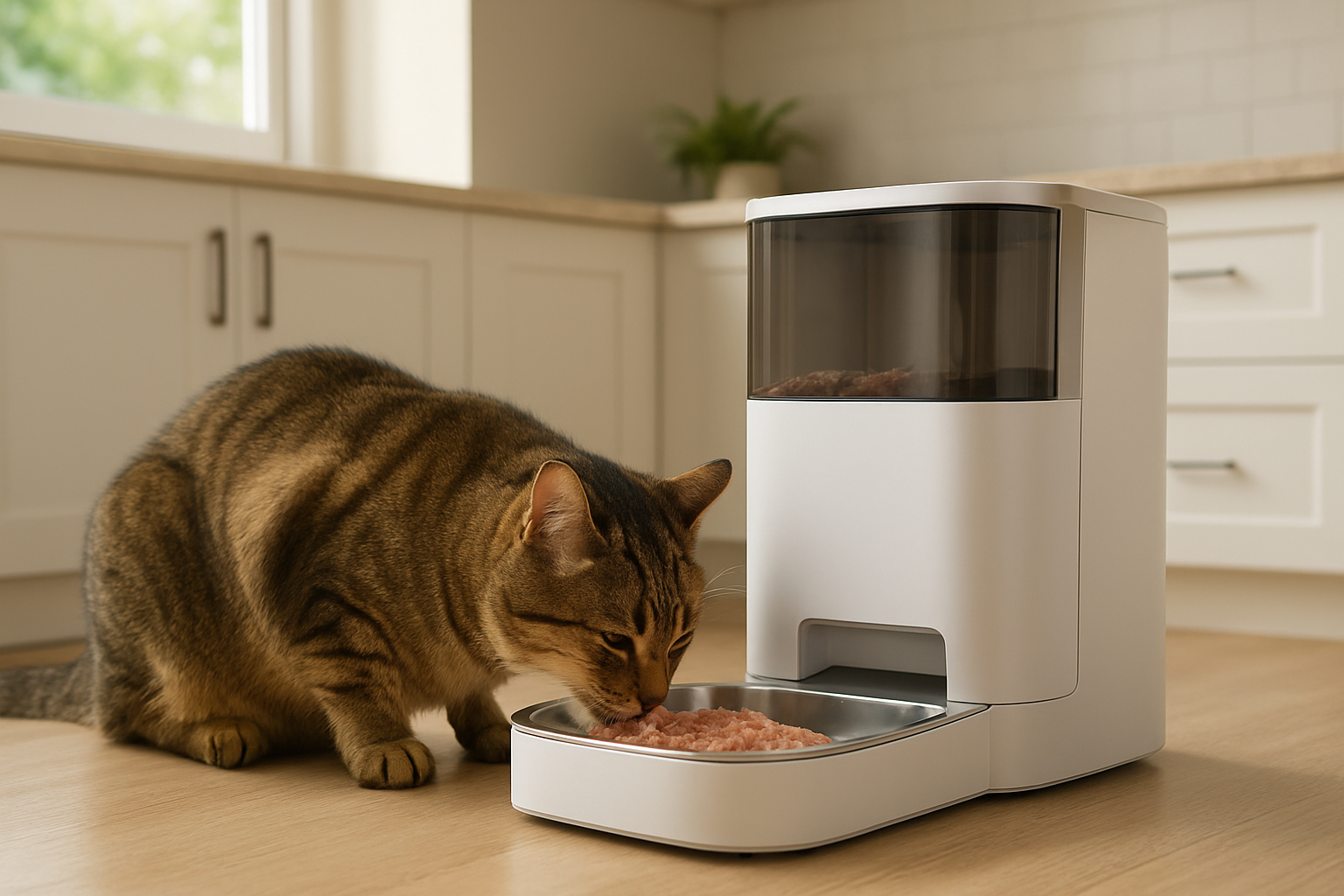
1. Decide how long the food must wait
Your schedule is the first filter. A feeder that works for a four-hour gap may not be suitable for an entire day, especially in a warm room or during summer.
The FDA advises promptly refrigerating or discarding unused canned and pouched pet food, with the refrigerator set at 40°F or below. That makes cooling performance more important than app controls or camera features.
| Your situation | What to look for | Warning sign |
|---|---|---|
| One or two meals while you are at work | Covered rotating tray, frozen ice pack, easy timer | No cooling method or unclear food-safety guidance |
| Several meals across a long day | Active refrigeration, multiple compartments, reliable power | Marketing that says “fresh” without explaining temperature control |
| Overnight feeding | Refrigerated storage, quiet operation, battery or outage backup | A feeder that only delays access but leaves food at room temperature |
| Multiple cats | Enough portions for each cat or microchip-controlled access | One open tray that allows food stealing |
Remember that a feeder is not a substitute for checking your cat. If your cat has a prescribed diet, poor appetite, vomiting, or a condition such as diabetes, ask your veterinarian how meals should be stored, portioned, and monitored.
2. Compare the main wet-food feeder designs
Refrigerated automatic feeders
These use active cooling rather than relying only on a frozen insert. For example, PetSafe describes its FreshFeed as a refrigerated feeder for scheduled, pre-portioned wet and fresh food meals. This design is generally the better fit when food needs to stay chilled for a longer period.
Its limitations are practical: active refrigeration usually means a larger footprint, a higher purchase cost than a simple timer tray, and greater dependence on a power adapter. Check what happens during an outage and whether the unit continues cooling or merely opens a compartment.
Ice-pack tray feeders
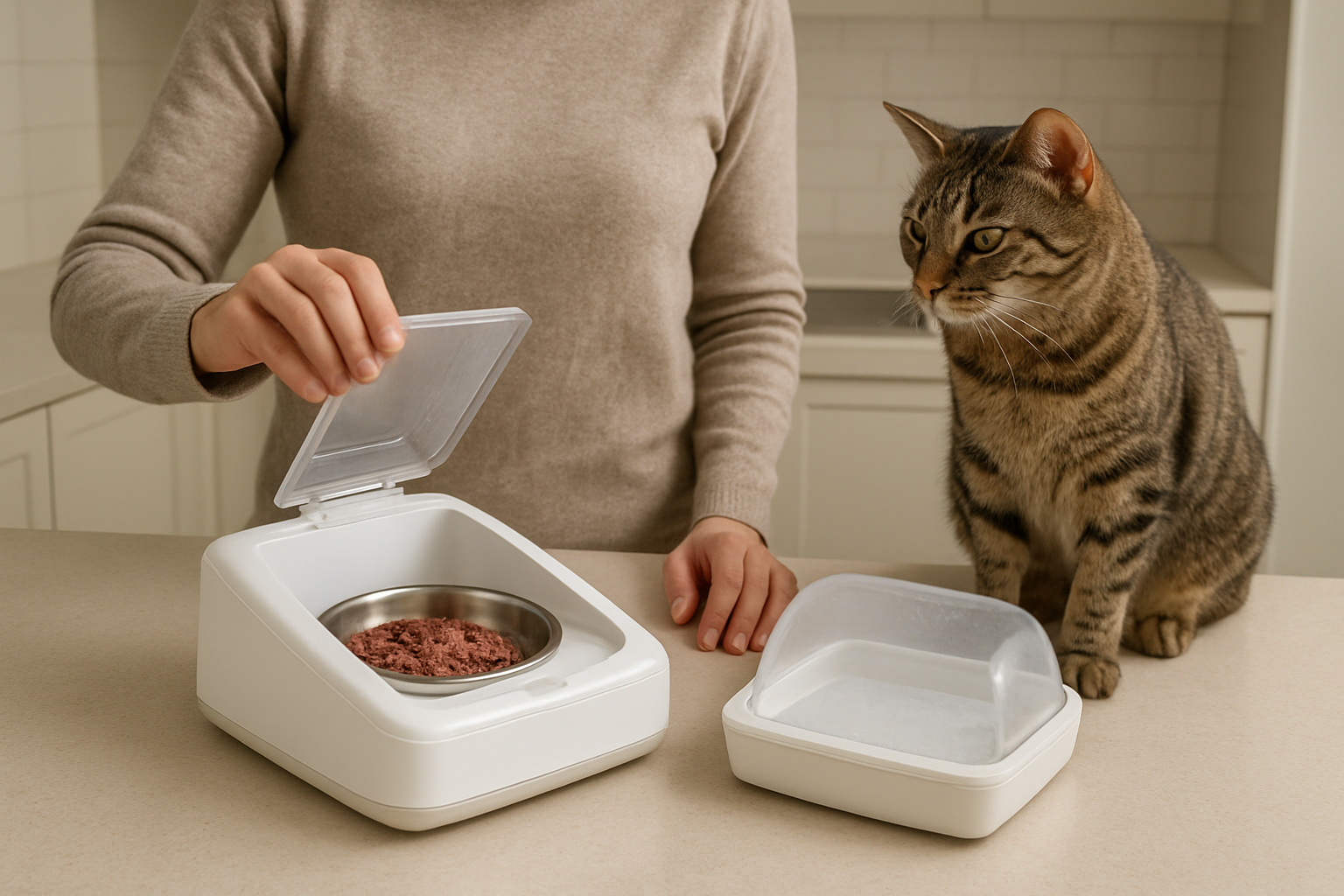
Tray-style feeders place food in covered sections and use one or more frozen packs underneath. They can be straightforward and relatively easy to understand, making them useful for short, predictable gaps.
The cooling period depends on the room, the starting temperature of the food, the ice pack, and how often the lid opens. Do not treat an ice pack as proof that food will remain safely chilled for a full day. The Cat Mate C500 manual, for instance, instructs owners to use freshly opened food and pre-frozen ice packs when feeding wet food.
Portion-controlled feeders with no cooling
These are often excellent for kibble but are usually the wrong choice for opened wet food. Some models advertise compatibility with dry or semi-moist food, which does not necessarily mean they are suitable for canned food.
If the product instructions do not clearly explain wet-food storage and cooling, assume it is intended for dry food only. A feeder that dispenses the right amount at the wrong temperature is not a safe solution.
3. Check capacity and portion control
Capacity should be measured in actual meals, not just the number of compartments. A large tray may still be unsuitable if each section is too small for your cat’s normal serving.
- Measure your cat’s usual wet-food portion before shopping.
- Check whether compartments accept cans, pouches, or only loose food.
- Look for removable trays that can be washed without dismantling the entire unit.
- Confirm whether the timer supports the feeding times you actually need.
- Prefer clear portion settings over vague claims such as “custom feeding.”
Meal frequency and total daily calories still need to come from your cat’s nutritional plan. Cornell’s feline health guidance notes that wet food commonly contains substantial moisture and may be fed instead of, or alongside, dry food, but the food should be nutritionally complete and offered in appropriate amounts.
4. Evaluate hygiene, access, and reliability
Wet food leaves residue that can harden in seams, hinges, and rotating mechanisms. A feeder with impressive electronics but difficult-to-clean parts may become frustrating quickly.
Cleaning questions worth asking
- Can the food tray be removed in seconds?
- Are the food-contact surfaces dishwasher-safe, if that matters to you?
- Will food collect underneath a silicone seal or around the motor?
- Can you clean the unit without exposing the electronics to water?
- Are replacement trays, lids, or ice packs available?
Also inspect the lid and base. A determined cat may push, tip, or chew a lightweight feeder. Test it on a stable, non-slip surface before leaving your cat alone with it.
Battery backup is useful, but it does not automatically solve every failure. A dead battery, disconnected Wi-Fi network, blocked lid, or empty water bowl can still interrupt care. Treat app notifications as a convenience, not as proof that your cat actually ate.
5. Match features to your cat rather than buying the longest feature list
Smart controls can help if you need remote scheduling, feeding alerts, or several daily meals. They are less valuable if your main concern is simple chilled storage and easy cleaning.
For a cat that eats slowly, a covered compartment may help protect the meal from dust or other pets, but it does not guarantee that food remains safe indefinitely. For a food-stealing cat, a feeder with a basic rotating lid may not provide enough access control; a selective-access feeder may be more appropriate, although many such products are designed around an exposed bowl rather than long-term wet-food refrigeration.
If your cat is nervous around motors, test the feeder while you are home. Start with one familiar meal and observe whether the opening sound, movement, or lid changes eating behavior.
6. Avoid these common buying mistakes
- Choosing a dry-food hopper: A hopper is not a wet-food refrigerator.
- Assuming “fresh” means refrigerated: Look for a stated cooling method and operating instructions.
- Ignoring warm-room conditions: Sunlight, heating vents, and hot rooms reduce your margin for error.
- Buying by compartment count alone: Verify the serving size and shape of each section.
- Skipping a trial period: Use the feeder for several days before relying on it during travel.
- Forgetting manual care: An automatic feeder still needs food preparation, cleaning, and checks.
- Overlooking diet labels: Specialty foods may not be complete and balanced; review the label or ask your veterinarian.
7. What if the feeder does not work as expected?
The food smells unusual or looks dry
Do not serve questionable food. Discard it, wash the compartment, and check the cooling method, preparation time, and room temperature. If your cat becomes ill after eating a product, the FDA recommends stopping that food and contacting your veterinarian.
Your cat refuses to use the feeder
Leave the feeder open and inactive near the usual bowl for a few days. Then place familiar food inside without setting the motor or timer. Gradual introduction is safer than switching suddenly before an absence.
The cat opens the lid or tips the unit
Move it to a heavier, level surface and check whether the model has a locking lid or non-slip feet. If the feeder still cannot resist your cat, it is not reliable enough for unsupervised use.
8. A practical buying checklist
- Does the product explicitly support wet food?
- Does it actively refrigerate, use frozen packs, or offer no cooling?
- How many hours must the food wait in your real routine?
- Are portions large enough and adjustable enough?
- Can every food-contact part be cleaned thoroughly?
- What happens during a power or Wi-Fi failure?
- Can your cat tip it, chew it, or force the lid open?
- Can you obtain replacement parts?
- Have you tested it while you are still at home?
9. Next actions before you buy
Write down your cat’s normal portion, feeding times, and the longest unattended gap. Then compare one refrigerated model with one ice-pack tray model using those exact requirements rather than comparing app features first.
Read the manufacturer’s operating manual, not only the product listing. Confirm the cooling instructions, cleaning method, outage behavior, and food compatibility. For broader cat-care planning, you may also find our guides to indoor cat breeds for apartment living and Siamese and Ragdoll cat differences useful.
Final verdict
The best automatic cat feeder for wet food is the one that keeps food appropriately chilled for the actual waiting period, delivers a suitable portion, and can be cleaned and checked without guesswork. Choose active refrigeration for longer unattended periods; choose a covered ice-pack tray for shorter daytime schedules. If a product cannot clearly explain how it manages wet food temperature, treat that uncertainty as a reason to keep looking.
Pingback: How to Make a Cat Carrier More Comfortable: A Practical Step-by-Step Guide – LaokPet
Pingback: Best Automatic Litter Boxes for Multi-Cat Households: What to Buy and What to Avoid – LaokPet