The best scratching post is tall or long enough for your cat to stretch fully, stable enough that it will not wobble, covered in a texture your cat enjoys, and placed where scratching already happens. Start by watching your cat rather than choosing by appearance alone. Notice whether they scratch upright, flat, or both; whether they prefer a rough or soft surface; and which parts of the home they use. Then compare the post’s size, base, material, construction, and location.
Scratching is normal cat behavior. It helps cats stretch, maintain their claws, leave scent and visual marks, and release energy. A suitable scratching post gives this behavior a safe, permitted outlet and can help protect furniture. It is not a guarantee that a cat will use one immediately, so successful selection also depends on placement and gentle introduction.
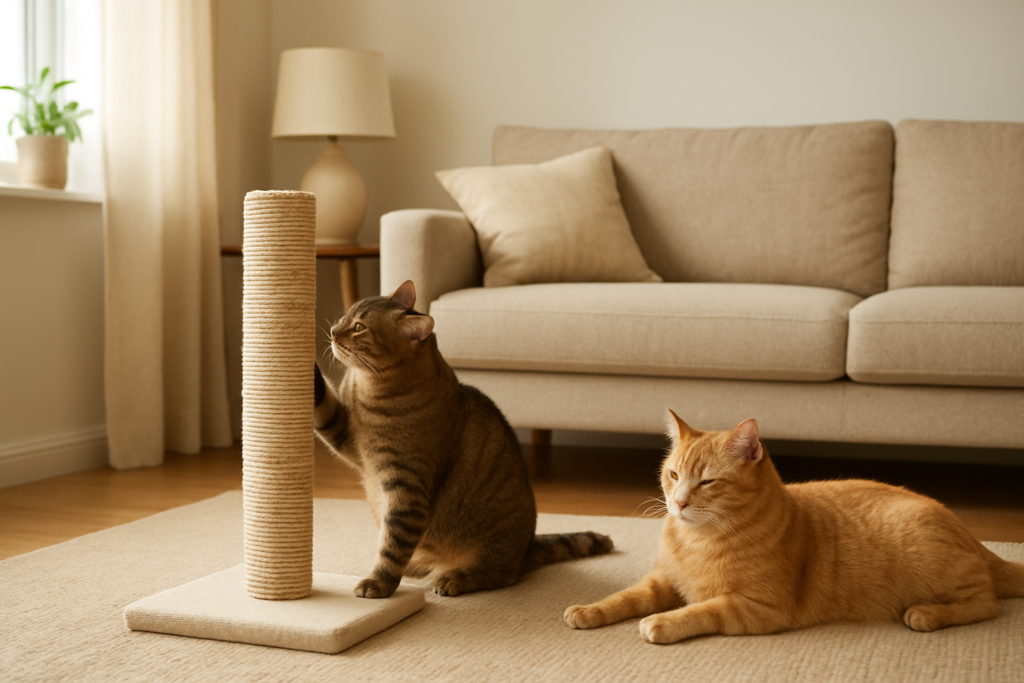
Prepare Before You Compare Scratching Posts
A few minutes of observation can prevent an unsuitable purchase. Look at your cat during ordinary routines, without interrupting or forcing them to scratch.
- Record the direction: Does your cat use the side of a sofa, a door frame, a rug, or the floor? A vertical, horizontal, or angled scratcher may be the closest match.
- Measure the available space: Check the height, width, and floor area where the post will stand. Leave enough room for your cat to approach, turn, and stretch.
- Inspect current targets: Look for scratch marks on furniture and cardboard, fabric, wood, or carpet fibers nearby. These clues can reveal texture preferences.
- Consider the cat: A large, long-bodied, elderly, timid, or highly active cat may need a different design from a small, confident, agile cat.
- Set a practical budget: A simple, sturdy scratcher can be more useful than a large feature that takes up space but does not match your cat’s habits.
Also decide whether you need one scratcher or several. Cats often scratch after waking, during active periods, or near important paths through the home. A single post hidden in a quiet corner may not serve all of those moments.
1. Match the Scratching Post to Your Cat’s Preferred Direction
Direction is one of the most important features. Cats that scratch the side of a sofa or a tall door frame are likely to investigate a vertical post first. Cats that scratch rugs, mats, or the floor may prefer a horizontal board. Some cats switch between both patterns, so a combination of shapes can be useful.
Vertical scratchers
Vertical posts support a long upward stretch and may suit cats that stand on their hind legs while scratching. Check the usable scratching area, not just the total product height. A tall decorative structure may have a short covered section that does not let your cat extend fully.
Horizontal and angled scratchers
Horizontal boards are easy to approach and can suit cats that scratch while crouched. Angled designs offer a middle option and may be useful when a cat shows interest in both floors and furniture sides. They also need a broad enough surface to keep paws from sliding off during use.
Mixed designs
A stable tower with both upright and flat surfaces can serve more than one habit. However, extra features do not automatically make a scratcher better. Prioritize the surfaces your cat is most likely to use, then consider platforms or hiding spaces only if they fit your home safely.
2. Check Height, Surface Area, and Comfort
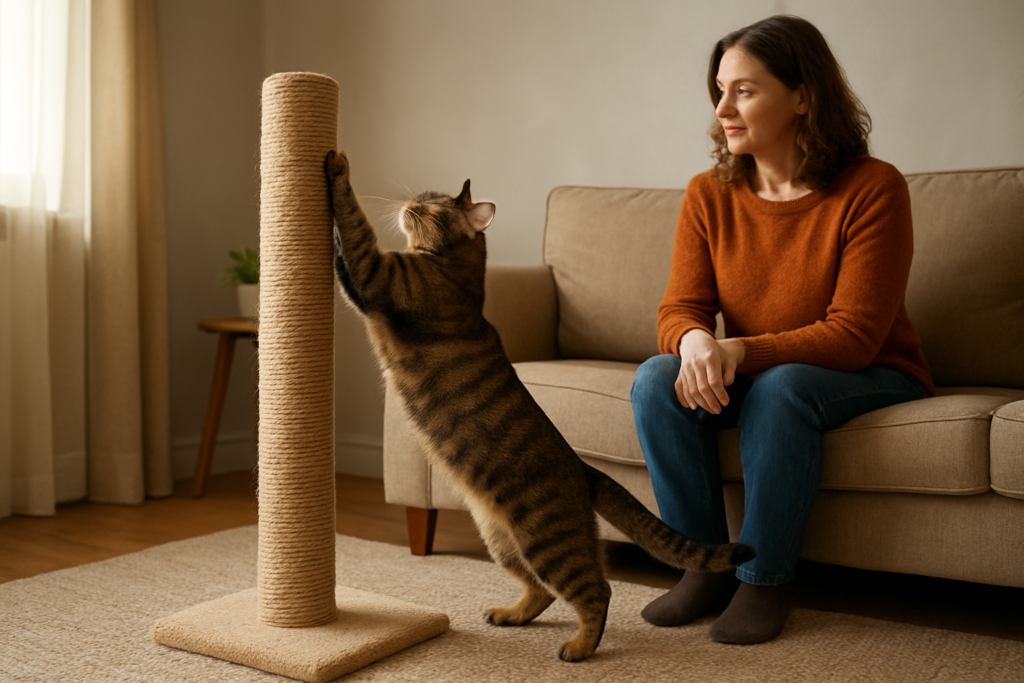
An upright post should let your cat extend through the shoulders and back without crouching. If your cat is still growing, choose a design with enough usable length for their expected adult size. For a horizontal scratcher, look for enough length for the cat to place the front paws comfortably and pull against the material.
Watch for crowded platforms, narrow edges, or surfaces interrupted by large gaps. A cat may avoid a scratcher if the claws catch awkwardly or the body cannot settle into a natural position. The surface should feel secure under the paws rather than soft, loose, or unstable.
| Feature | What to look for | Warning sign |
|---|---|---|
| Height or length | Enough usable area for a comfortable stretch | Your cat must crouch or stop halfway |
| Surface width | Room for the front paws and a natural pulling motion | Paws slip off the sides |
| Base | Wide, heavy, and level on the floor | The post rocks, tips, or shifts |
| Texture | Firm fibers or material that gives useful resistance | Loose strands, sharp edges, or instantly flattened covering |
| Location | Near a known scratching or resting route | The scratcher is hidden and difficult to reach |
3. Compare Materials and Textures
Texture affects whether a cat finds a scratching post satisfying. Common options include sisal-like rope or fabric, corrugated cardboard, carpet-like covering, and plain wood. Cats can have strong individual preferences, so there is no single material that suits every household.
- Rope or woven fiber: Often provides firm resistance and a clear vertical surface. Examine the covering for secure attachment and loose ends.
- Cardboard: Can provide a shreddable, horizontal texture. It may create small pieces, so place it where the floor can be cleaned and inspect it as it wears.
- Carpet-like fabric: May feel familiar, but avoid designs that closely resemble rugs or furniture if you want to make household rules clearer.
- Wood: Some cats enjoy a firm, natural-feeling surface. It should be smooth enough to avoid splinters and free from exposed staples or sharp fasteners.
Do not judge a texture only by touching it with your hand. A cat’s claws need material that offers controlled resistance. Covering that unravels quickly can become a hazard, while a very smooth surface may not provide the feedback your cat wants. When uncertain, offer two safe textures and observe which one receives more use.
4. Test Stability and Construction
Stability is essential. A post that moves during scratching can frighten a cat and may cause them to return to the sofa. Before using it, place it on a level surface and apply firm pressure from several directions. It should remain upright without sliding or rocking.
For a flat scratcher, check that it does not curl, buckle, or skid. For a tall post or tower, inspect the connection between the scratching column and its base. Platforms should be secure, and any hanging parts should not create a loop or tangled area that could catch a paw, collar, or neck.
Recheck the construction regularly. Screws, joints, and coverings can loosen with use. Replace or repair the item when it becomes unstable, exposes sharp components, or has damaged material that your cat could swallow.
5. Choose a Safe and Useful Location
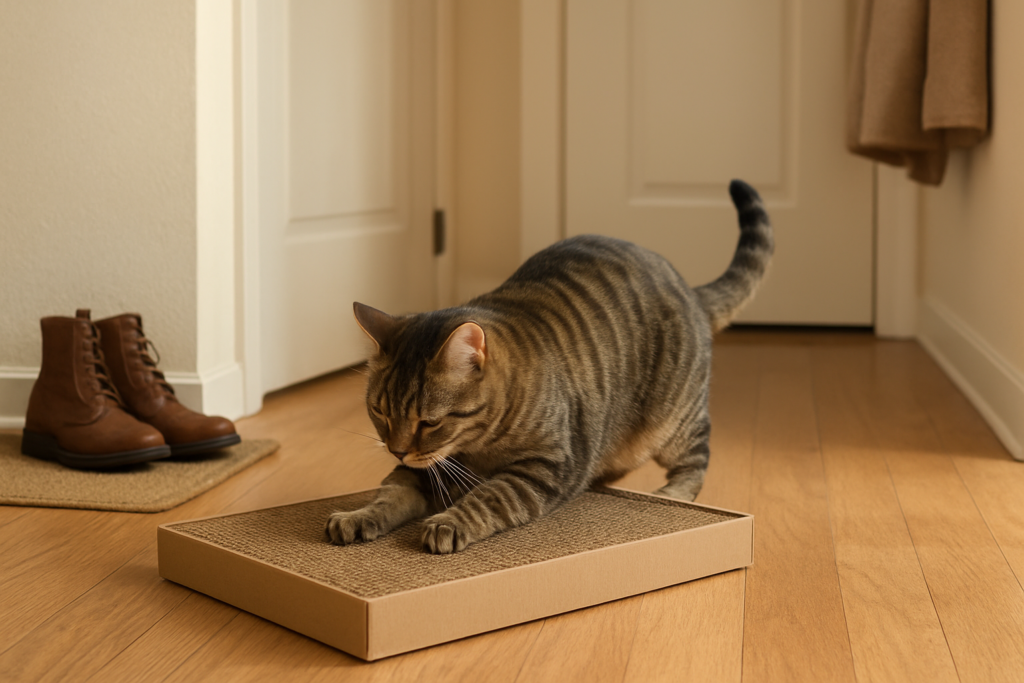
Placement often matters as much as the post itself. Put the first scratcher beside the furniture, rug, or doorway your cat already targets. Once the new habit is established, you can gradually move it a small distance at a time if needed.
Other useful locations include:
- near a favorite sleeping area, because cats often stretch after waking;
- along a regular route between rooms;
- near a doorway or social area where the cat spends time;
- in a calm spot where the cat can scratch without being startled;
- near, but not blocking, food, water, litter, or escape routes.
Keep the base on a level, non-slippery surface. Make sure the cat can approach and leave freely. Do not place a tall scratcher where it could fall onto a staircase, heater, glass surface, or other dangerous area. If a cat tree includes elevated platforms, check that it cannot tip and that the surrounding landing space is clear.
6. Introduce the Scratching Post Without Pressure
Place the scratcher and allow your cat to investigate at their own pace. You can make it interesting by playing nearby with a toy or by offering calm praise when the cat approaches. If your cat uses it, reward the behavior with attention or a small treat if treats are already part of their normal routine.
Avoid grabbing the cat’s paws and rubbing them on the surface. This can create discomfort and make the post less appealing. Avoid forcing the cat onto a tower or using strong scents that may irritate them or make the item unpleasant. If catnip is appropriate for your individual cat, a small amount may attract interest, but it is not necessary and some cats do not respond to it.
Protect a tempting piece of furniture temporarily with a cover or by changing access, while keeping the suitable scratcher close by. Reward the behavior you want rather than punishing scratching. Punishment can increase stress and does not teach the cat which surface is acceptable.
Use This Scratching Post Checklist
- ☐ The design matches my cat’s vertical, horizontal, angled, or mixed habit.
- ☐ The usable surface allows a comfortable stretch and natural paw placement.
- ☐ The base stays stable when pushed and pulled.
- ☐ The texture offers resistance without loose, sharp, or unsafe parts.
- ☐ The size fits the room while leaving a clear approach and exit.
- ☐ The post can be inspected, cleaned, repaired, or replaced as it wears.
- ☐ I have placed it near a current scratching location or favorite route.
- ☐ I will introduce it calmly and avoid forcing my cat to use it.
Common Scratching Post Mistakes
Choosing style over function
A scratcher may match your decor but fail to match the cat’s movement. Start with scratching direction, stable construction, and usable surface area. Appearance should come after those needs.
Buying a post that is too short
If the cat cannot stretch, the item may not replace a full-height furniture target. Measure the cat’s body in a relaxed stretch when possible and compare that with the actual scratching area.
Putting it in an isolated corner
A quiet corner can seem ideal to people but unhelpful to a cat that scratches in a busy living area. Begin where the behavior already occurs, then adjust gradually.
Ignoring movement
Even a strong material will fail if the whole post slides or tips. Stability should be checked before the cat climbs or pulls on it.
Removing it as soon as it looks worn
Wear can show that the cat is using the surface. Remove it when the material becomes unsafe, but consider replacing it with a similar texture and shape so the preferred habit can continue.
Troubleshoot If Your Cat Does Not Use It
First, check the simple factors: location, stability, direction, size, and texture. Move the scratcher beside the area your cat targets. If it is vertical, try placing it directly against the furniture side temporarily. If it is flat, test it near the rug or mat the cat prefers.
If the cat still ignores it, offer a different orientation or material rather than adding pressure. Keep the new option available for observation and avoid presenting too many changes at once. A cat may use a scratcher at a particular time of day, so watch quietly for several days rather than judging after one brief introduction.
If scratching suddenly changes, becomes unusually intense, or occurs with signs of pain, limping, paw sensitivity, or difficulty walking, stop assuming it is only a preference issue. Contact a veterinarian for advice. A professional can help assess possible claw, paw, skin, joint, or stress-related concerns. Seek prompt veterinary guidance for bleeding, a trapped claw, a serious injury, or severe distress.
Advanced Practical Tips for Multi-Cat Homes
In a home with several cats, one shared scratcher may not be enough. Cats can have different preferences, and one cat may avoid an item that another cat guards. Offer separate options in different areas, especially along important routes and near individual resting places.
Watch how each cat approaches the scratcher. A timid cat may need a low-pressure location away from busy traffic, while a confident cat may prefer a visible social area. Keep escape paths open, and do not arrange resources in a way that forces one cat to pass another to reach them.
You can also combine a tall post with a flat scratcher. This gives cats a choice without requiring one product to satisfy every habit. Keep a simple note of which surfaces are used and where; this makes future replacements more precise.
What to Do After You Choose
Once the scratching post is in place, inspect it during the first few uses. Confirm that it stays stable, the cat’s claws do not catch in loose material, and the post does not create a trip or climbing hazard. Clean surrounding debris according to the material’s care needs, and keep cardboard pieces or fibers away from areas where children or other pets may ingest them.
Observe rather than constantly repositioning the item. If it is used, leave it in place long enough to become part of the cat’s routine. When it wears out, select a replacement with the same successful direction, height, and texture whenever possible.
For more practical comparisons, browse LaokPet’s pet gear reviews. For broader routines and everyday guidance, explore the pet care guides.
Learning how to choose the right scratching post for a cat is mainly an exercise in matching the cat, not the catalog. Observe the behavior, choose a comfortable and stable surface, place it where scratching already makes sense, and adjust calmly when the first option is not a good fit.