The best puppy toys for teething and chewing are size-appropriate, slightly flexible, easy to inspect, and suited to your puppy’s chewing style. For most puppies, start with a soft puppy rubber toy that can be chilled or filled, then add one supervised chew and one interactive toy for variety.
Teething is normal, but it can turn into damaged furniture, nipping, or swallowed toy pieces if your puppy has no suitable outlet. This guide ranks practical toy types rather than promising that one product will suit every dog. It also explains how to check hardness, size, wear, and supervision needs before you buy.

1. Use these criteria before comparing puppy chew toys
A good teething toy should satisfy several requirements at the same time. It needs to be large enough to reduce choking risk, soft enough not to damage developing teeth, and durable enough for the individual puppy using it.
- Flexibility: You should usually be able to indent the material with a fingernail or bend it slightly. Veterinary guidance commonly warns against objects that are extremely hard because they may fracture teeth. VCA’s puppy teething guidance explains this distinction in practical terms.
- Correct size: A toy should not be small enough to fit entirely in your puppy’s mouth. Recheck the size as your puppy grows.
- Simple construction: Avoid loose eyes, ribbons, thin plastic parts, exposed squeakers, and seams that are already opening.
- Supervision: No chew toy is completely risk-free. Remove it if your puppy breaks off pieces, swallows material, or begins biting it with excessive force.
- Purpose: Decide whether you need gum relief, quiet enrichment, training, tug play, or a longer-lasting chew. A toy designed for one job may be poor at another.
Most puppies begin losing baby teeth at roughly three to four months, with adult teeth generally emerging over the following months. The exact timing varies, so age labels should be treated as guidance rather than a substitute for watching your puppy’s behavior and mouth.
2. The best puppy toys for teething and chewing, ranked
These rankings are based on versatility, safety features, ease of supervision, and usefulness during the teething period. They are not based on personal testing, ratings, or a claim that any product is safe for every dog.
1. Chilled puppy rubber toy — Best overall
A soft puppy rubber toy with a hollow center is the most useful starting point for many homes. You can offer it plain, spread a small amount of suitable food inside, or chill it to provide a cold surface for sore gums. KONG describes its puppy rubber range as designed for young dogs and suitable for freezing when filled. The manufacturer’s sizing and life-stage guide is useful when comparing versions.
Best for: Everyday chewing, crate settling, and puppies that need a reusable activity.
Limitations: Very determined chewers may still damage soft rubber. Food-filled versions also add calories and may make a mess.
2. Puppy-specific flexible chew bone — Best for focused gnawing
A puppy-labeled flexible chew bone gives your dog a recognizable object for sustained chewing. Choose the puppy or teething version, not an adult-strength or power-chewer version, because a harder material may be unsuitable for developing teeth.
Nylabone, for example, separates its chew products by life stage and chewing strength, and advises owners to supervise puppies for large pieces. Its use guidelines also recommend replacing a chew when it becomes too small or develops dangerous edges.
Best for: Puppies that prefer a firm, bone-shaped object.
Limitations: “Puppy” does not mean indestructible. Inspect it often and stop using it if large flakes, sharp edges, or missing sections appear.
3. Freezer-friendly teething ring — Best for sore gums
A soft teething ring or textured rubber ring can be chilled in the refrigerator or freezer, depending on the manufacturer’s instructions. The cold surface may make chewing more comfortable, while the shape gives your puppy several angles to hold.
Look for a ring that is thick enough not to collapse into the throat and has no narrow sections your puppy can bite through. A chilled toy should not be offered if freezing makes the material brittle.
Best for: Puppies that seek cold surfaces or chew more intensely during teething episodes.
Limitations: Some puppies lose interest quickly, and frozen toys can become too hard if the material is not designed for chilling.
4. Treat-dispensing puppy puzzle toy — Best for chewing plus mental activity
A treat-dispensing toy turns chewing into a slower food activity. It can be especially useful when your puppy is restless, needs a calm activity, or is learning to settle. Start with an easy filling so the puppy succeeds quickly, then increase the challenge gradually.
Use a portion of your puppy’s normal daily food rather than adding unlimited treats. VCA notes that food-filled toys can provide enrichment but should be supervised, particularly while a dog is learning how to use them.
Best for: Busy puppies, crate routines, and short periods of quiet enrichment.
Limitations: It is not necessarily a dedicated teething toy, and food residue can become unhygienic if the toy is not cleaned properly.
5. Soft puppy tug toy — Best for interactive play
A soft fleece or fabric tug toy can redirect biting onto an appropriate object and give you a structured way to play together. Use gentle movements during teething rather than forceful pulling, twisting, or lifting.
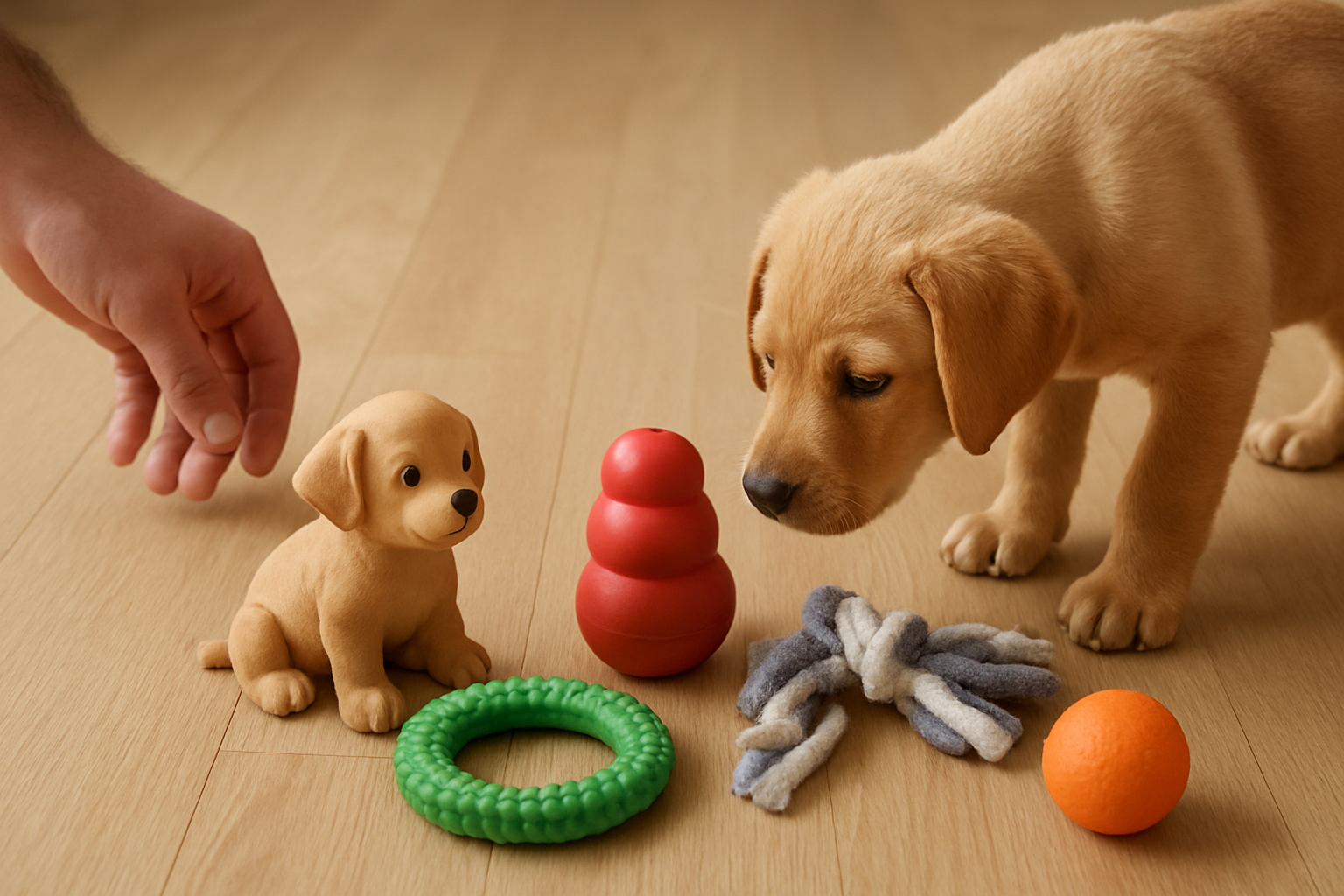
Keep tug toys for supervised play. They are not a good choice for unsupervised chewing because loose fibers, frayed seams, or swallowed fabric can create problems.
Best for: Puppies that want social play more than solitary chewing.
Limitations: It may be destroyed quickly by a puppy that shreds fabric, and it does not provide the same gum pressure as a rubber chew.
6. Soft puppy fetch ball — Best for redirecting mouthy behavior
A soft, correctly sized ball can help you replace hand-biting with a game of fetch or carry. Choose a ball that is too large to swallow and avoid leaving it available for obsessive chewing, especially if its surface becomes rough or damaged.
Best for: Active puppies that need movement and a clear alternative to grabbing hands or clothing.
Limitations: A ball is primarily a play toy, not a long-duration chew. Never use a small ball simply because it is marketed for puppies.
7. Puppy dental chew or edible teething treat — Best for occasional edible chewing
Edible chews can be useful for puppies that prefer food-based rewards, but they must be matched to the puppy’s age, size, chewing ability, and diet. The Veterinary Oral Health Council maintains a list of products that have earned its Seal of Acceptance for specific dental claims; its list includes puppy dental chews, but acceptance does not replace size guidance or supervision.
Best for: Occasional chewing when you want an edible option.
Limitations: Edible chews can contribute calories, cause stomach upset, or become a choking risk if swallowed too quickly. Bones, antlers, and very hard chews are poor choices for teething puppies.
3. Compare the main toy options at a glance
Use this table to match the toy type to the job you want it to perform.
| Toy type | What to look for | Best use | Warning sign |
|---|---|---|---|
| Soft puppy rubber | Flexible material, puppy sizing, smooth edges | Daily chewing and chilling | Chunks missing or rubber splitting |
| Flexible chew bone | Puppy strength rating and suitable size | Focused gnawing | Sharp edges, large flakes, or reduced size |
| Teething ring | Freezer-safe material and sturdy shape | Sore gums | Material becomes brittle when cold |
| Food puzzle | Easy-to-clean design and adjustable difficulty | Quiet enrichment | Puppy bites off pieces to reach food |
| Fabric tug | Strong seams and soft, thick fibers | Interactive play | Fraying or swallowed threads |
| Edible chew | Correct weight range and puppy suitability | Occasional food-based chewing | Swallowed without chewing or digestive upset |
4. How to introduce a teething toy safely
- Offer the toy when your puppy is calm, rather than waiting until the puppy is already biting intensely.
- Move it gently if your puppy ignores it, and praise engagement without forcing the toy into the mouth.
- Redirect hand, clothing, and furniture biting to the toy. Reward the choice with calm praise or a small training treat.
- Supervise every new toy until you know how your puppy uses it.
- Rotate a few toys instead of leaving every toy out at once. This keeps familiar items more interesting and makes inspection easier.
Never allow children to take a chew from a puppy’s mouth. Teach a calm “drop” exchange using a treat or another toy, and involve an adult whenever high-value chews are present.
5. Common mistakes when buying puppy chew toys
- Choosing by age alone: A six-month-old small-breed puppy and a six-month-old large-breed puppy may need very different dimensions.
- Buying the hardest toy available: Durability is not the same as dental safety.
- Assuming “natural” means risk-free: Bones, antlers, hooves, and rawhide can still fracture teeth or cause choking and obstruction risks.
- Leaving damaged toys in rotation: Replace a toy as soon as pieces, stuffing, fibers, or sharp edges become available.
- Using food toys without adjusting meals: Count fillings and edible chews as part of the daily diet.
- Giving too many toys at once: A smaller rotation makes it easier to see which toys your puppy destroys or ignores.
6. What if your puppy still chews furniture or hands?
Increase management before buying more toys. Use gates, remove shoes and children’s objects, keep tempting furniture out of reach where possible, and offer a toy before your puppy becomes overtired. Puppies often chew more when they need sleep, exercise, or a brief break from stimulation.
If your puppy is swallowing toy pieces, has repeated vomiting, seems painful, cannot keep food down, is gagging, or may have swallowed a large object, contact a veterinarian promptly. Do not wait for symptoms to become severe after a suspected obstruction.
For persistent hand-biting, fear, guarding, or aggressive behavior around toys, ask your veterinarian or a qualified reward-based behavior professional for individualized help. The American Kennel Club’s teething guidance also recommends redirecting biting toward appropriate toys and supervising play.
7. A simple buying checklist
- Confirm the toy is labeled for puppies or developing teeth.
- Choose a size that cannot fit entirely inside your puppy’s mouth.
- Check whether the material bends or indents slightly.
- Avoid detachable parts, sharp edges, and loose fibers.
- Buy one everyday rubber toy, one interactive toy, and one optional edible or chilled option.
- Inspect every toy before and after use.
- Keep the manufacturer’s size, age, and supervision instructions.
Final recommendation by scenario
For most puppies, begin with a soft, puppy-sized rubber toy that can be chilled or filled. Add a flexible puppy chew bone if your dog prefers sustained gnawing, a food puzzle if settling is difficult, and a soft tug toy if play with you is the best way to redirect nipping.
The best puppy toys for teething and chewing are not necessarily the toughest toys. They are the toys your puppy can use without damaging developing teeth, swallowing pieces, or turning supervised play into an unsafe chewing session. Match the toy to the puppy, inspect it frequently, and replace it before it becomes a hazard.
For more practical dog-care guidance, see LaokPet’s step-by-step dog nail-trimming guide, everyday dog leash guide, and Purina Pro Plan dog food review.