The best puppy playpen for house training is secure, easy to clean, tall enough to prevent climbing, and large enough for a separate rest and activity area. A playpen can reduce unsupervised wandering, but it does not replace scheduled bathroom trips, close supervision, or crate training when appropriate.
This guide explains how to choose a puppy pen for your home, how to arrange it for training, and which buying decisions are most likely to create accidents or safety problems. The recommendations are based on established house-training guidance from the American Kennel Club, including its advice on supervision, exercise pens, crates, and puppy-safe confinement.
1. Decide whether a playpen fits your house-training plan
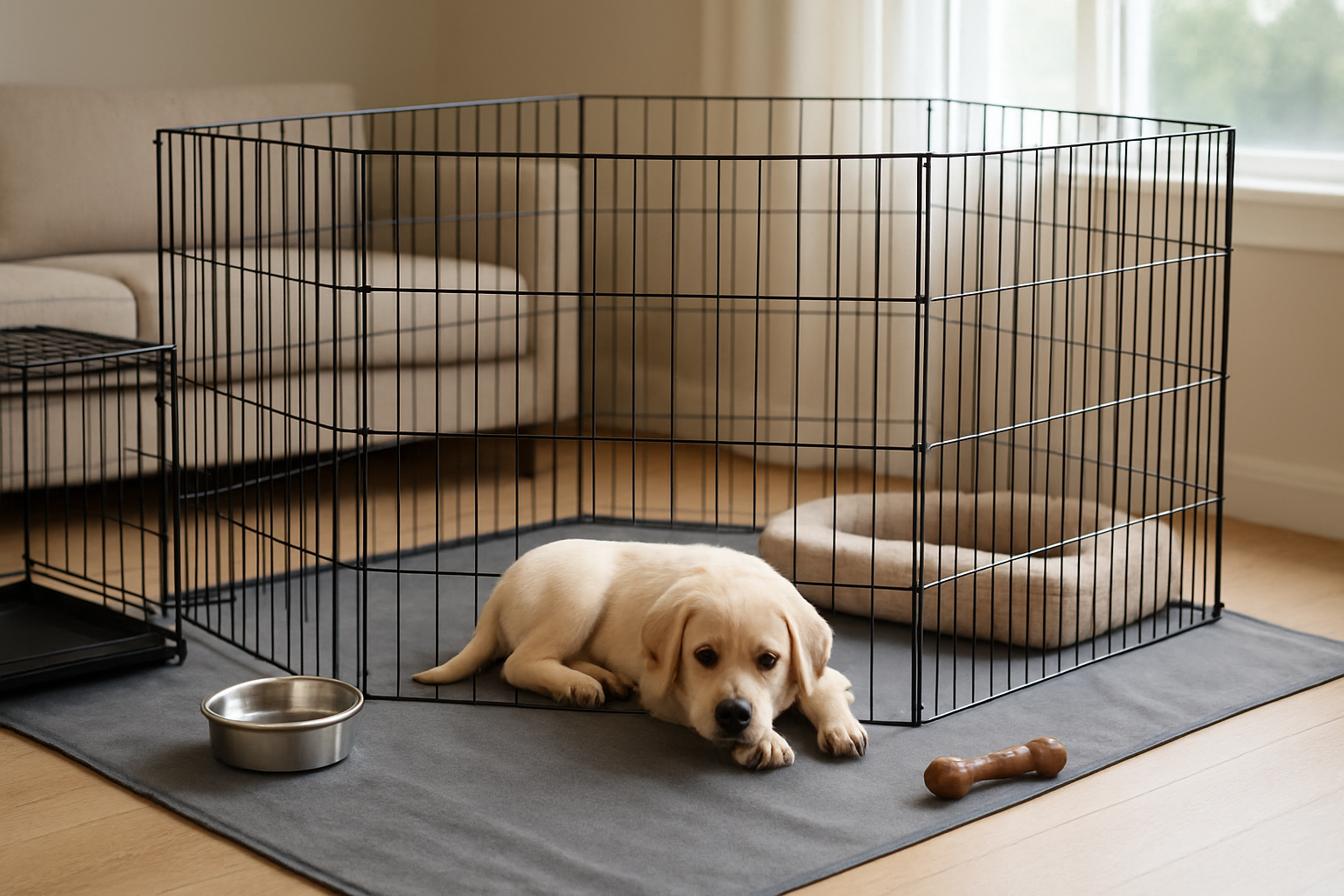
A playpen is most useful when you need to limit a puppy’s access to the home while still allowing more movement than a crate. The AKC describes an exercise pen as a practical option for contained playtime and a puppy-proofed area when direct supervision is not possible. Its puppy-training guidance also emphasizes limiting opportunities for accidents while teaching appropriate behavior.
However, a pen is not automatically a toilet-training device. If it is oversized or left set up with bedding and pee pads indefinitely, your puppy may learn that eliminating indoors is acceptable. Decide first whether your goal is outdoor house training, a temporary indoor toilet option, or a flexible arrangement for a puppy who cannot yet hold their bladder for long periods.
- For outdoor house training: keep the pen compact and use it between scheduled trips outside.
- For longer unavoidable absences: use a puppy-proofed area only when necessary, and arrange bathroom breaks, a sitter, or other care whenever possible.
- For apartment living: a pen can support supervision, but it should work alongside a clear outdoor or indoor elimination routine.
2. Choose the right playpen type and material
Different pen styles solve different problems. Metal exercise pens are usually a strong choice for determined puppies because they provide ventilation and are less likely to retain odors. Plastic panels can be easier to wipe down and may suit puppies who dislike the visual openness of metal bars. Fabric pens are lightweight, but they are more vulnerable to chewing, digging, and collapse.
Look beyond appearance. Check how the panels connect, whether the door latches securely, whether the base can slide across the floor, and whether your puppy can get a paw or jaw caught in the structure.
Use these criteria when comparing puppy playpens for house training:
| What to look for | Why it matters | Warning sign |
|---|---|---|
| Stable panels and wide feet | Reduces tipping and movement during play | The pen shifts whenever the puppy jumps |
| Secure, easy-to-operate latch | Prevents escapes while allowing quick bathroom trips | The door can be nudged open or has a loose hinge |
| Washable surface or compatible floor mat | Makes accidents easier to clean thoroughly | Fabric, seams, or untreated wood absorb urine |
| Appropriate panel spacing | Helps prevent trapped paws, heads, or collars | Your puppy can push its head through an opening |
| Height matched to the puppy | Limits climbing and jumping out | The puppy can place front paws over the top |
3. Size the pen for management, not maximum freedom
A common mistake is buying the largest pen available and filling it with bedding, food, toys, and a toilet area. That may be useful for a specific indoor-potty arrangement, but it can undermine outdoor training by giving the puppy enough space to sleep in one corner and eliminate in another.
For a house-training setup, aim for enough room to stand, turn, stretch, play briefly, and rest comfortably without creating unnecessary unused floor space. The correct size will change as your puppy grows, so an adjustable pen or modular panels may provide better long-term value than a fixed small enclosure.
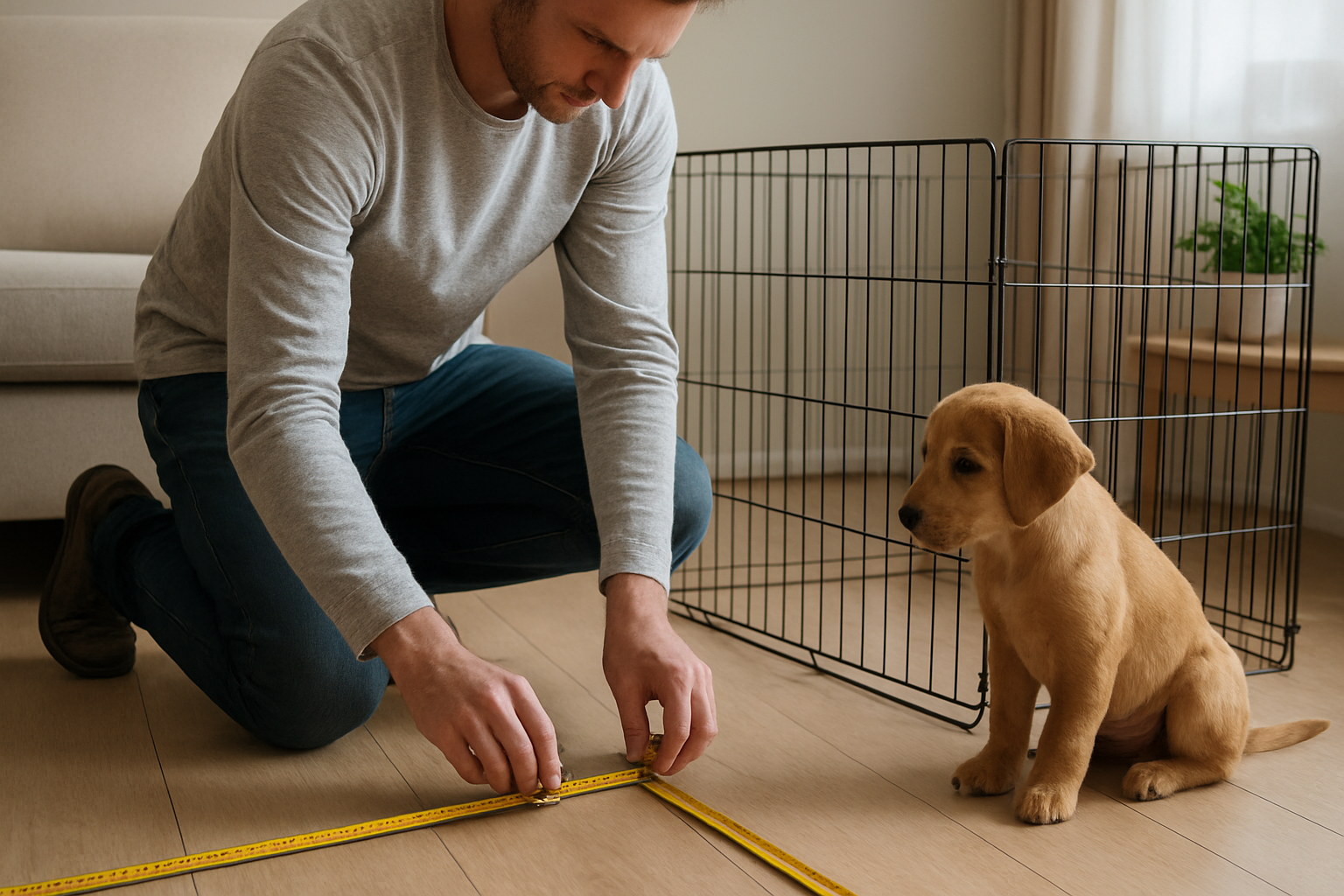
Measure the usable interior rather than relying only on the manufacturer’s advertised dimensions. Include the space taken by a crate, water bowl, bed, and any floor protector. If the pen will sit near furniture, doors, or heating equipment, measure the entire footprint before buying.
4. Build a layout that supports better habits
Placement matters as much as the pen itself. Put it in a part of the home where you can see and hear your puppy, away from drafts, direct heat, household chemicals, dangling cords, and busy walkways. A visible location makes it easier to notice restlessness, sniffing, circling, or sudden pauses that may precede an accident.
A practical arrangement may include an open crate or bed at one end, water positioned so it cannot be easily tipped, and a small selection of safe chew toys. Keep the floor simple enough to inspect and clean. Avoid loose blankets, pads, or mats that your puppy repeatedly shreds or soils.
- Use a crate inside or beside the pen if your puppy is comfortable with crate training.
- Keep food away from the sleeping area and remove leftovers after meals.
- Rotate toys rather than filling the pen with items that are difficult to inspect.
- Secure the pen to a wall or heavy furniture if your puppy can push it across the floor.
5. Use the playpen without replacing supervision
House training depends on scheduling and supervision. The AKC recommends watching a puppy closely when it is loose and using a safe enclosed area when you cannot supervise. Its guidance on potty training in apartments also distinguishes between using a playpen while you are home and using a crate or another safe arrangement for rest and absences.
Take your puppy outside after waking, eating, drinking heavily, playing, and exciting interactions. Reward outdoor elimination promptly. If an accident occurs, clean the area with a suitable enzymatic cleaner and adjust the schedule rather than punishing the puppy.
A pen should not become an all-day substitute for exercise, training, social contact, or bathroom breaks. If your puppy shows distress, persistent barking, frantic climbing, heavy drooling, or repeated attempts to escape, make the area safer and consult a qualified trainer or veterinarian. The AKC’s crate-training guidance similarly warns against confinement that causes panic or exceeds what a puppy can comfortably manage.
6. Compare playpens with crates and baby gates
No single confinement tool is best for every puppy. A crate usually provides a smaller resting space and can support house training when used correctly. A playpen offers more movement and may be preferable for supervised play or for puppies who need a larger puppy-proofed area. A baby gate can be useful when you want to restrict access to a room rather than create a freestanding enclosure.
Many households use these tools together: a crate for rest, a pen for supervised activity, and gates for gradual access to the wider home. Introduce each option positively with treats, meals, and calm time. Do not use confinement as punishment.
7. Avoid these common buying and training mistakes
- Choosing based only on price: weak latches and unstable panels can create escape and injury risks.
- Ignoring the adult size of the dog: a pen suitable for a small puppy may become easy to climb later.
- Using absorbent flooring: urine can remain in seams and encourage repeat marking.
- Leaving collars or harnesses on unattended: they can catch on pen components.
- Putting the pen far from people: isolation makes supervision and early accident detection harder.
- Expecting the pen to teach the behavior: it manages access; your schedule and rewards teach elimination habits.
8. Quick checklist before you buy
- Can the puppy stand, turn, rest, and move comfortably inside?
- Is the pen tall and stable enough for the puppy’s expected growth?
- Does the door latch securely but open quickly for bathroom trips?
- Can every surface be wiped, washed, or replaced?
- Are the gaps too narrow for trapped paws or wide enough for a head to pass through?
- Will the pen fit safely in a visible, temperature-controlled area?
- Do you have a plan for nighttime, work hours, exercise, and bathroom breaks?
9. What if the setup is not working?
Your puppy keeps eliminating in the pen
Reduce the available space if it is unnecessarily large, increase the frequency of outdoor trips, and review whether the puppy is being left too long. If accidents are sudden, frequent, painful, or accompanied by changes in drinking or behavior, contact a veterinarian.
Your puppy climbs or pushes the pen
Increase stability, remove footholds such as large beds near the wall, and consider taller panels or a puppy-proofed gated room. Do not add unsafe weights or improvised ties that could fall or trap the puppy.
Your puppy panics inside
Shorten confinement periods and rebuild the association with treats, meals, and calm interaction. For persistent distress, seek help from a qualified positive-reinforcement trainer or veterinary behavior professional.
10. Next actions before ordering
Measure the intended location, estimate your puppy’s adult size, and decide whether you are training for outdoor elimination or using an indoor backup. Then compare pen stability, latch quality, cleanability, height, and available space before considering decorative features.
For related puppy-management advice, see LaokPet’s guide on preventing separation anxiety in a puppy. If your dog is a powerful chewer, you may also find its guide to durable chew toys useful when choosing safe items for supervised pen time.
Bottom line: The best puppy playpens for house training are not necessarily the biggest or most feature-heavy. Choose a secure, washable, appropriately sized enclosure, use it with a consistent bathroom schedule, and adjust the setup as your puppy grows. A pen is a management aid; successful house training still depends on timing, supervision, rewards, and realistic expectations.