To teach a dog to settle on a mat, reward the dog for choosing the mat, lying down, relaxing, and staying there while distractions increase slowly. Begin in a quiet room with a comfortable mat and small, appealing treats. Keep sessions short, use a calm voice, and let your dog leave when you release them. The goal is not to force stillness. It is to build a safe habit of resting in one useful place.
A reliable mat settle can help during meals, remote work, visitors, grooming preparation, or other everyday moments. It is also a practical way to give your dog clear information: this is where you can relax, and calm behavior will be noticed.
What “settle on a mat” means
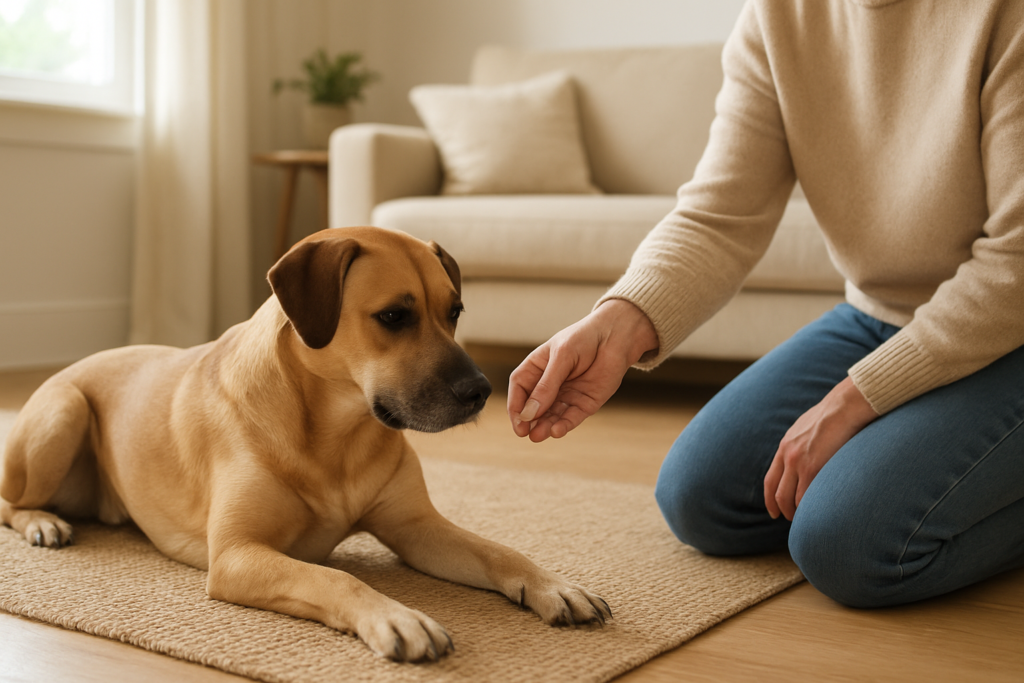
A settle is more than touching a mat with one paw. In a finished behavior, your dog walks to the mat, lies down or adopts a comfortable resting position, and remains there with a soft body until you give a release cue. Some dogs may rest their head, sigh, or shift position. Perfect stillness is not necessary.
Choose a simple release word such as “free,” “okay,” or “all done.” Use the same word every time. The release cue tells your dog when the exercise is over, so they do not have to guess whether standing up will be rewarded.
Prepare for the first training session
Choose the right mat and location
Use a mat that is comfortable, stable, and large enough for your dog to lie on without hanging off awkwardly. A nonslip surface can make the exercise easier, especially on smooth floors. Avoid a mat that your dog already guards, chews intensely, or dislikes touching.
Start in a quiet part of the home. There should be enough room for you to move naturally, but not so much activity that your dog cannot concentrate. Place the mat near you rather than sending your dog across the house at the beginning.
Prepare rewards and a release cue
Use small treats that your dog enjoys and can eat easily. You can also use part of your dog’s usual daily food if it works as a reward. Keep the pieces small so you can reinforce many calm choices without making the session a large meal.
Have the treats ready before you place the mat. A quiet marker such as “yes” can tell your dog exactly which behavior earned the reward. If a marker makes your dog excited, simply place the treat calmly instead.
Start with a realistic goal
Your first goal may be only to notice the mat, walk toward it, or place one paw on it. Do not begin by expecting a long down-stay beside a busy family. Settling is built in small layers.
How to teach a dog to settle on a mat
1. Make the mat worth investigating
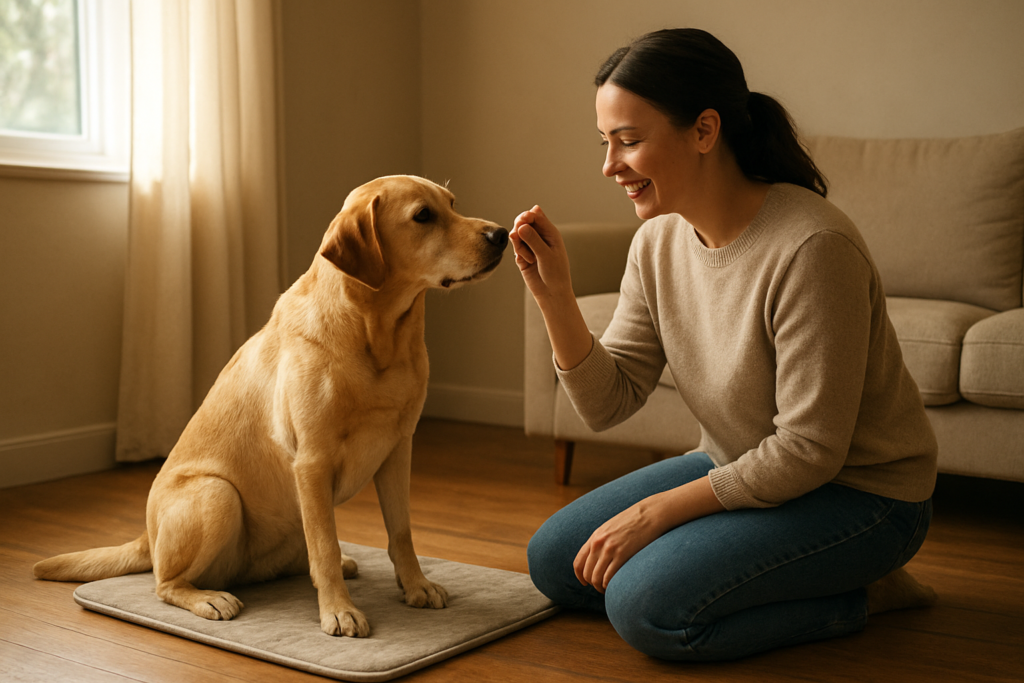
Put the mat on the floor and wait. Look for any interest in it. If your dog glances at the mat, moves toward it, sniffs it, or touches it, mark the moment and place a treat on the mat. Let your dog eat the treat and move away if they wish.
Repeat this several times. Do not lure your dog onto the mat with a treat held in front of their nose for every repetition. Luring can be useful briefly, but rewarding voluntary interest helps your dog learn that the mat itself predicts good things.
2. Reward all four paws on the mat
When your dog readily approaches, wait for them to step fully onto the mat. Mark and reward. Feed the treat low and between the dog’s front paws if possible. This keeps the dog’s body oriented toward the mat instead of pulling them back toward you.
After the reward, use your release cue and encourage your dog to step off. You can toss one treat a short distance away, then wait for the dog to return. This creates a clear pattern: go to the mat, earn rewards, hear the release cue, and reset.
3. Add the down position
Once your dog is comfortable standing on the mat, wait for a natural bend of the elbows or a down. Mark and reward immediately. If your dog already knows a relaxed “down,” you may give that cue once, then reward the response on the mat.
Do not repeat the cue several times or push the dog’s shoulders down. If the down does not happen, reward standing on the mat for now and try again later. Some dogs need time to feel safe lying on a new surface.
4. Build duration one calm second at a time
After your dog lies down, reward quickly. Then pause for a very short interval before giving another reward. At first, one or two seconds may be enough. Gradually vary the pauses rather than increasing them in a straight line every time.
Continue to deliver rewards while your dog remains relaxed. If your dog stands, do not scold. Wait for the dog to become available again, then make the next attempt easier. You might reward sooner, return to standing on the mat, or take a quiet break.
5. Teach the release cue
When your dog is resting, say your release word in a pleasant, neutral tone. Then toss a treat away from the mat or invite your dog to move. Repeat this often enough that the release cue becomes clear.
Release before your dog feels the need to leave. This helps your dog learn that staying does not mean being trapped. As the behavior becomes stronger, you can wait for a little more duration before releasing.
6. Add distance carefully
Take one small step away, then return and reward if your dog stays settled. Next, try two steps, a brief turn of your body, or sitting in a nearby chair. Change only one challenge at a time.
If your dog follows you, reduce the distance. You can also return to the mat more often so your dog does not experience your movement as a signal that the exercise is ending.
7. Add everyday distractions
Introduce mild, familiar distractions before difficult ones. For example, pick up a book, place a cup on a table, open a quiet cupboard, or take a few steps around the room. Reward calm responses and release your dog before they become frustrated.
Later, practice while a family member moves around, a meal is prepared, or a visitor enters at a distance. Increase difficulty slowly. A dog that can settle in a quiet room may not yet be ready to settle beside an exciting doorway or during a lively gathering.
8. Move the mat to useful places
When the behavior is comfortable in one location, move the mat a short distance and practice again. Then try another room. Dogs do not always generalize a behavior automatically, so each new setting may need a few easy repetitions.
Use the mat where you genuinely need calm behavior: beside your desk, outside the kitchen work area, or a comfortable distance from the front door. Keep the mat a resting option, not a place where the dog is routinely sent away for long periods.
Training checkpoints and progression
Use these checkpoints to decide whether to continue, pause, or make the exercise easier:
| What you see | What to do next |
|---|---|
| Your dog investigates the mat but leaves quickly. | Reward investigation and all four paws. Keep sessions very short. |
| Your dog lies down but pops up often. | Reward sooner, reduce distractions, and release earlier. |
| Your dog stays down but looks tense. | Lower the difficulty. Use a quieter location and avoid reaching over the dog. |
| Your dog stays relaxed for several repetitions. | Add one small challenge, such as a step away or a brief pause. |
| Your dog succeeds in one room. | Practice the same easy version in another room before increasing difficulty. |
Progress is not always linear. A dog may manage a longer settle in the morning and need an easier exercise after an exciting walk or busy day. Treat each session as information, not a test your dog can fail.
Quick mat-settle checklist
- Comfortable, stable mat in a quiet starting location
- Small rewards ready before training begins
- One consistent marker and one clear release cue
- Rewards delivered calmly and low on the mat
- Short sessions ending while the dog is still comfortable
- Difficulty increased by only one small step at a time
- Freedom to leave when the release cue is given
Common mistakes that slow learning
Asking for too much too soon
Long duration, distance, visitors, food, and noise are separate challenges. Combining them too early often leads to repeated failures. Return to the last version your dog could do comfortably, then change one factor.
Rewarding only perfect stillness
Dogs learn from the moments you notice. Reward soft body language, a lowered head, a quiet breath, or choosing to remain on the mat. If you wait for a flawless performance, you may miss the small behaviors that create a relaxed settle.
Using the mat only when fun ends
If the mat always predicts being ignored, confined, or separated from everyone, your dog may avoid it. Include easy practice when nothing unpleasant is happening. Give rewards, release your dog, and sometimes offer calm attention while they rest.
Repeating cues or moving the dog into place
Repeated cues can make the message unclear. Physical guidance can also make the mat feel uncomfortable. Give your dog time to think, reward small steps, and adjust the environment instead.
Calling the dog off the mat without a release cue
Unplanned interruptions can weaken the meaning of staying. When possible, approach quietly, reward, and then use the release cue. If you must interrupt for safety, do so without turning it into a correction.
Troubleshooting a difficult settle
My dog will not step onto the mat
Check the surface first. It may slide, feel hot or cold, or have a strong unfamiliar smell. Try a different comfortable surface or place the mat beside a familiar resting area. Reward looking toward it, then approaching it, without pulling your dog forward.
My dog grabs or chews the mat
Chewing can mean the mat is exciting, the dog is bored, or the exercise is too difficult. Keep sessions brief and reward calm contact. Remove the mat calmly when you cannot supervise. If chewing is persistent, choose a safer setup and ask a qualified behavior professional for individual guidance.
My dog gets up whenever I move
Make your movement smaller. Shift your weight, sit back down, and reward. Then stand briefly, return, and reward. Increase distance only when your dog can remain relaxed through the current movement.
My dog barks or becomes frustrated
Stop and lower the difficulty. Your dog may be tired, overexcited, confused, or worried about being left. Offer a calm break and try a shorter repetition later. Avoid raising your voice, since extra pressure can add excitement or concern.
My dog settles at home but not elsewhere
Practice generalization in small steps. Begin in a familiar room, then a quiet part of another location. Bring the same mat and use a generous rate of reinforcement at first. Busy public settings should come much later, if they are suitable for your dog.
Practical ways to strengthen the behavior
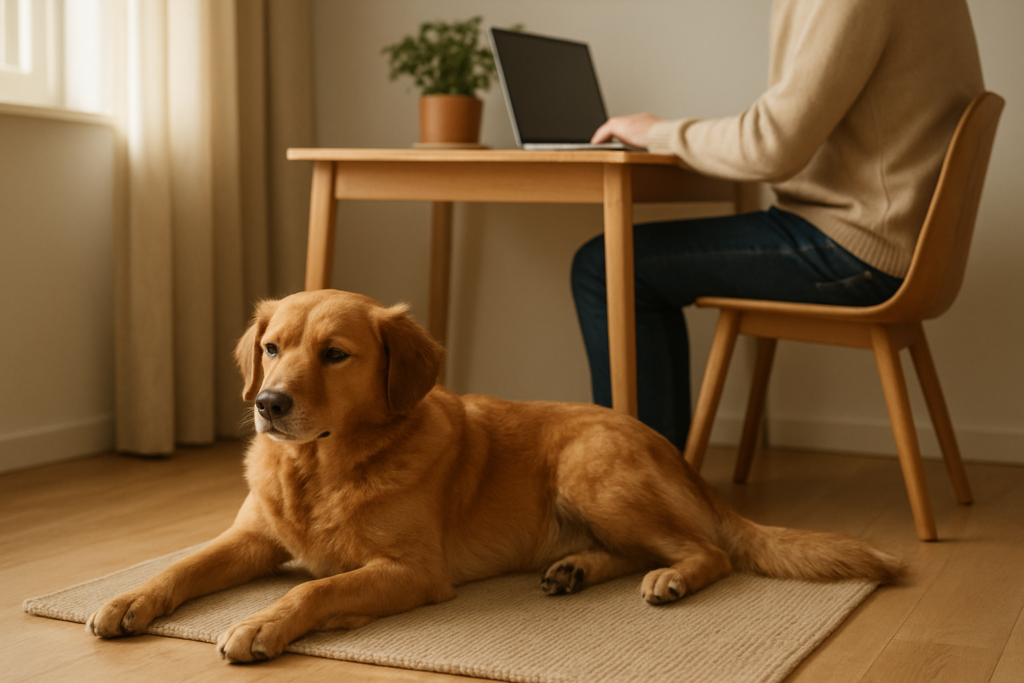
Use mat training during ordinary routines instead of relying only on formal sessions. Ask for a brief settle while you read a message, fill a water bowl, or prepare a simple meal. Reward, release, and return to normal life. These small repetitions make the behavior useful without making it feel like a demanding event.
Vary your rewards. Food is often efficient during early learning, but calm praise, a gentle interaction, or access to a favorite quiet activity may also be meaningful to your dog. Do not use exciting play as a reward if it makes leaving the mat difficult.
Reward duration before you need it. If you expect your dog to settle while guests arrive, practice the same skill on quiet days first. Place the mat far enough from the door that your dog can notice activity without being overwhelmed. Ask visitors to ignore the dog at first and reward calm behavior before greetings.
For meals, begin with a very short settle and release your dog before frustration builds. Keep food that may be unsafe for dogs out of reach. The mat is a training station, not a substitute for supervision around food, children, doorways, or other hazards.
For more calm-training ideas, explore LaokPet’s training and behavior guides. You can also find related routines in the pet care guides section.
Safety and when to seek help
Mat training should be voluntary, low-pressure, and appropriate for your dog’s physical comfort. Do not ask for repeated downs if your dog has difficulty lying down, rising, walking, or changing position. A sudden change in willingness to move or rest can have many possible causes and should be discussed with a veterinarian.
Give your dog enough space from children, other animals, food bowls, and door traffic. Teach children not to climb onto, touch, or disturb a dog who is resting. Never use the mat as a punishment area or leave a dog confined there without a way to move away.
If your dog shows fear, growling, snapping, intense distress, or repeated attempts to escape when asked to settle, stop the exercise and create distance from the trigger. A veterinarian can help consider health-related factors, and a qualified, reward-based behavior professional can help you create a plan suited to your dog. Seek urgent veterinary help for sudden severe distress, injury, breathing difficulty, collapse, or other signs of an immediate emergency.
Your next steps
Choose one quiet location, place the mat down, and reward your dog for the smallest signs of interest. Keep the first practice brief and finish with a clear release cue. Over the next sessions, build the pattern in this order: mat interest, four paws, down, calm duration, release, distance, distractions, and new locations.
Keep notes on what your dog can do comfortably rather than counting only the longest stay. If your dog struggles, make the next repetition easier. With patient, reward-based practice, the mat can become a familiar invitation to pause and rest while you get on with everyday life.