The best way to keep an indoor cat mentally stimulated is to give them small, varied chances to hunt, explore, climb, solve problems, and make choices every day. Enrichment does not need to be expensive or complicated. A few minutes of interactive play, a safe lookout, a food puzzle, and a rotating selection of household objects can make an indoor routine more interesting.
Every cat has a different age, temperament, body condition, and play style. Start gently, watch your cat’s response, and adjust the challenge. The aim is not to keep a cat busy every minute. It is to create a home where natural behaviours have safe outlets.
Why mental stimulation matters for indoor cats
Indoor living can protect cats from many outdoor hazards, but it can also make the environment predictable. A cat may have food, water, a litter tray, and a comfortable bed, yet still need opportunities to use their senses and skills.
In the wild, cats spend time watching, locating, approaching, chasing, catching, and eating. They also choose resting places, investigate new scents, and monitor their surroundings. Home enrichment can imitate parts of this sequence without bringing outdoor risks indoors.
Good enrichment may help a cat use energy appropriately and stay engaged with their surroundings. It can also strengthen the bond between cat and caregiver because many activities involve patient, positive interaction. Enrichment is not a replacement for veterinary care, and a sudden change in behaviour should not be explained away as boredom.
Prepare the home before you begin
Learn what your cat already enjoys
Observe your cat for several days. Do they watch birds through a window, chase moving objects, bat at small items, climb, investigate bags, or search for food? Do they prefer quiet activities or fast movement? These clues help you choose enrichment that feels natural rather than forcing a game your cat does not understand.
Also note when your cat is most alert. Some cats are ready to play after a nap, while others become interested around their usual meal times. Work with their rhythm where possible.
Create a small enrichment area
Choose a clear, safe space for play and exploration. Remove loose strings, unstable objects, toxic plants, and anything small enough to swallow. Keep a few approved toys in a container so that you can rotate them instead of leaving everything out all the time.
Provide access to a stable elevated place, a hiding space, and a comfortable resting area. These do not need to be large or elaborate. A sturdy cat tree, a secure shelf, an empty cardboard box, or a covered bed may all serve different purposes.
Use ordinary items thoughtfully
Cardboard boxes, paper bags with handles removed, paper balls, folded blankets, and empty cartons can become useful enrichment materials. Inspect each item first. Avoid sharp edges, staples, tape, loose threads, small detachable parts, and materials that may break into pieces.
How to keep an indoor cat mentally stimulated: 8 practical steps
1. Schedule short interactive hunting games
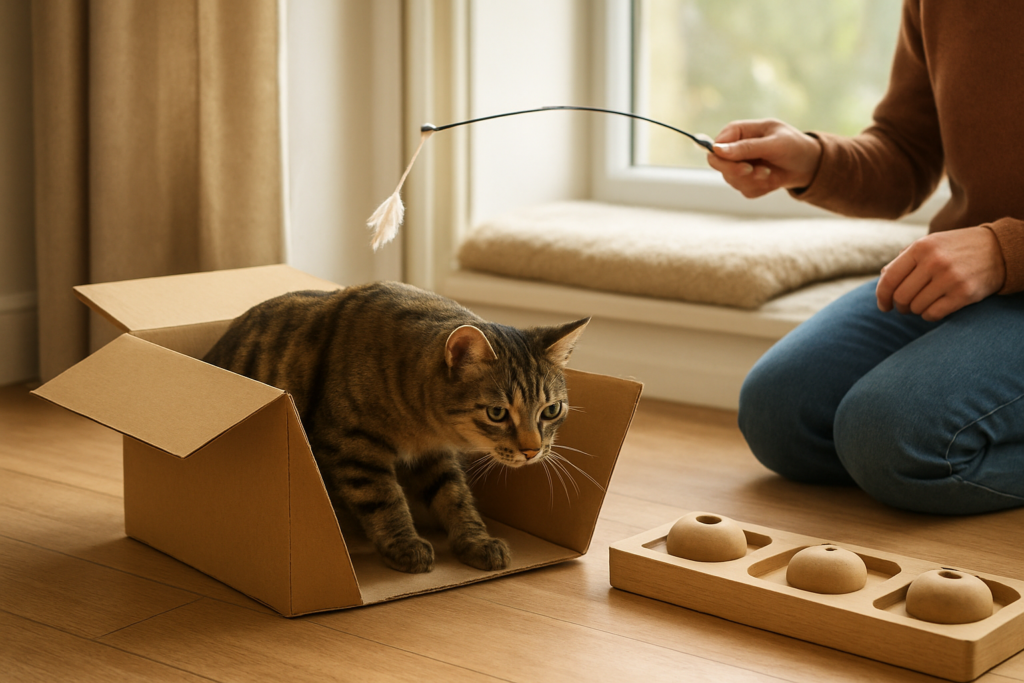
Use a suitable wand toy or another toy that keeps your hands away from your cat’s teeth and claws. Move it like prey: pause, hide it behind an object, make a short dash, then stop. Do not wave it constantly in your cat’s face. Natural pauses give your cat a chance to watch, plan, and pounce.
Let your cat catch the toy regularly. A game with no successful captures can become frustrating. End with a slower movement and, when appropriate, a small portion of their normal food. This gives the activity a more complete hunt-and-eat pattern.
Keep sessions brief enough that your cat remains interested. Several short sessions are usually more practical than one exhausting session.
2. Turn some meals into a food-search activity
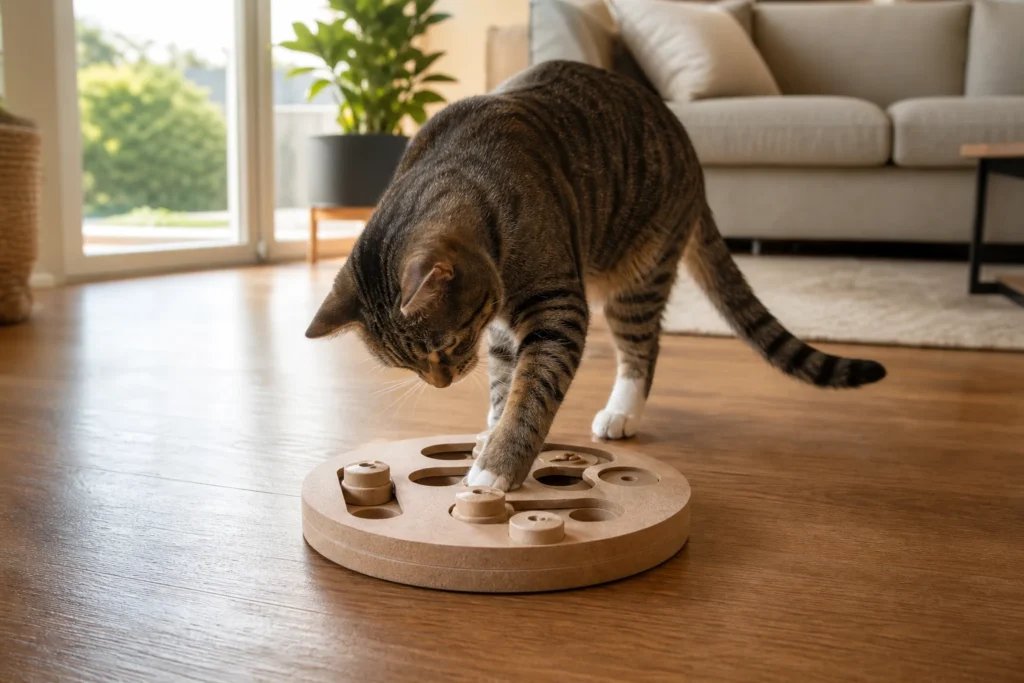
Instead of placing every meal in one bowl, hide small portions of the cat’s usual food in easy-to-find locations. Start with spots that are visible and accessible. Once your cat understands the activity, use a few more locations or a simple puzzle feeder.
For dry food, you might place pieces in a shallow tray, an egg carton, or a food puzzle designed to release food safely. For wet food, use a suitable lickable surface or divide the meal into several dishes. Reduce the amount in the regular bowl so that the total daily food remains appropriate.
Supervise new food puzzles. If your cat becomes distressed, stops eating, or cannot access the food, make the puzzle easier. Food enrichment should encourage steady eating, not create a stressful competition.
3. Build safe climbing and viewing options
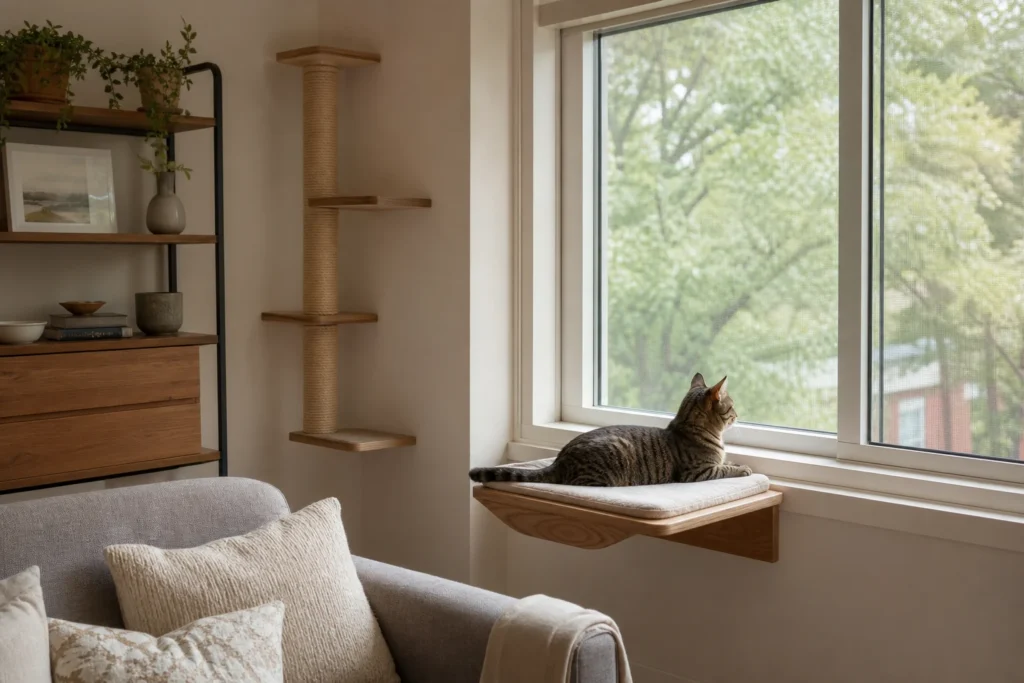
Height gives many cats a way to observe the room while feeling secure. Offer a stable perch away from busy walkways. A window view can add visual interest, especially when the cat can choose whether to watch or retreat.
Secure shelves and climbing furniture carefully. Check them regularly for wobbling, damaged surfaces, or gaps where a paw could become trapped. Keep perches away from unsafe open windows, hot surfaces, and objects that could fall.
Do not assume every cat wants to climb high. Older, anxious, or less mobile cats may prefer a low platform with easy access.
4. Rotate toys instead of displaying everything
Leave out a small selection, then store the rest and bring back different items every few days. Rotation can make familiar toys feel less predictable. Include different textures and movement styles, such as a soft kicker, a lightweight rolling object, and a toy for chasing.
Rotation does not mean removing a favourite toy permanently. Keep track of what your cat chooses. If an item is ignored repeatedly, replace it with a different type of activity rather than adding more clutter.
5. Encourage scent and texture exploration
Cats gather information through scent. You can offer a clean cardboard box, a folded towel, or a safe new object for investigation. Let your cat approach in their own time. Never push an object toward their face or confine them with something unfamiliar.
Cat-safe plant material may interest some cats, but check that any plant is safe before bringing it indoors. Avoid essential oils, scented sprays, and strongly perfumed products around cats. Their sense of smell is sensitive, and concentrated fragrances may be irritating or unsafe.
6. Teach simple, reward-based behaviours
Training is mental exercise. Begin with a behaviour your cat can offer easily, such as looking at you, touching a target with their nose, or stepping onto a mat. Mark the desired action with a calm word and offer a tiny food reward from the daily allowance.
Keep the environment quiet and the sessions short. Use rewards, not punishment. If your cat walks away, hides, or becomes agitated, stop and try again later with an easier request. Training should feel like a cooperative game.
7. Add controlled novelty
Move a box to a different safe location, change the route to a favourite perch, or create a new paper tunnel. Small changes can encourage investigation while preserving the familiar parts of the home.
Introduce only one major change at a time. Some cats enjoy novelty, while others find it unsettling. Keep essential resources—food, water, litter trays, and resting places—easy to find and available in familiar areas.
8. Make quiet observation part of enrichment
Mental stimulation is not always energetic play. A secure window perch, a calm place to watch household activity, or a covered bed can give your cat choices and control. Allow your cat to observe without being picked up or interrupted.
Quiet enrichment is especially useful after active play or for cats that become overwhelmed by fast movement. A balanced day includes excitement, problem-solving, rest, and privacy.
A simple daily enrichment routine
| Part of the day | Activity | What to watch for |
|---|---|---|
| Morning | Short hunting game followed by part of breakfast | Interest, successful catches, relaxed eating |
| Middle of the day | Food search, puzzle feeding, or access to a viewing place | Easy access and calm problem-solving |
| Evening | Play, simple training, or toy rotation | Stop before your cat becomes frustrated or overexcited |
This is a framework, not a strict timetable. If your cat prefers several tiny interactions, divide activities into smaller pieces. Keep food portions consistent with their normal feeding plan.
- Offer at least one short interactive play session.
- Provide a safe place to climb, hide, or observe.
- Use part of a meal for searching or problem-solving when suitable.
- Rotate a few safe toys and household enrichment items.
- Give your cat a chance to choose whether to join an activity.
- Inspect toys, perches, boxes, and puzzle feeders regularly.
- Keep total food intake and treats within the cat’s normal plan.
Checkpoints: how to tell whether the activity is working
Look for voluntary engagement. Your cat may watch closely, approach, bat, chase, search, or return to the activity later. Afterward, they should be able to settle, eat normally, groom, and rest.
Some signs that the challenge is too easy include walking away immediately or showing no interest after several attempts. Try changing the movement, location, texture, or reward. Signs that it is too difficult may include staring without acting, pawing frantically, vocalising, abandoning food, or becoming tense. Simplify the task and offer an easier success.
Keep a simple mental note of which activities your cat chooses and how they respond. This helps you create a personalised rotation rather than guessing.
Common mistakes to avoid
Leaving string toys unattended
String, ribbon, elastic, feathers, and similar parts can be dangerous if swallowed or if they become wrapped around a cat. Put interactive toys away after use and check toys for damage.
Using hands as toys
Hand wrestling can teach a cat to bite or scratch people during excitement. Direct play toward an appropriate toy instead, and keep movements calm if your cat becomes overstimulated.
Making every activity food-based
Food puzzles are useful, but cats also need movement, exploration, social contact, and rest. Too many treats can contribute to unwanted weight gain. Use normal meal portions where possible.
Changing too much at once
A completely rearranged room, unfamiliar objects, and a new feeding method may overwhelm a cautious cat. Introduce changes gradually and preserve reliable safe spaces.
Assuming lack of interest means stubbornness
Your cat may be tired, uncomfortable, anxious, or simply uninterested in that particular activity. Do not force participation. Try a different style or speak with a veterinary professional if behaviour changes noticeably.
Troubleshooting common enrichment problems
“My cat ignores toys.”
Try moving the toy away rather than toward your cat. Use pauses, hide the toy briefly, and test different textures. Play when your cat is naturally alert. If there is still no interest, focus on window watching, food searches, scent exploration, or training.
“My cat becomes too rough.”
End the game calmly before excitement peaks. Increase the distance between your hands and the toy, slow the movement, and provide a catch at the end. Avoid shouting or physical punishment, which can increase fear and confusion.
“My cat gives up on puzzle feeders.”
Start with a simple, open design and place food where it is easy to see. Demonstrate by moving one piece near the opening, then let your cat work it out. Increase difficulty only after repeated success.
“My cat is bored at night.”
Offer a predictable evening routine with interactive play and an appropriate meal beforehand. Add safe independent options for quiet exploration, but do not leave hazardous toys out overnight. If night vocalising or restlessness is new or intense, consult a veterinary professional.
Advanced practical ideas
Once your cat is comfortable with basic enrichment, combine activities into a small sequence. For example, hide a toy behind a box, lead your cat toward a food search, and finish with access to a favourite perch. Keep the sequence flexible so your cat can leave at any point.
You can also create a “choice board” with two safe options, such as a box or a toy. Present them at a comfortable distance and see which your cat approaches. Choice is valuable because enrichment should support agency, not simply demand performance.
For multi-cat homes, provide enough space and resources to reduce competition. Offer separate play areas where possible, and watch for one cat blocking another from food, resting places, or puzzle activities. Enrichment works best when each cat can participate without pressure.
Older cats or cats with limited mobility may benefit from low-impact games, shallow food puzzles, warm resting places, and easy-to-reach observation points. Adjust surfaces and heights to reduce jumping demands. A veterinary professional can advise on suitable activity if your cat has a known health condition.
Safety and when to seek professional advice
Inspect enrichment items often. Remove anything that is frayed, splintered, sharp, unstable, or missing a piece. Keep toxic plants, chemicals, medications, unsafe human foods, and small objects out of reach. Secure windows and balconies, and do not use household items as toys unless they are clean and safe.
Contact a veterinary professional if your cat suddenly loses interest in normal activities, hides more, becomes unusually irritable, changes appetite or drinking, stops using the litter tray normally, limps, vomits repeatedly, or shows other concerning changes. Pain and illness can look like boredom or low motivation. A veterinarian can assess your cat and recommend appropriate next steps.
For more everyday ideas, browse LaokPet’s cat-care articles and explore the wider pet-care guides.
Your next steps
- Choose one short hunting game and one calm activity for today.
- Set aside a safe box, perch, or food-search setup.
- Watch what your cat chooses without forcing participation.
- Repeat the activities that produce relaxed interest and adjust the ones that do not.
- Build a small rotation across play, food, exploration, training, and rest.
When you ask how to keep an indoor cat mentally stimulated, start with consistency rather than complexity. A safe home, thoughtful observation, and a few short daily opportunities can turn ordinary moments into meaningful enrichment.