To introduce a cat to a new kitten, keep them separate at first, exchange their scents, then move through short supervised meetings only when both cats remain calm. A slow introduction gives your resident cat time to adjust and helps the kitten feel secure instead of overwhelmed.
This guide explains how to prepare your home, read each cat’s behavior, decide when to progress, and respond if the introduction becomes difficult. The goal is not necessarily instant friendship. Peaceful sharing of the home is a successful outcome.
1. Prepare the home before the kitten arrives
Choose a quiet room that your resident cat does not rely on for sleeping, eating, or using the litter tray. The kitten should have this space for several days or longer while both cats become familiar with each other’s presence.
Set up the room before arrival so you are not changing everything at once. Include:
- Food and water bowls placed away from the litter tray
- A clean litter tray in a quiet, easy-to-reach location
- A bed, hiding place, and secure carrier
- Age-appropriate toys and a scratching surface
- Safe vertical space, if the room allows it
Keep windows secured and remove exposed cords, toxic plants, medicines, cleaning products, and small objects a kitten could swallow. International Cat Care recommends giving a new kitten a dedicated settling-in room with its own essential resources rather than immediately sharing the resident cat’s belongings.
Before the first meeting, arrange a veterinary appointment for the kitten. Ask about vaccinations, parasite control, infectious-disease screening, and whether the kitten is healthy enough to meet another cat. Keep the cats separated until your veterinarian advises that contact is appropriate.
2. Protect the resident cat’s routine and resources
Your resident cat may view a new kitten as a change to its territory, schedule, and access to important resources. Continue normal feeding, play, rest, and attention as consistently as possible.
Provide separate resources rather than expecting the cats to share immediately. Add extra food and water stations, beds, hiding places, scratching posts, and litter trays. A useful starting point is one litter tray per cat plus one extra, placed in separate areas where neither cat can trap the other.
Do not punish hissing, growling, hiding, or staring. These behaviors are warnings that a cat needs more distance. Calmly end the interaction or increase separation instead.
3. Start with scent, not sight
For the first stage, allow the cats to learn about one another through smell. Feed or offer treats on opposite sides of the kitten’s closed door, beginning far enough away that both cats will eat normally.
After each cat is relaxed around the door, exchange bedding or soft cloths between rooms. You can also gently rub a clean cloth around one cat’s cheeks and place it near the other cat’s resting area. Do not force either cat to investigate.
Checkpoint: Move forward when both cats can eat, play, rest, and use the litter tray normally while the other cat’s scent is nearby. If one cat avoids food, hides continuously, or becomes unusually reactive, continue this stage and speak with your veterinarian if the change persists.
4. Build positive associations through a closed door
Once scent exchange is calm, create brief activities on either side of the closed door. Use meals, treats, gentle play, or a favorite toy. Keep sessions short and stop while both cats are still comfortable.
Gradually move food bowls closer to the door over multiple sessions. Never use food to lure a cat into a position where it feels trapped. Each cat should be able to walk away.
You can also allow the kitten to explore a larger area while the resident cat is secured elsewhere. Then return the kitten to the safe room and let the resident cat inspect the new smells. This gives each cat information without direct confrontation.
5. Introduce visual contact with a barrier
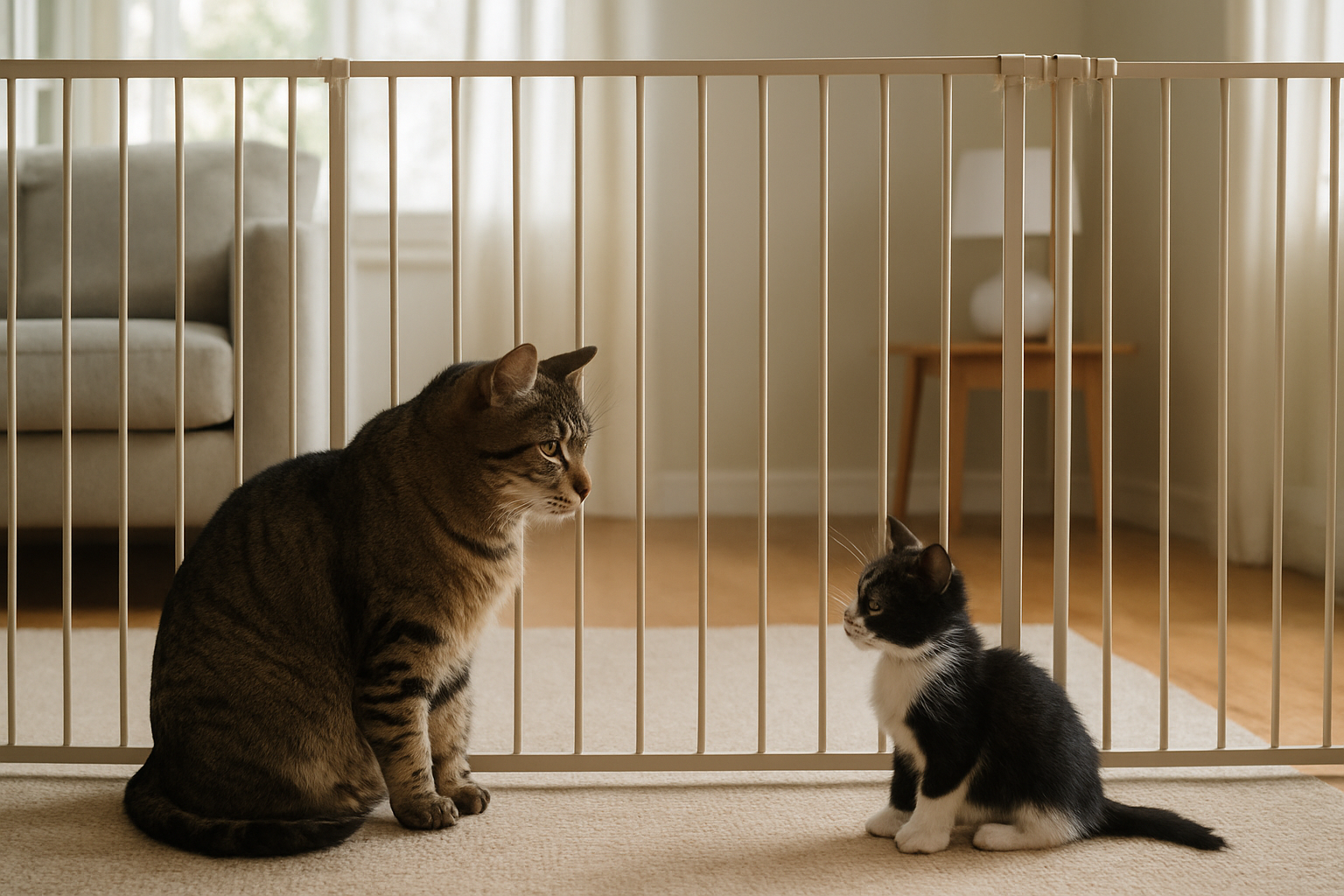
When the cats remain relaxed at the closed door, use a tall pet gate, secure screen, cracked door with a doorstop, or another barrier that prevents contact. Ensure the kitten cannot squeeze through or climb over it.
Start with a few seconds of visual contact, then close the door and offer a reward. Repeat several times a day if both cats stay calm. Increase the duration gradually rather than trying to complete one long session.
Look for soft body language: loose posture, normal blinking, casual sniffing, grooming, play, or the ability to look away. Slow down if you see flattened ears, a stiff body, intense staring, tail lashing, repeated swatting at the barrier, or persistent vocalization.
Use the following comparison as a practical progress guide:
| Stage | What to look for | Warning sign | What to do |
|---|---|---|---|
| Scent exchange | Normal eating and resting near exchanged bedding | Refusal to eat or prolonged hiding | Use less scent, increase distance, and wait |
| Closed-door sessions | Calm play or meals on both sides | Repeated growling or door guarding | Shorten sessions and move resources farther away |
| Barrier contact | Brief looks followed by relaxed behavior | Rigid posture, lunging, or frantic swatting | Block the view and return to closed-door work |
| Direct meetings | Sniffing, disengaging, or quiet shared activity | Chasing, cornering, biting, or screaming | Separate safely and seek professional guidance |
6. Allow short, supervised face-to-face meetings
Choose a room with escape routes and high resting places. Remove narrow spaces where one cat could be cornered, and keep a large piece of cardboard, cushion, or blanket nearby to help block sightlines if necessary.
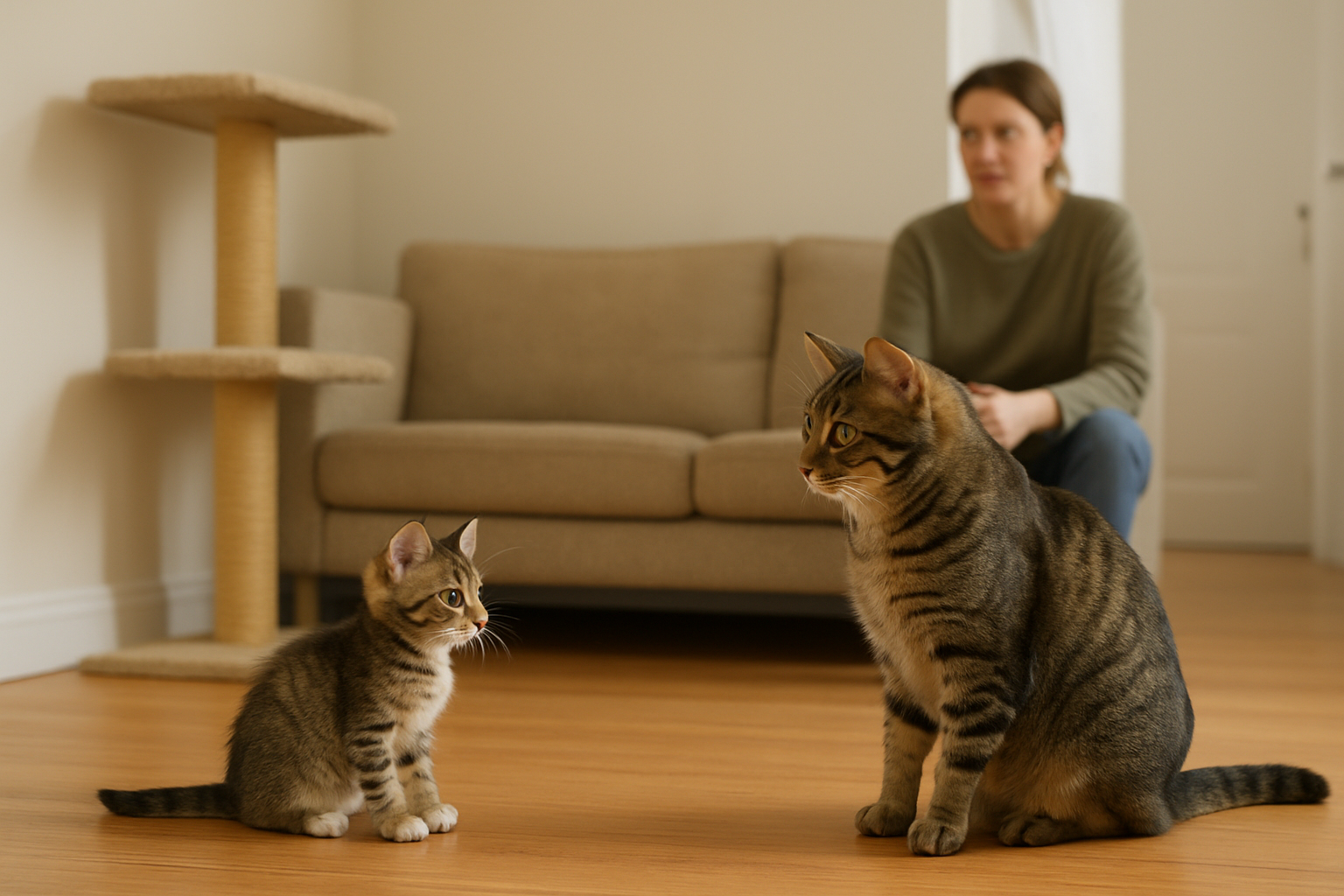
Open the barrier and allow the cats to choose whether to approach. Keep the first meeting brief. You can use a wand toy or scattered treats to create space, but do not make the cats compete for one toy or food bowl.
End the session while it is still calm. Return the kitten to its safe room, then repeat later. Increase freedom only after multiple peaceful meetings, and continue supervising until you are confident neither cat is chasing, trapping, or attacking the other.
7. Adjust the plan when the cats struggle
What if the resident cat hisses at the kitten?
One or two hisses can be a normal request for distance. Separate the cats without scolding and repeat a slower stage. Hissing becomes more concerning when it is paired with lunging, cornering, repeated attacks, or an inability to settle after separation.
What if the kitten keeps chasing the adult cat?
Young kittens often have more energy than adult cats want to tolerate. Schedule several interactive play sessions each day, provide climbing and scratching opportunities, and interrupt chasing before it escalates. Give the adult cat elevated spaces and kitten-free rest periods.
What if one cat stops eating or using the litter tray?
Stress can affect normal behavior, but appetite loss, elimination changes, vomiting, diarrhea, breathing problems, wounds, or marked lethargy require veterinary advice. Do not assume these signs are simply part of the introduction.
Common mistakes to avoid
- Putting the cats together immediately because the kitten seems friendly
- Holding one cat close to the other during a first meeting
- Allowing chasing because you hope they will “work it out”
- Making the cats share food, litter trays, beds, or hiding places
- Progressing after one calm session instead of looking for a consistent pattern
- Punishing hissing, growling, hiding, or defensive behavior
- Leaving the kitten and adult cat unsupervised too soon
Practical introduction checklist
- Prepare a separate kitten room before arrival.
- Remove hazards and secure windows, cords, and cupboards.
- Book a veterinary check and discuss health precautions.
- Keep the resident cat’s routine as stable as possible.
- Provide separate resources throughout the process.
- Begin with scent exchange and closed-door meals.
- Use a secure barrier before direct contact.
- Keep face-to-face meetings short and supervised.
- Return to an earlier stage whenever either cat becomes distressed.
Advanced tips for difficult or multi-cat homes
If you have several resident cats, introduce the kitten to one calm cat at a time rather than presenting the entire group at once. A senior, ill, highly anxious, or territorial cat may need a much slower plan than a confident young adult.
Synthetic feline pheromone products may help some households, but they are not a substitute for separation, resource management, or behavior support. Keep expectations realistic: some cats become close companions, while others simply learn to coexist with enough space.
For additional guidance, compare this plan with the International Cat Care introduction steps and the Humane Society’s advice for introducing a new cat to resident cats. The ASPCA’s general cat-care guidance is also useful when preparing food, water, litter, and veterinary care.
Next actions
- Choose and prepare the kitten’s safe room today.
- List the extra resources each cat will need.
- Schedule the kitten’s veterinary examination.
- Begin scent exchange only after both cats are safely separated.
- Record each cat’s behavior after sessions so you can identify steady progress or setbacks.
When learning how to introduce a cat to a new kitten, measure success by relaxed behavior, reliable routines, and safe access to resources—not by how quickly the cats cuddle. Move at the pace of the more cautious cat, and the household has a better chance of developing a stable relationship.