The best interactive cat toys for indoor cats are usually a small rotation of wand toys, puzzle feeders, chase toys, and durable solo-play options—not one complicated gadget. Choose toys that match your cat’s natural hunting style, then use them safely and replace them when damaged.
Indoor cats need more than food, water, and a comfortable bed. They also benefit from opportunities to stalk, chase, pounce, forage, climb, and retreat. This guide ranks the most useful interactive toy types, explains what each one does well, and helps you build a practical play setup without wasting money on toys your cat ignores.
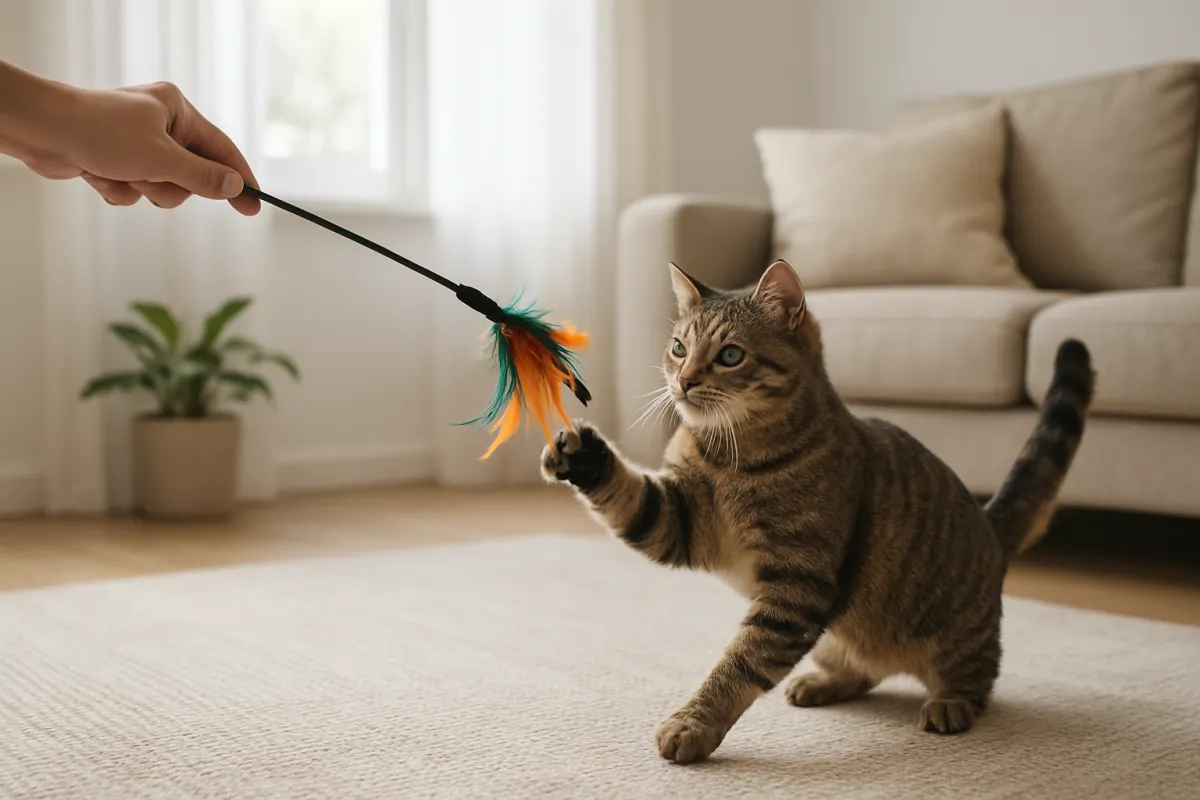
1. Decide what kind of interaction your cat needs
“Interactive” can mean different things. Some toys require you to move them, while others make your cat solve a problem or chase a moving object independently. The best choice depends on your cat’s age, confidence, food motivation, activity level, and ability to play safely without supervision.
Indoor-only cats benefit from simulated hunting and foraging opportunities, along with play and safe territory. The Feline Veterinary Medical Association lists these as important parts of an enriched indoor environment. Read the FelineVMA guidance on indoor cat environmental needs for broader enrichment ideas.
Before comparing products, observe how your cat already plays:
- Stalks and pounces: Try a wand toy or lure that moves along the floor.
- Chases moving objects: Consider a rolling ball, track toy, or motion-activated toy.
- Batters objects under furniture: A lightweight ball or kicker toy may work well.
- Searches for food: A puzzle feeder or treat maze can add useful mental work.
- Watches but rarely joins: Use slower movements, quieter toys, and shorter sessions.
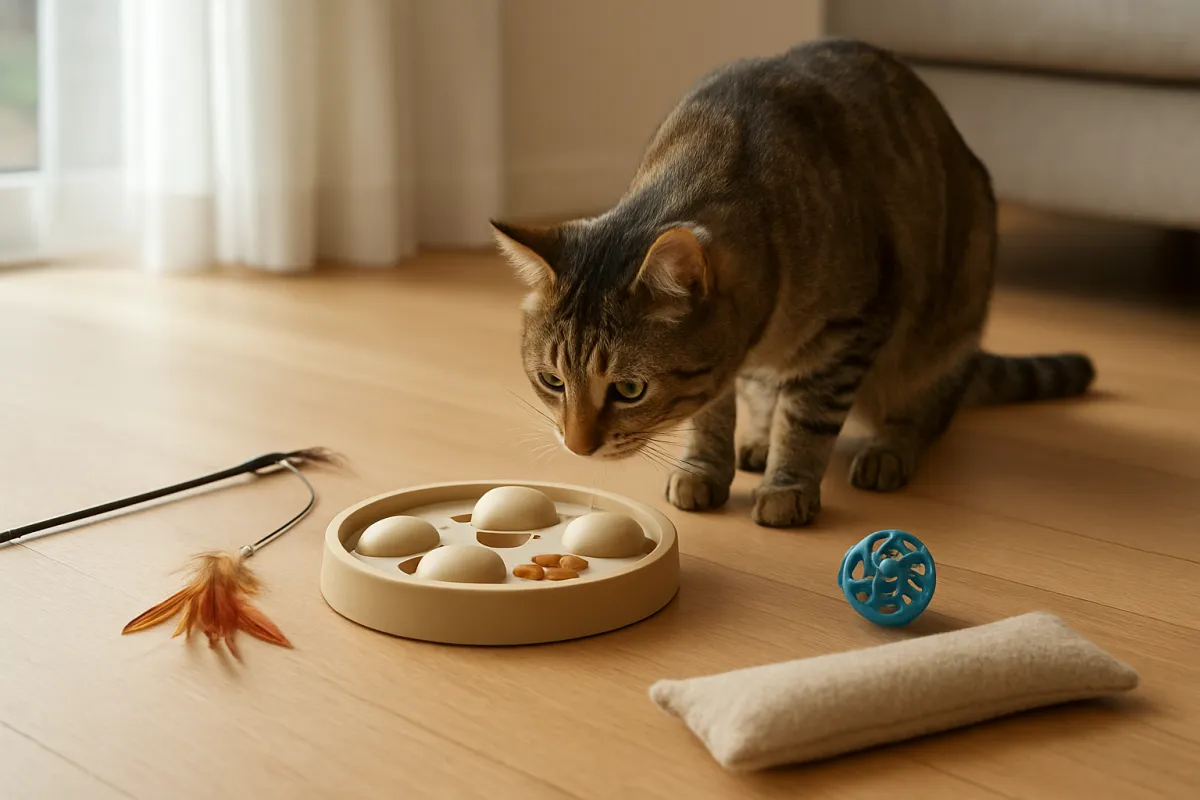
2. Compare the best interactive cat toys for indoor cats
The ranking below is based on practical enrichment value, ease of use, safety, suitability for different play styles, and how easily you can vary the activity. It is not based on personal testing, ratings, or a promise that every cat will like every toy.
Use the table as a quick filter, then read the individual assessments for limitations and setup advice.
| Rank | Toy type | Best for | What to look for | Warning sign |
|---|---|---|---|---|
| 1 | Wand toy with interchangeable attachments | Shared hunting play | Replaceable parts, secure attachment, comfortable handle | Loose string, exposed wire, or small parts that detach |
| 2 | Food puzzle feeder | Food-motivated cats and mental stimulation | Adjustable difficulty, easy cleaning, stable base | Too difficult, frustrating, or impossible to wash |
| 3 | Rolling treat dispenser | Active cats that enjoy chasing | Adjustable openings and durable, non-sharp material | Cracks, excessive noise, or treats falling out too easily |
| 4 | Interactive track or circuit toy | Repeated batting and visual tracking | Stable construction, enclosed ball, accessible cleaning | Ball jams or the base slides across the floor |
| 5 | Motion-activated moving toy | Short bursts of solo activity | Quiet motor, automatic shutoff, protected moving parts | Noise, overheating, or a fearful response |
| 6 | Electronic laser-style toy | Visual chase games | Controlled speed, safe enclosed light source, limited sessions | No chance to catch or finish the game with a physical reward |
| 7 | Interactive kicker or catnip toy | Wrestling, kicking, and scent-based play | Strong stitching, washable cover, age-appropriate filling | Filling leaks or fabric tears under normal use |
1. Wand toys with interchangeable attachments
Best for: cats that enjoy stalking, chasing, and pouncing with a person.
A wand toy is the most flexible starting point because you control the speed, direction, pauses, and distance. Move the attachment like prey: let it disappear behind a chair, pause near a corner, then move it away rather than waving it continuously in your cat’s face.
Choose a handle that is comfortable to hold and attachments that connect securely. Interchangeable lures can help you discover whether your cat prefers feathers, fabric strips, crinkle material, or a small plush shape.
Limitations: Wand toys are not appropriate as unsupervised toys. Store them away after play, especially if they contain long string, elastic, ribbon, or detachable pieces. International Cat Care recommends interactive play as a way to support activity and the human-cat bond; its guide to playing with cats also explains why movement and timing matter.
2. Food puzzle feeders
Best for: food-motivated cats, indoor cats that eat quickly, and households seeking quiet enrichment.
Puzzle feeders make your cat work for part of a meal or a few treats. They can encourage sniffing, pawing, problem-solving, and slower eating. Start with an easy design in which food is visible and accessible, then increase difficulty only when your cat understands the task.
Look for a broad, stable base and surfaces that can be washed thoroughly. If your cat eats wet food, choose a design intended for moist foods or use it only with dry portions according to the manufacturer’s instructions.
Limitations: A puzzle that is too hard can become frustrating rather than enriching. Introduce it when your cat is calm, and do not remove regular access to food as a way to force engagement.
3. Rolling treat dispensers
Best for: active cats that like to chase, bat, and follow moving objects.
These toys combine movement with food motivation. Your cat pushes or rolls the dispenser, and small amounts of food are released through an opening. They are especially useful when you want a short activity that does not require constant human movement.
Adjustability matters. Begin with a larger opening or a smaller amount of food so the reward arrives predictably. Once your cat understands the toy, make the challenge more gradual.
Limitations: Rolling toys can be noisy on hard floors and may disappear under appliances or furniture. Check the toy after use for cracks, sharp edges, or chewing damage.
4. Track and circuit toys
Best for: cats that like repeated batting and visual tracking.
A track toy keeps a ball in a channel while your cat bats it around the circuit. It offers a simple activity that can be repeated in short bursts and may appeal to cats that are interested in moving objects but do not enjoy food puzzles.
Choose a wide, stable base that does not tip easily. The ball should remain enclosed, but the track should still allow you to remove hair, dust, and food debris.
Limitations: Some cats lose interest once they learn the circuit. Place it near a quiet resting area rather than in a busy walkway, and rotate it with other toys instead of leaving it permanently available.
5. Motion-activated moving toys
Best for: cats that enjoy brief, unpredictable bursts of movement.
These toys may move, vibrate, or change direction after a tap. They can add novelty during the day, particularly when you are working or cannot lead a play session yourself.
Prioritize a quiet motor, a reliable automatic shutoff, and protected moving components. Introduce the toy while you are present so you can see whether your cat investigates it, avoids it, or becomes overstimulated.
Limitations: Some cats find motors or sudden movement frightening. Batteries and moving mechanisms also add maintenance. This category should supplement, not replace, interactive play with you.
6. Electronic laser-style toys
Best for: cats that respond strongly to small moving points of light.
Light-based chase games can provide movement in a small space, but they need thoughtful handling. Keep the light away from your cat’s eyes, people’s eyes, reflective surfaces, and areas where a sudden chase could cause a collision.
End the session by directing your cat toward a physical toy or a small food reward. This gives the chase a more complete finish instead of leaving the cat searching for something it can never catch.
Limitations: Not every cat enjoys light play, and some may become frustrated or fixated. Stop if your cat shows agitation, repeatedly searches after the toy is put away, or begins chasing reflections and shadows at other times.
7. Interactive kicker and catnip toys
Best for: cats that enjoy wrestling, grabbing, bunny-kicking, or scent-based play.
Kicker toys are usually larger than small batting toys, giving a cat something to hold with the front paws while kicking with the back legs. They can be useful for energetic cats that prefer close-contact play with an object rather than a fast chase.
Inspect stitching and seams frequently. If the toy contains catnip or another scented filling, remember that individual responses vary; some cats become interested while others show little reaction.
Limitations: Kicker toys do not provide as much problem-solving as a puzzle feeder. They may also be unsuitable for cats that chew fabric aggressively or remove filling.
3. Match the toy to your cat’s age and play style
Kittens often need short, frequent sessions with toys that are easy to see and control. Avoid toys with small detachable parts, and teach young cats to direct their play toward objects rather than hands or feet.
Adult cats may prefer a clear hunting sequence: watch, stalk, chase, catch, and rest. Combine a wand session with a small meal or treat when appropriate, then allow your cat time to settle.
Senior cats can still benefit from interactive toys, but choose slower movement, low-impact chasing, and easy-access food puzzles. If your cat’s interest, coordination, appetite, or behavior changes suddenly, contact a veterinarian rather than assuming the problem is simply boredom.
4. Use interactive toys safely
Safety depends as much on supervision and maintenance as on the toy’s design. Inspect toys before each session, particularly when your cat chews, pulls, or carries them.
- Put away toys with string, ribbon, yarn, elastic, feathers, or detachable pieces after play.
- Replace toys when stitching opens, plastic cracks, or filling becomes accessible.
- Do not allow your cat to chew electrical cords or battery compartments.
- Keep food puzzles clean and remove uneaten moist food promptly.
- Use toys in a clear area away from stairs, glass, hot surfaces, and unstable furniture.
- Separate cats during competitive play if one cat guards the toy or food.
Long string-like materials can become dangerous if swallowed. The ASPCA warns that string, yarn, ribbon, and similar items may cause a gastrointestinal foreign body; if you suspect ingestion, contact a veterinarian promptly and do not pull visible material from your cat’s mouth or rectum. Review the ASPCA’s cat safety guidance about string hazards.
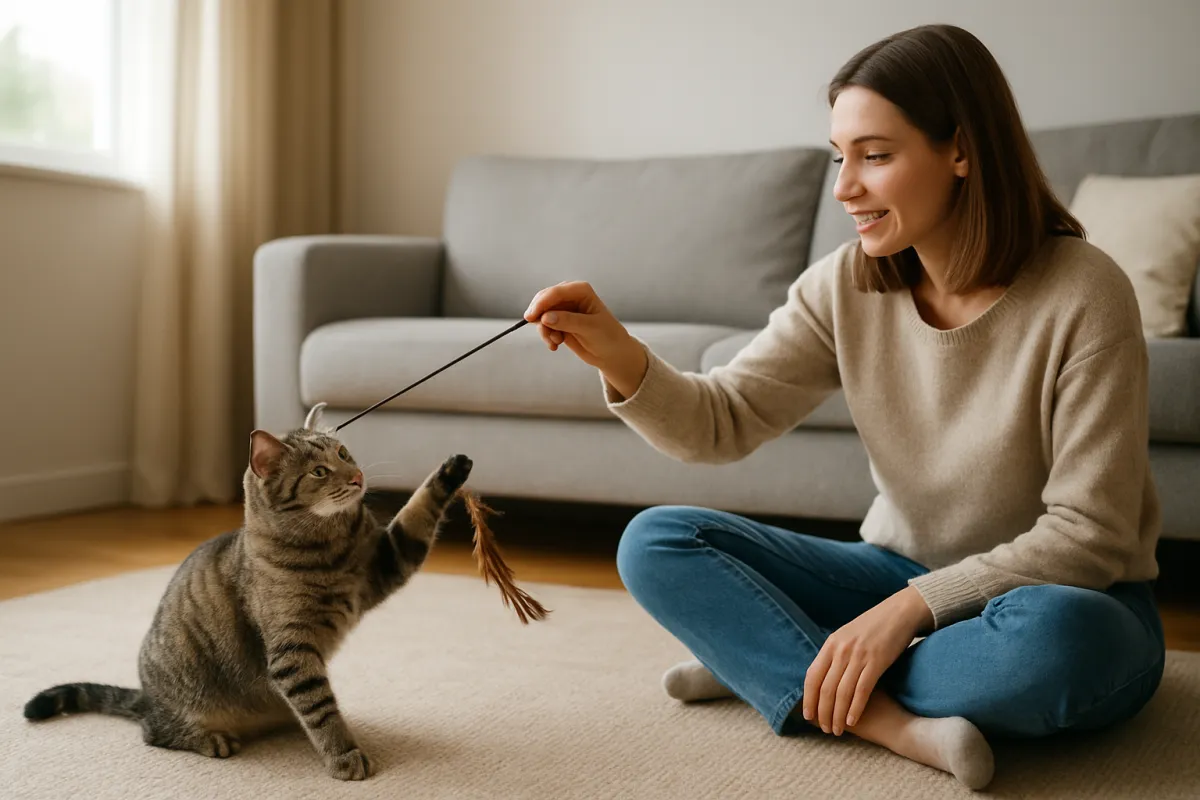
5. Build a simple rotation instead of buying too many toys
A practical rotation might include one supervised wand toy, one food puzzle, one rolling or track toy, and one soft kicker. Keep only a few options available at once, then change one or two every several days.
Variation can come from how you use the toy, not only from buying new products. A wand can move across the floor one day, behind furniture the next, and upward onto a low cat-safe surface another day. Keep sessions short enough that your cat remains interested rather than exhausted or frustrated.
A useful weekly routine
- Most days: Offer a brief wand session with pauses and a catch at the end.
- Several times a week: Use a food puzzle for part of a normal meal.
- When you are busy: Offer a safe rolling, track, or kicker toy.
- After play: Return the toy to storage and note which movement your cat preferred.
For more ideas, the ASPCA’s feline enrichment guide includes low-cost ways to make a cat’s environment more engaging.
6. Common mistakes when choosing cat toys
- Choosing complexity over usefulness: A simple toy that matches your cat’s preferred movement is often more valuable than a feature-heavy product.
- Leaving every toy out all the time: Constant availability can reduce novelty. Rotate a manageable number.
- Making food puzzles too difficult: Begin with visible rewards and increase the challenge gradually.
- Using hands as prey: Keep fingers and toes out of chase games to reduce unwanted biting and scratching.
- Ignoring noise: A motor that seems quiet to you may be aversive to a sensitive cat.
- Skipping inspection: A toy can become unsafe after weeks of chewing, even if it was well made initially.
- Expecting exercise alone to solve behavior problems: Scratching, hiding, aggression, or house-soiling may have multiple causes. Enrichment helps, but persistent or sudden changes deserve veterinary or qualified behavior advice.
7. What if your cat ignores interactive toys?
Start with the least intimidating option. Move a wand slowly along the ground instead of toward your cat, use a toy around a corner, and stop after a few minutes if there is no interest. Try again at a different time of day, particularly when your cat is naturally alert.
Some cats prefer texture, scent, or sound over movement. Offer cardboard boxes, paper bags without handles, safe hiding places, or a small amount of food scattered in a simple search game. Always remove handles, staples, loose tape, and other parts that could be swallowed.
If a previously playful cat suddenly stops playing, seems painful, loses appetite, hides more, or has difficulty jumping, arrange a veterinary assessment. A sudden behavior change should not automatically be treated as a toy preference.
Action checklist before you buy
- Identify whether your cat prefers chasing, batting, hunting, food searching, or wrestling.
- Decide whether the toy will be used with supervision or left briefly for solo play.
- Check for secure attachments, sturdy seams, stable bases, and washable surfaces.
- Choose a difficulty level your cat can understand without becoming frustrated.
- Measure the play area and consider noise, floor type, and other pets.
- Plan where the toy will be stored after use.
- Buy one or two suitable options first, then adjust based on your cat’s response.
Final recommendations by scenario
- Best overall starting point: A supervised wand toy with interchangeable attachments.
- Best for food-motivated cats: An adjustable puzzle feeder, introduced at an easy level.
- Best for active solo play: A rolling treat dispenser or stable track toy.
- Best for busy owners: A safe food puzzle combined with a short daily wand session.
- Best for sensitive or senior cats: Quiet, slow-moving toys and low-effort food searches.
- Best for cats that enjoy wrestling: A durable kicker toy with strong stitching.
- Best approach for multi-cat homes: Provide more than one play area and supervise high-value toys or food activities.
The best interactive cat toys for indoor cats are the ones your cat can use safely and repeatedly in a way that resembles natural hunting or foraging. Begin with a wand toy and one simple independent activity, observe what your cat chooses, and build a small rotation around those preferences rather than buying a large collection at once.