For most homes, the Maine Coon is the easier all-around choice if you want a highly social, playful, trainable companion. The Norwegian Forest Cat may be better if you prefer a more independent cat that enjoys high places, adapts well to indoor life, and usually needs slightly less coat maintenance.
Both breeds are large, long-haired, intelligent cats with friendly reputations. The more useful question is not which one is universally better, but which cat fits your space, schedule, tolerance for shedding, and preferred style of companionship.
This guide compares the two breeds using practical criteria: personality, adult size, grooming, activity, family compatibility, home setup, and likely ownership challenges. Breed tendencies are useful starting points, but an individual cat’s socialization, health, age, and background still matter.
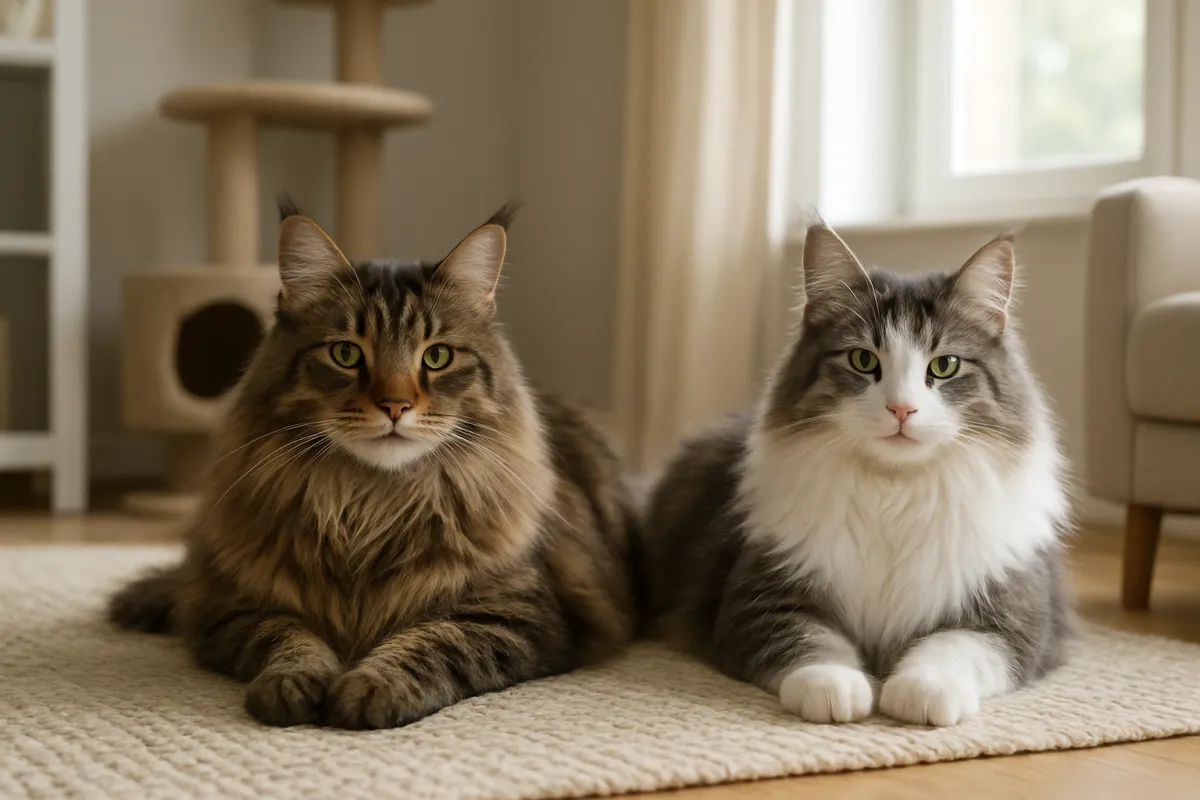
1. Start with the features that will affect daily life
Before comparing photographs or coat colors, decide what you need from a cat. Large long-haired breeds can be wonderful companions, but they also need suitable furniture, dependable grooming, and a home that can accommodate a substantial adult cat.
- Companionship: Do you want a cat that actively joins games and household routines, or one that is affectionate without being especially demanding?
- Space: Can your home support a strong, tall cat tree, large litter boxes, wide sleeping areas, and sturdy scratching posts?
- Coat care: Are you prepared to comb a long-haired cat several times a week during heavier shedding periods?
- Activity: Will you provide daily play, climbing opportunities, and puzzle-style enrichment?
- Household fit: Are there young children, dogs, older pets, or family members who may be unsettled by a very large cat?
These questions often narrow the choice more accurately than appearance. A beautiful breed can still be a poor match if its activity level or care requirements do not fit your routine.
2. Compare personality and interaction style
Maine Coon: sociable, playful, and people-oriented
The Maine Coon is commonly described as gentle, friendly, intelligent, and easygoing. The International Cat Association notes that the breed is generally sweet-tempered, gets along with many types of households, and often retains a playful nature into adulthood. Some Maine Coons enjoy fetch, leash training, or simple reward-based commands, although these behaviors should never be treated as guarantees for every cat. TICA’s Maine Coon breed profile provides a useful overview of these tendencies.
Many Maine Coons like to follow household activity without needing continuous cuddling. They may seek interaction when you are available, then settle nearby. Their communication can include chirps and trills as well as ordinary meows, so they may feel expressive without necessarily being loud.
Norwegian Forest Cat: affectionate, intelligent, and more independent
The Norwegian Forest Cat is also friendly and family-oriented, but often has a stronger independent streak. The Cat Fanciers’ Association describes the breed as moderately active, adaptable, sensitive, and comfortable participating in family life while still choosing when it wants attention. It may stay close to you without insisting on being held or sitting on your lap.
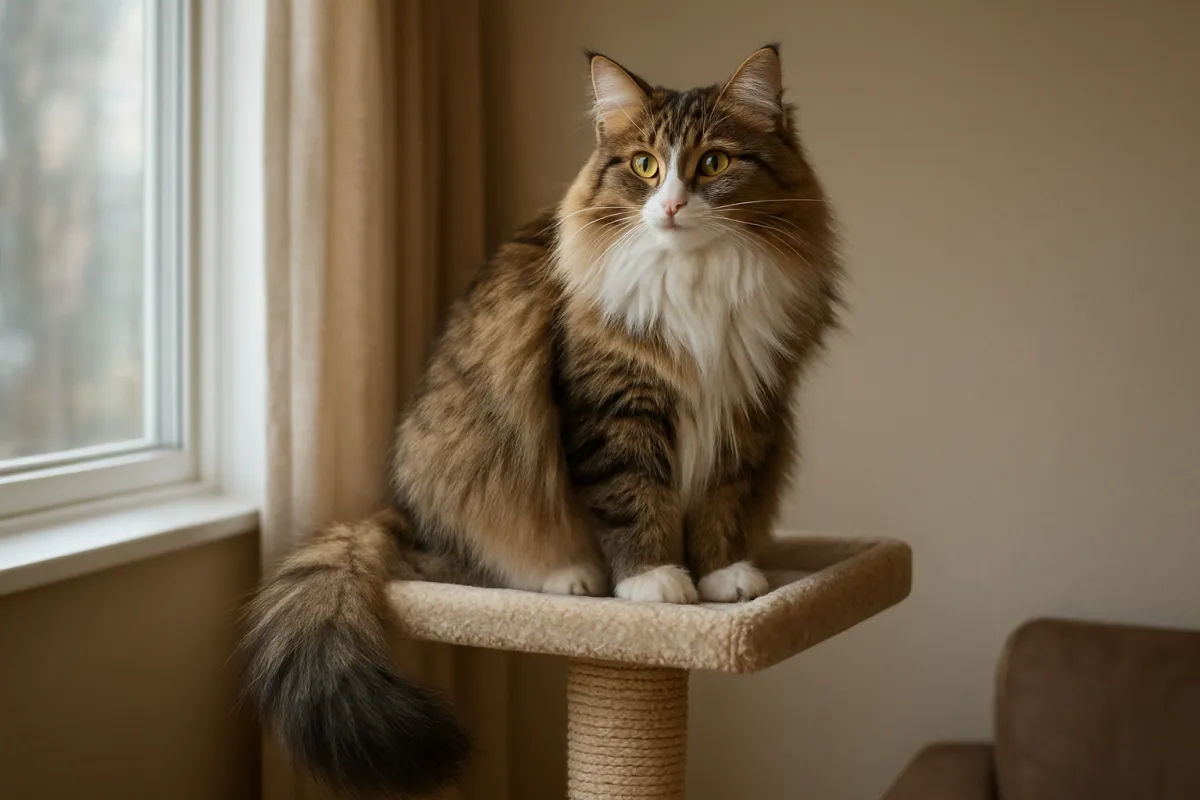
Norwegian Forest Cats are also known for enjoying elevated spaces. A tall cat tree, secure shelves, or a stable climbing tower is not an optional decoration for many individuals; it is part of creating an environment that lets them behave naturally. The breed profile from the Cat Fanciers’ Association highlights this preference for height and climbing.
Practical difference: The Maine Coon often feels more like an interactive household companion, while the Norwegian Forest Cat may feel more like an observant partner who joins you on its own terms. There is plenty of overlap, so meet the individual cat whenever possible.
3. Look at size, body shape, and furniture needs
Both breeds are large, slow-maturing cats, but they do not have exactly the same build. Maine Coons are known for a long, rectangular body, broad chest, substantial bone structure, large feet, and a long flowing tail. TICA states that Maine Coons may not reach full maturity until around four years of age, with adult males commonly weighing more than average domestic cats.
Norwegian Forest Cats are also sturdy and substantial, with a distinctive triangular head, strong body, long bushy tail, and hind legs that are longer than the front legs. CFA notes that they can take up to five years to reach full growth. Individual weight varies with sex, frame, body condition, and genetics, so avoid choosing a cat based on a target number alone.
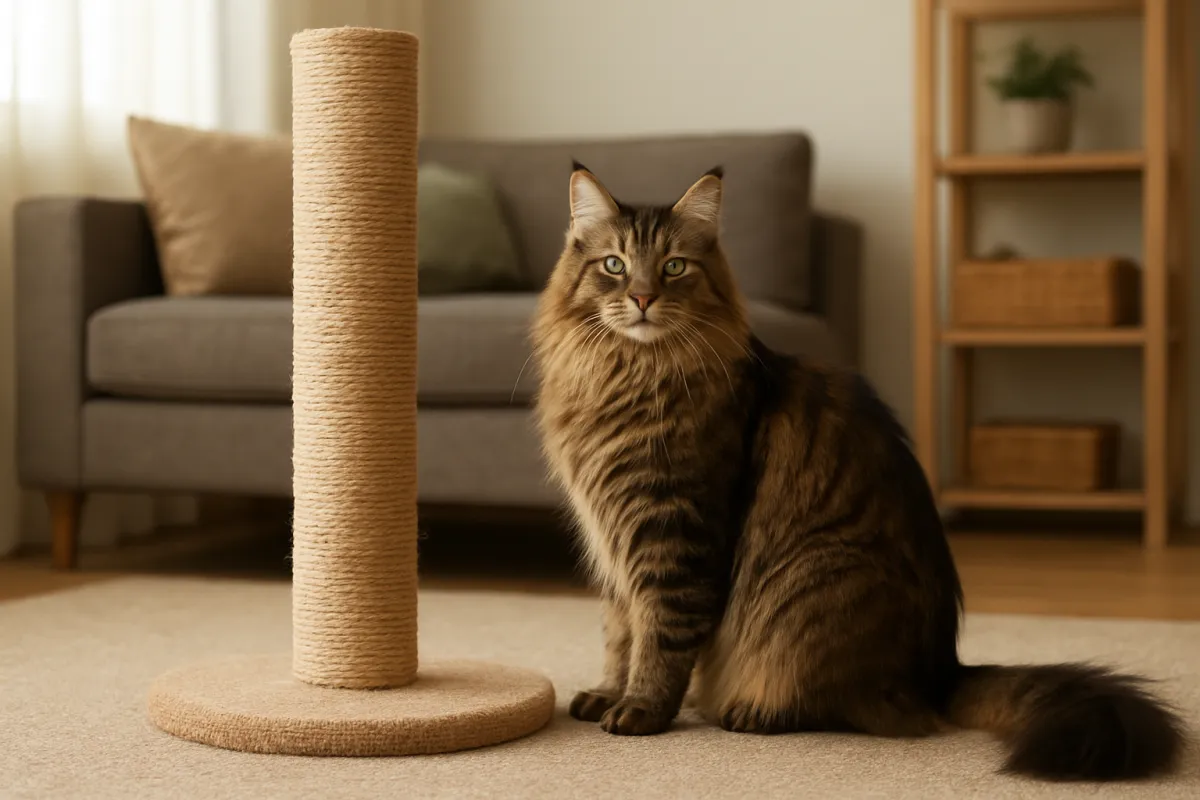
For either breed, prepare for adult proportions rather than kitten size. A lightweight scratching post that wobbles under pressure may be ignored or become unsafe. Choose wide-based equipment, deep sleeping platforms, and litter boxes large enough for a cat to turn around comfortably.
For more everyday cat setup ideas, you can also review LaokPet’s guide on making a cat carrier more comfortable before bringing a large breed home.
Side-by-side comparison: the features most likely to affect your routine
| Factor | Maine Coon | Norwegian Forest Cat | What it means for you |
|---|---|---|---|
| Typical interaction style | Social, playful, and often eager to join family activity | Friendly, observant, and more self-directed | Choose based on whether you want more active engagement or calmer companionship |
| Body type | Long, rectangular, broad-chested, heavily boned | Sturdy, balanced, muscular, with a distinctive high-rumped shape | Both need strong furniture and large accessories |
| Climbing preference | Usually benefits from vertical enrichment | Often especially motivated to climb and perch high | Provide stable towers and secure elevated resting places |
| Coat structure | Long, shaggy coat with shorter hair around the shoulders | Double coat with water-resistant guard hairs and dense undercoat | Both shed; grooming frequency depends on the individual coat |
| Grooming starting point | Combing two or three times weekly is commonly recommended | Weekly combing may be enough for many cats, with more during seasonal shedding | Inspect behind the legs, under the collar area, and around the tail |
| Best fit for | Families wanting a playful, interactive gentle giant | Homes wanting an affectionate but independent climber | Use lifestyle fit rather than appearance as the deciding factor |
4. Compare grooming, shedding, and household maintenance
Neither breed is low-maintenance in the same sense as a short-haired cat. Their coats can bring loose hair, occasional tangles, and hairballs into the home. The amount of work depends on coat texture, season, age, diet, health, and how comfortable the cat is with handling.
Maine Coon grooming
CFA recommends combing a Maine Coon two or three times per week to help control shedding, reduce hairballs, and prevent mats. Short sessions are usually easier than waiting until a large knot has formed. Pay particular attention to the belly, armpits, trousers, and the longer hair around the tail.
Norwegian Forest Cat grooming
The Norwegian Forest Cat’s coat is designed around a dense undercoat and longer guard hairs. It may resist tangling better than some long-haired coats, but it still requires regular inspection. Spring shedding can create a noticeable increase in loose undercoat, so you may need more frequent combing at that time.
Do not assume that a water-resistant coat means bathing is simple. If bathing becomes necessary, use cat-safe products and ask a veterinarian or experienced groomer for advice, especially if the cat has skin problems or becomes distressed during handling.
5. Match the breed to children, dogs, and other cats
Both breeds are often considered suitable for family homes, but “good with children” does not remove the need for supervision. A large cat can accidentally knock over a young child, and a child who hugs, chases, or corners a cat can create fear or defensive behavior.
- Give the cat a high retreat and a quiet room where children cannot follow.
- Teach children to let the cat approach, rather than carrying or restraining it.
- Introduce dogs gradually with barriers, short sessions, and escape routes.
- Keep food, litter, and resting areas separate during the early adjustment period.
- Watch body language: flattened ears, tail lashing, hiding, hissing, or repeated avoidance mean the interaction needs to stop.
Maine Coons may appeal to households seeking a more obviously interactive pet. Norwegian Forest Cats may suit families that appreciate a cat who is sociable but not constantly available for handling. In both cases, the individual animal’s previous experience with children and pets is more informative than the breed label alone.
6. Choose the better home setup for each breed
A Maine Coon-friendly setup
- A wide, stable cat tree with platforms that support a long body.
- Large litter boxes placed in quiet, accessible areas.
- Interactive toys for chasing, retrieving, and problem-solving.
- Durable scratching surfaces that do not tip when the cat stretches fully.
- Daily contact with people, even if it is short play or calm companionship.
A Norwegian Forest Cat-friendly setup
- Vertical routes, window perches, and secure high resting places.
- Scratching posts tall enough for a full-body stretch.
- Opportunities to climb, explore, hide, and observe household activity.
- Regular play sessions balanced with the cat’s ability to entertain itself.
- Coat checks that increase during heavier seasonal shedding.
An apartment can work for either breed if it offers meaningful vertical space and daily enrichment. A large floor area alone is not enough if the cat has nowhere safe to climb, scratch, retreat, or watch the outside world.
7. Consider health screening and responsible sourcing
Large pedigreed cats can be affected by inherited conditions, and the risk is not eliminated by choosing one breed over the other. A responsible breeder should be willing to discuss veterinary care, health records, family history, registration, socialization, and the tests used in their breeding program.
CFA identifies hypertrophic cardiomyopathy and glycogen storage disease among hereditary concerns reported in Norwegian Forest Cats. That does not mean every cat will develop these conditions, but it is a reason to ask specific questions rather than relying on broad claims such as “healthy line” or “never sick.”
For Maine Coons, ask what screening is performed for the health issues relevant to the breeder’s lines, how kittens are raised, and whether the parents have appropriate veterinary documentation. A veterinarian can help you evaluate the kitten’s health after adoption and establish a preventive-care plan.
Do not buy solely because a kitten is unusually large, has dramatic ear tufts, or is advertised as “rare.” Those features do not prove health, temperament, or responsible breeding.
8. Use this decision checklist before choosing
- Can you provide sturdy, large-scale furniture and accessories?
- Will someone offer daily play or companionship?
- Are you comfortable combing a long-haired cat regularly?
- Do you prefer a more interactive cat or a more independent one?
- Can every household member respect the cat’s need for retreat?
- Have you considered litter-box size, transportation, and veterinary handling for a large adult cat?
- Have you met the specific cat and observed how it responds to people?
- Can the breeder, rescue, or current caregiver explain the cat’s history honestly?
9. Common mistakes when comparing Maine Coon and Norwegian Forest Cat
Mistake 1: Choosing by face or coat alone
These breeds can look similar in photographs, especially when both have ear tufts and full tails. Appearance does not tell you whether a particular cat is confident, tolerant of handling, or comfortable around dogs.
Mistake 2: Assuming a large cat needs no exercise
Both breeds can be gentle without being inactive. Without play, climbing, and hunting-style enrichment, a bored cat may gain weight or develop unwanted behaviors.
Mistake 3: Underestimating furniture strength
A post that works for an average-sized cat may wobble when a Maine Coon or Norwegian Forest Cat launches onto it. Stability is more important than decorative design.
Mistake 4: Treating grooming as optional
A coat can look manageable until a hidden mat forms beneath the front legs or around the collar. Short, calm grooming sessions are easier for both you and the cat than emergency detangling.
Mistake 5: Expecting breed stereotypes to predict every behavior
Some Maine Coons are reserved, and some Norwegian Forest Cats are exceptionally cuddly. Use breed traits as a guide, then give greater weight to the individual cat’s behavior and history.
10. What if your home has a special constraint?
What if you work long hours?
A Norwegian Forest Cat may suit you if the home is enriched and the cat has appropriate companionship, but neither breed should be left without stimulation for extended periods every day. Consider a bonded pair only if you can responsibly support two cats and complete gradual introductions.
What if you have limited space?
Focus on vertical territory, not just floor area. A secure tall tree, window perch, and separate retreat can make a smaller home more usable, provided the equipment is stable and the cat receives regular play.
What if someone in the home has allergies?
Neither breed should be treated as hypoallergenic. Spend time with the specific cat before committing, but remember that short visits cannot guarantee how someone will react over weeks or months. Discuss persistent symptoms with a qualified healthcare professional.
What if you want a lap cat?
Do not choose either breed on the assumption that size equals cuddliness. Ask the current caregiver how the cat behaves when resting, being brushed, picked up, or sitting beside people. A cat that prefers nearby companionship may still be affectionate without being a lap cat.
11. Take these next steps before bringing one home
- Write down your non-negotiables: grooming tolerance, activity level, children, dogs, and available space.
- Visit reputable breeders or rescues and observe adult cats, not only kittens.
- Ask for health records, socialization details, and a clear return policy.
- Prepare large litter boxes, sturdy scratching posts, a carrier, grooming tools, and a secure resting area.
- Arrange a veterinary appointment soon after adoption.
- Introduce the cat gradually and allow it to control the pace of contact.
If you are still unsure, compare the actual cats available rather than trying to solve the decision from breed descriptions alone. A calm, well-socialized individual of either breed may be a better match than a kitten whose appearance seems perfect but whose needs do not fit your household.
Final verdict: Maine Coon or Norwegian Forest Cat?
The Maine Coon is usually the better choice for a home that wants a playful, sociable, highly interactive large cat and can commit to regular grooming and sturdy equipment. The Norwegian Forest Cat is often the better choice for people who prefer an intelligent, affectionate companion with a stronger independent streak and a clear enthusiasm for climbing.
Neither breed is automatically better. If your priority is family interaction and trainable play, lean Maine Coon. If your priority is adaptable companionship, vertical exploration, and somewhat simpler coat upkeep for many individuals, lean Norwegian Forest Cat. In either case, choose the healthiest, best-socialized cat whose real temperament fits your home.
For more practical pet-care guidance, visit the LaokPet homepage and explore related guides for preparing a comfortable, safe household.